1st - Mipham Rinpoche's Verses to the 8 Noble, Auspicious Ones (Generally recited 1x at open of session):
2cd - Vajra 7 Line Prayer to Guru Padmasambhava (Recite 3x, visualizing Guru Rinpoche and all the enlightened ones and their retinues in the space in front; if visualization is difficult, then confidently feel their presence in the space in front):
HUNG
OR GYEN YUL GYI NUB JANG TSAM
In the north-west of the land of Orgyen,
PE MA GE SAR DONG PO LA
In the heart of a lotus flower,
YA MTSEN CHOG GI NGÖ DRUP NYÉ
Endowed with the most marvelous attainments,
PE MA JUNG NÉ ZHÉ SU DRAG
You are renowned as the Lotus-born,
KHOR DU KHAN DRO MANG PÖ KOR
Surrounded by many hosts of dakinis.
KHYÉ KYI JÉ SU DAG DRUB KYI
Following in your footsteps I practice.
CHIN GYI LAB CHIR SHEG SU SOL
I pray to you: come to this place and bestow blessings.
GURU PEMA SIDDHI HUNG
(optional: follow the above prayer with a mala of the Vajra Guru mantra, then proceed)
3rd - General short lineage prayers and prayers to root guru (you can just think of Guru Rinpoche until you have a root guru)
(Recite 1x each, continuing to visualize/feel the refuge field in the space in front):
KÜN ZANG DOR SEM GA RAB SHI RI SINGH
Samantabhadra, Vajrasattva, Garab Dorje, Shri Singha,
PE MA KA RA JE BANG NYI SHU NGA
Pemakara, the 25, king and subjects,
SO ZUR NUB NYAG TER TON JA TSA SOG
So, Zur, Nub, Nyag, and the 100 tertons and others,
KA TER LA MA NAM LA SOL WA DEB
The lamas of kama and terma lineages, to you I pray!
OG MIN CHÖ KYI YING KYI PO DRANG NA
In the palace of the Ogmin Dharmadhatu,
DÜ SUM SANG GYE KUN GYI NGO WO NYID
The essence of all the buddhas of the three times,
RANG SEM CHÖ KU NGON SUM TON DZE PA
The one who shows clearly the dharmakaya of my own mind,
TSA WE LA ME ZHAB LA SOL WA DEB
We pray at the feet of the root guru.
PAL DEN TSA WE LA MA RIN PO CHE
Glorious root lama, precious one,
DA GI CHI WOR PE ME DEN ZHUG LA
Dwelling on the lotus seat on the crown of my head,
KA DRIN CHEN PÖ GON NE JE ZUNG TE
Hold me with your great kindness.
KU SUNG TUG KYI NGÖ DRUP TSAL DU SOL
Bestow the accomplishments of body, speech, and mind.
*One might then follow with some version of the Calling the Lama from Afar, then some version of the 4 thoughts that turn the mind to Dharma, then some liturgy for refuge and bodhicitta, then whatever meditation practice one regularly does... May this be of benefit!
http://www.lotsawahouse.org/8_auspicious_ones.html
-Borrowed from the blog, no mud, no lotus
May 10, 2010


The Thief Who Became a Disciple
The Thief Who Became a Disciple
One evening as Shichiri Kojun was reciting sutras a thief with a sharp sword entered, demanding wither his money or his life.
Shichiri told him: “Do not disturb me. You can find the money in that drawer.” Then he resumed his recitation.
A little while afterwards he stopped and called: “Don’t take it all. I need some to pay taxes with tomorrow.”
The intruder gathered up most of the money and started to leave. “Thank a person when you receive a gift,” Shichiri added. The man thanked him and made off.
A few days afterwards the fellow was caught and confessed, among others, the offense against Shichiri. When Shichiri was called as a witness he said: “This man is no thief, at least as far as I am concerned. I gave him the money and he thanked me for it.”
After he had finished his prison term, the man went to Shichiri and became his disciple.
One evening as Shichiri Kojun was reciting sutras a thief with a sharp sword entered, demanding wither his money or his life.
Shichiri told him: “Do not disturb me. You can find the money in that drawer.” Then he resumed his recitation.
A little while afterwards he stopped and called: “Don’t take it all. I need some to pay taxes with tomorrow.”
The intruder gathered up most of the money and started to leave. “Thank a person when you receive a gift,” Shichiri added. The man thanked him and made off.
A few days afterwards the fellow was caught and confessed, among others, the offense against Shichiri. When Shichiri was called as a witness he said: “This man is no thief, at least as far as I am concerned. I gave him the money and he thanked me for it.”
After he had finished his prison term, the man went to Shichiri and became his disciple.
The Sun Behind the Clouds
This looks like a must-see: The Sun Behind the Clouds
It will be released in October, 2010.

“The documentary does a superlative job of examining the half-century dispute over Chinese rule of mountainous Tibet.”
VA Musetto, New York Post
“A potent update on Tibetans‘ 50-year struggle for justice and recognition…essential viewing for anyone who cares about the fate of the mountain region and the legacy of the Dalai Lama.”
Sheri Linden, The Hollywood Reporter
“…a welcome departure from many previous films about the decades-long friction between Tibet and China…an exception in what is not an angry film but a notably calm, well-considered and balanced one.”
Robert Koehler, Variety
It will be released in October, 2010.
“The documentary does a superlative job of examining the half-century dispute over Chinese rule of mountainous Tibet.”
VA Musetto, New York Post
“A potent update on Tibetans‘ 50-year struggle for justice and recognition…essential viewing for anyone who cares about the fate of the mountain region and the legacy of the Dalai Lama.”
Sheri Linden, The Hollywood Reporter
“…a welcome departure from many previous films about the decades-long friction between Tibet and China…an exception in what is not an angry film but a notably calm, well-considered and balanced one.”
Robert Koehler, Variety
May 08, 2010
Buddha Nature.
LAMA SURYA DAS.
"The innate Buddha-nature or Buddha-ness within each and every single sentient being is genderless, unborn, and undying-more akin to clear light than to our personalities - and timeless, untarnished, and incorruptible.
All beings are endowed with this inner lamp of pure spirit, along with the potential for its divine unfolding. The equanimity of us all is the natural implication of this recognition of universally innate Buddha-nature or Buddhaness, the primordially pure and untrammeled inner light. Thus, one of the principle tenets of Buddhism has always been nonviolence, the protection and cherishing of all forms of life, and the interwoven interdependence of all things, including all creatures great and small."
When I have the opportunity to read Lama Surya Das his words it appears like a naturally fresh waterfall of wisdom brought by humor. Really really great offering for all of us.
May 07, 2010
Dedication.
Gyalse Ngulchu Thogme his golden advice:
"Give up all attachment and belief in things as truly existing,
and benefit others with your actions, words, and thoughts,
Is truly excellent practice."
His advice and kindness is reflecting in others who appear like Buddhas. Behind this advice is the radiance in happiness (no suffering) for all. As "my" happiness is a joke which can be painful.
The meaning about dedication, powerfully break the walls of my poor limited knowing.
"Through dedication of meritious actions, may all beings become like Chenrezig, who is beyond extremes of samsara and nirvana".
Homage to Gyalse Ngulchu Thogme.
"Give up all attachment and belief in things as truly existing,
and benefit others with your actions, words, and thoughts,
Is truly excellent practice."
His advice and kindness is reflecting in others who appear like Buddhas. Behind this advice is the radiance in happiness (no suffering) for all. As "my" happiness is a joke which can be painful.
The meaning about dedication, powerfully break the walls of my poor limited knowing.
"Through dedication of meritious actions, may all beings become like Chenrezig, who is beyond extremes of samsara and nirvana".
Homage to Gyalse Ngulchu Thogme.
May 06, 2010
A Long-Life Prayer for His Holiness the 14th Dalai Lama, Tenzin Gyatso
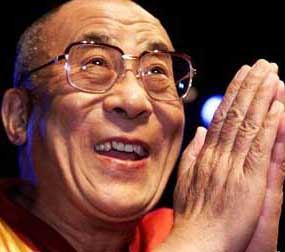
A Long-Life Prayer for His Holiness the 14th Dalai Lama, Tenzin Gyatso
“The Showers of True Bliss”.
Composed by Erick Sherab Zangpo
Found at his blog, Echos Bouncing Off Echos (Empty Elephant)
OM AMARANI JIVANTAYE SVAHA!
For the hosts of beings caught in this
prison of projections and hallucinations,
you gently show the path of clearing
away the imprints resulting from dualistic
fixation. Avalokiteshvara, you pour the
nectar of cherishing others on the
seeds of our innate love and compassion.
Lord of Love, the 14th Dalai Lama, may you abide forever,
raining down the showers of true bliss.
OM MANI PADME HUM
Declaring peace and waging non-violence
in a world beset by the evil forces of
fundamentalist ideology and greed, you have made the
actual transmission of awakened mind
blow across the eight directions of the world.
Your example and influence brings tears to
the eyes of those with faith,
and to recall your face of unimaginable
benevolence makes fears scatter like the parting clouds.
Lord of Compassion, the 14th Dalai Lama, may you abide for kalpas upon kalpas,
raining down the showers of true bliss.
OM MANI PADME HUM
Wish-fulfilling Jewel, when the sprouts of
our bodhichitta shoot forth, we must look to you
in gratitude. When the suffering of cyclic
existence is weakened, we must acknowledge
the force of your enlightened intent. When
we at last begin to see the inseparable
nature of dependent arising and emptiness,
we must know that this was after all your
real wish. When the essence nakedly dawns as clear
light, we shall prostrate to you with
bodies as numerous as dust motes.
Lord of Joy, the 14th Dalai Lama, may you abide for aeons,
raining down the showers of true bliss.
OM MANI PADME HUM
Now a dark age has fallen upon the
people of the world. The armies of ignorance
have turned the world into a fortress of confusion.
The armies of attachment have turned the world
into a citadel of avarice. The armies of anger
have turned the world in a maelstrom of hatred.
The armies of jealousy have turned the world into
a machine of competition. The armies of pride
have turned the world into a swamp of conceit.
For the people of this great Earth, and especially for your
subjects of Tibet, summon forth the unexcelled power of
your extraordinary dynamic skill. We pray:
overwhelm the cold forces of negative emotions
with the warm light of your expedient means.
The time has come! Help all beings
to recognize eachother as their mothers and friends.
Lord of Equanimity, the 14th Dalai Lama, may you abide for as long as space endures,
raining down the showers of true bliss!
OM MANI PADME HUM
This prayer of longing for the longevity of the Victorious Precious One, His Holiness Tenzin Gyatso, the Fourteenth Dalai Lama, was written on the occasion of His Holiness’ 73rd birthday, a time of much celebration — an auspicious day, at an auspicious place, near the Great Stupa of Jalungkhashor, where all wishes can come true. It was written amongst the playing of Tibetan horns, drums, and other instruments, announcing the presence of victory. It was completed in Darjeeling, where the rain truly showers down (but its bliss is in the eye of the beholder!). May the Dalai Lama live long! May auspiciousness pervade the realms of all beings in all times, and may the nectar of deathlessness wash away the defilements of self-grasping! Sarva Mangalam!
Destiny.
This body, a collection of bones and flesh has no other destiny than desintegration. To use it without attachment, it is a great tool for practice Dharma and no any opportunity should be waste for purification, practicing for the welfare of others. As what other practice there can be to nondual?
How to see the primordial simplicity when one practices for own being? To not recognize the unchanging nature of all along equanimity, rather to see in duality changing things to judge when one is a knowing solidity...then what is there other than painful burning of a fleshi ego bumper?
To be humble and the less among all opens the door of the destiny where no change is. A prayer on my lips: May all precious sentient beings see the unchanging nature and be free without traces. _/\_
How to see the primordial simplicity when one practices for own being? To not recognize the unchanging nature of all along equanimity, rather to see in duality changing things to judge when one is a knowing solidity...then what is there other than painful burning of a fleshi ego bumper?
To be humble and the less among all opens the door of the destiny where no change is. A prayer on my lips: May all precious sentient beings see the unchanging nature and be free without traces. _/\_
May 05, 2010
The Challenges of Samsara and the Buddhist Path
This is a response to a post I wrote at a discussion forum called Dharma Wheel. Here is the particular post: Safe Escape: User Friendly Dharma
My response was as follows. I'm sharing it because it reveals a lot of my general opinions about samsara, the bodhisattva path, and dharma practice.
Huseng wrote: Is there a quick solution to this horrific situation we're in? Some would like to believe there is and it might give them a lot of comfort in cherishing such thoughts, but the conquest of samsara might prove far more difficult than what one initially expects or is told.
My response was as follows. I'm sharing it because it reveals a lot of my general opinions about samsara, the bodhisattva path, and dharma practice.
So much of what you write jives with the teachings I've encountered in Vajrayana. And I understand entirely your comments on the seriousness of our situation. I think too many people may underestimate it or let it slip to lower levels of consciousness as we're absorbed in the grueling challenges of daily life in samsara.
That said, there is a solution. I make no bones about the fact that I don't believe it's a quick solution. I believe that we're just ordinary and the stages of the path are dauntingly challenging to accomplish.
But on the upside, we do have this precious human birth, at least for this moment. So as if our very hair was on fire we can work and work and work to plant seeds or move forward. And hopefully when this body breaks up and we we continue the cycle of birth, we'll be fortunate enough to carry on some traces of seeds we've planted in this life and others.
The solution will vary according to the person and his/her predispositions (I've never been so fond of the word "capacity.") But there most certainly is a solution and we live in such a fortunate age of the Buddha Shakyamuni. Many of us are fortunate enough to live in a place with access to information and dharma, and the means to put the teachings into action. In a way many of us are very privileged. Even those of us who really struggle just to make it in life every day.
So I have hope. I think it's excellent to be realistic, and to acknowledge that the task at hand is enormous, to say the least. And that we are just ordinary. But there is a a way, and it's at our finger tips.
Thank you for your kind reminders; for we are in a serious situation. At the same time that we acknowledge this disenchantment with samsara and the dangers of birthing in other realms, we can practice happiness and direct our minds to places of bodhicitta and joy.
Thanks for listening to my two cents. Or one
Kind wishes,
Laura

A Reminder, The Four Immeasurables
May all sentient beings have happiness and its causes,
May all sentient beings be free of suffering and its causes,
May all sentient beings never be separated from bliss without suffering,
May all sentient beings be in equanimity, free of bias, attachment and anger.
_/\_
The Buddha taught the following to his son Rahula (from "Old path white clouds" by Thich Nhat Hahn):
"Rahula, practice loving kindness to overcome anger. Loving kindness has the capacity to bring happiness to others without demanding anything in return.
Practice compassion to overcome cruelty. Compassion has the capacity to remove the suffering of others without expecting anything in return.
Practice sympathetic joy to overcome hatred. Sympathetic joy arises when one rejoices over the happiness of others and wishes others well-being and success.
Practice non-attachment to overcome prejudice. Non-attachment is the way of looking at all things openly and equally. This is because that is. Myself and others are not separate. Do not reject one thing only to chase after another.
I call these the four immeasurables. Practice them and you will become a refreshing source of vitality and happiness for others."
A Word from Ajhan Chah
This word from Ajhan Chah touched me. So I thought I'd share it here.
"If you haven't wept deeply, you haven't begun to meditate."
-Ajhan Chah
Happy day.
In the morning on awaking we should from the core of our heart make this pledge: "Through this whole day today, my mind will never forget Bodhichitta. My stream of being will bath in it".
During eating, dressing, meditating, working, talking, walking, I will practice constantely, remain aware constantely. Ready in case it slips away of mind, I will remind myself and will not allow me to wander in painful states like anger, desire, ignorance. Not forget the dreamlike quality of the daily mandala is a help for own afflictions, while help to other beings is our activity.
When it goes wrong, I should carefully reflect about, even I entered the Buddhadharma and not being able to put it into practice, and so still being incapable to remain mindful. This reflection can help to see how delusion is blinding one's natural dwelling through the day. With fresh courage and enough effort, one lets grow the seed of Bodhichitta.
When at the end of the day, own being never left an altruistic attitude, then offer it for the welfare of all, not just in thought, but in speech and action as well, specially for beings in desperate dwelling; those who are without love, without good health, those who harm others in helpless blindness of poisoned emotions...
Then there is the joy which is emerging and one should say: "Tomorrow I do better." By that never be satisfied or have a feeling: "Great! I am so great, I did it so good"!
May Bodhichitta grow in each sentient being and their own pain will in their given warm altruistic attitude dissolve. So we can be interconnected.
muni, inspired by Kyabje Dilgo Khyentse Rinpoche.
During eating, dressing, meditating, working, talking, walking, I will practice constantely, remain aware constantely. Ready in case it slips away of mind, I will remind myself and will not allow me to wander in painful states like anger, desire, ignorance. Not forget the dreamlike quality of the daily mandala is a help for own afflictions, while help to other beings is our activity.
When it goes wrong, I should carefully reflect about, even I entered the Buddhadharma and not being able to put it into practice, and so still being incapable to remain mindful. This reflection can help to see how delusion is blinding one's natural dwelling through the day. With fresh courage and enough effort, one lets grow the seed of Bodhichitta.
When at the end of the day, own being never left an altruistic attitude, then offer it for the welfare of all, not just in thought, but in speech and action as well, specially for beings in desperate dwelling; those who are without love, without good health, those who harm others in helpless blindness of poisoned emotions...
Then there is the joy which is emerging and one should say: "Tomorrow I do better." By that never be satisfied or have a feeling: "Great! I am so great, I did it so good"!
May Bodhichitta grow in each sentient being and their own pain will in their given warm altruistic attitude dissolve. So we can be interconnected.
muni, inspired by Kyabje Dilgo Khyentse Rinpoche.
May 04, 2010
Whaling
The Hunting of Whales
Whaling is the hunting of whales. It was responsible for the death of over two million whales in the 20th century and still continues today.

What is a whale?
A whale is a marine mammal. It is a warm-blooded, air-breathing animal that gives birth to live young and is part of the cetacean family. Cetacean is the collective term for whales, dolphins and porpoises; there are over 80 species in the world.
Whales are separated into two categories (called suborders):
Baleen whales (Latin name: Mysticeti) Baleen whales are filter-feeders, using ‘baleen plates’ as a sieve to filter food from the water. This suborder includes the humpback whale and blue whale. The blue whale is the largest animal to have ever lived.
Toothed whales (Latin name: Odontoceti) Toothed whales have teeth. Instead of filtering their food, they hunt fish, squid and sometimes other marine mammals. This suborder includes all porpoises and dolphins as well as killer whales and sperm whales.
Social animals
Whales show a wide range of different behaviours, social organisations and communication methods which vary greatly between species. Many whales, particularly juveniles, are inquisitive and playful and can frequently be observed interacting with boats and divers as well
Some species, particularly toothed whales, form groups where there are close bonds between individuals and even cooperative hunting. Whales may stay in these groups for many years or even their whole lifetime.
Baleen whales tend to lead a more solitary existence, although they gather in groups for feeding and breeding. Although they appear solitary, baleen whales use sound to communicate with one another over great distances. The songs of humpback whales are thought to form an important part of their social systems and communities.
Depending on species, calves can remain with their mothers for up to 18 months. Females are protective of their young, actively steering them away from threats and defending them against predators.
Toothed whale
Any of several usually large whales of the suborder Mysticeti, such as the right whale and rorquals, having a symmetrical skull, two blowholes, and whalebone plates instead of teeth. Also calledmysticete, whalebone whale.
Also defined as a smallish whale with teeth: a smallish whale that has teeth and feeds on fish and mollusks. Suborder Odontoceti.
Did you know?
Whales can feel pain, fear and distress. Animals that have this ability are called ‘sentient’.
Did you know?
At 16,000km, humpback whales undertake the longest annual migration of any mammal from their cold water feeling grounds to warmer tropical waters to breed and give birth.
Teeth-Why are whales hunted?
Whales have been hunted for their meat and other products, such as oil and blubber, for thousands of years. Blubber (fat) was turned into oil which was used for lighting, mechanical lubrication or in cosmetic products like soap. Today the meat and blubber from all whaling operations is used for human consumption although these days only a few communities of indigenous people actually rely on whale meat to survive.
The current demand for whale meat and other products is a lot less than it used to be. Whale meat is sold commercially in Norway, Japan and Iceland but it is consumed only by small sections of the population. This has resulted in unused stockpiles of frozen, excess meat, while at the same time whales are still being killed and adding to this surplus supply. This is particularly the case in Japan.
The main types of whaling conducted today are commercial whaling, aboriginal subsistence whaling and scientific whaling.
Commercial whaling
• Commercial whaling is the hunting of whales where the products are sold for financial gain.
• Norway and Iceland both hunt whales commercially.
Aboriginal subsistence whaling
• This is the hunting of whales for local consumption, carried out by or on behalf of indigenous people who rely on whaling to meet their nutritional needs.
• The four countries that still carry out aboriginal subsistence whaling of large whales are the USA, Greenland, Russia, and St Vincent and the Grenadines.
• The methods used to kill whales in these hunts are less efficient than those used by commercial whalers. Data reported from these hunts shows that whales often take longer to die and are even less likely to die straight away.
Scientific whaling
• Also known as ‘special permit whaling’, this type of hunt is carried out by Japan. The meat resulting from this ‘scientific research’ is sold commercially.
• Many scientists argue that there is no valid research need for scientific whaling programmes that result in the death of the whale. Many countries have said Japan’s lethal ‘scientific’ programmes are unnecessary and have
asked Japan to stop.
No Demand: Excess supplies of whale meat go unused.
How are whales hunted?
Whaling boats equipped with harpoons look for whales at sea. Most commonly, they will use a harpoon with an explosive grenade at the tip, called a ‘penthrite harpoon’. This is designed to explode inside the whale’s body.
While most countries now have regulations and legislation to protect and control the welfare of farm animals at the time of slaughter, these laws do not extend to include whales. Their welfare during a hunt is not protected by any adequate legal guidelines.
How hunts affect whale welfare
Both the whales and the water are constantly moving, making it difficult for whalers to aim an accurate and lethal harpoon shot. Inaccurate shots, combined with the sheer size and body mass of whales, make it impossible to ensure a swift and humane death.
Instead of killing the whale instantly, the harpoon frequently causes massive shock, blood loss and internal injuries. On average, it takes a harpooned whale between two to three minutes to die, although some whales have been reported as taking over an hour to die.
• Norway’s whalers reported that one in five whales (20%) failed to die instantaneously during 2002.
• Japan reported that almost 60% of whales their ships hunted failed to die as soon as they were shot in 2002/3.
Did you know?
Killing Machine: a whaling harpoon at The Whale Museum in Ulsan, Korea
Did you know?
Norway has killed over 8,100 whales since the whaling ban began, including 534 minke whales in 2008 alone.
In order to dive underwater for extended periods, whales are able to shut down the blood supply to all but their essential organs, including the brain. This may allow them to maintain consciousness following significant blood loss and despite appearing to be dead to humans.
In 2009 up to 2,500 great whales will be slaughtered and their meat sold commercially in shops and restaurants.
This natural ability means many more whales may suffer prolonged, agonizing deaths than reported by whaling countries.
Some whales are struck but not killed during hunts. They may die a slow death from their wounds, or be unable to dive, feed or breed properly as a result of their injuries.
Does anyone manage the world’s whaling?
There is an established international body that is responsible for the conservation and management of the world’s whales.
The International Whaling Commission (IWC) was set up 1946. By 2008, 75 countries – both pro- and anti- whaling – had joined this committee of member governments. Together member nations of the IWC and its scientists review whale populations all over the world, set hunting quotas and oversee whaling activities where they take place. The IWC also co-ordinates and funds research into the threats that whales face.
Visit the IWC website at www.iwcoffice.org for more information on the Commission and see which countries are members.
The powers of the IWC
In 1982 IWC members agreed on temporary ban (a ‘moratorium’) on commercial whaling. This came into force in 1986.
Japan, Iceland, and Norway
The moratorium remains in place today. Pro-whaling countries continue to push for it to be lifted while anti-whaling nations argue it must be
maintained and strengthened.
Three countries have been responsible for the vast majority of whaling since the IWC ban was introduced.
Did you know?
In 2007 the government of Iceland cited lack of demand for whale meat as the reason why the country stopped whaling. Yet in 2008 they allowed up to 40 minke whales to be killed in Icelandic commercial hunts.
In 2008 Japan set out to kill 1,415 great whales for ‘scientific research’. The IWC believes the current lethal ‘scientific’ programmes are unnecessary and has called on Japan to stop this kind of whaling 15 times in the last 20 years.
Painful death: Norwegian whaler “Brandsholmboen” and a harpooned Minke whale kill in Hamningberg.
If there is a ban, why does whaling still take place?
Despite the introduction of the moratorium, over 30,000 great whales have been killed since the ban came into force in 1986.
In addition, tens of thousands of small whales, dolphins, and porpoises are killed annually worldwide in hunting activities not regulated by the IWC.
Japan carries out ‘scientific whaling’. A legal loophole in the IWC ban allows any nation to allocate itself a quota of whales in the name of scientific research. However, the meat is still sold commercially and many countries and non-governmental organisations like WSPA argue that the necessary research could be carried out without killing whales.
Norway and Iceland have officially lodged ‘objections’ to the IWC moratorium and continue their commercial whaling.
In 2006 Japan, Norway and Iceland stopped providing whale welfare data – such as how long it takes whales to die during hunts – to the IWC. Anti-whaling member countries believe this decision severely limits the IWC’s ability to monitor and improve the humaneness of hunts.
All three countries have repeatedly announced their long-term intention to continue whaling. They have also expressed interest in resuming international trade in whale products
What other threats do whales face?
As well as whaling, a number of environmental threats affect whales. These include: pollution, entanglement in fishing nets (called ‘by-catch’), climate change, global over-fishing (which affects the whales’ food supply), collisions with ships, habitat loss and noise pollution (which is thought to affect whales’ diving patterns and navigation and may lead to strandings as well as hearing damage).
Whaling and other threats have led to at least five of the 13 species of great whales being listed as endangered.
Are there any alternatives to whaling?
These days commercial whaling is not necessary for our food supply. Instead, people can benefit from whales by enjoying watching them in the wild.
Every year over 10 million people worldwide go on whale watching trips, a growing industry which annually generates 1.25 billion US dollars, making it far more profitable than whaling. Whale watching occurs in over 90 different countries and provides jobs and increases tourism in many coastal communities. It also provides an opportunity for important scientific research to take place, helping human beings to find out more about how these unique and intelligent creatures behave and live.
Close bonds: Humpback mother and calf
As with any wildlife watching, whale watching must be carefully managed to ensure that it does not put the animals under stress or affect their natural behaviours. For example, whale watching boats should keep the correct distance and speed around whales, and should not chase or approach whales head-on.
How does WSPA work on whaling?
The World Society for the Protection of Animals (WSPA) works to improve and protect whale welfare.
• We use diplomacy and public support to encourage the IWC to carefully consider whale welfare at their annual meetings.
• We support and encourage animal welfare organisations, in both pro- and anti-whaling countries, to campaign against whaling on welfare grounds.
• We produce reports to back up our welfare claims and perspective with good science.
• We founded the Whalewatch network. This is a group of NGOs (non-governmental organisations) united by an opposition to whaling on welfare grounds. By sharing information and working together we are better able to promote the importance of whale welfare across the globe.
Our work is based on WSPA’s whaling policy:
• WSPA believes that there is no humane way to kill whales at sea.
The exploding harpoon is an inhumane weapon and there are numerous uncontrollable factors (such as visibility, sea state and animal behaviour) which make it impossible to ensure an instant, humane kill.
• Whales face a multitude of threats to their survival in the 21st century. WSPA is asking the IWC to focus its attention on the long-term protection and recovery of whale populations, rather than concentrating on whaling.
• WSPA also believes that whale watching is the only humane and sustainable use of whales in the 21st century. We are calling for the IWC to encourage and manage the continued growth of the whale watching industry, giving people the opportunity to see and appreciate these fascinating animals and helping us to understand more about their lives.
More information
To find out more about whaling, whales, and how you can get involved, visit:
www.wspa-international.org/wspaswork/whaling www.whalewatch.org
You can watch WSPA’s five minute underwater film, The Hidden Life of Whales, at www.wspa-international.org/whaling
For further information about the International Whaling Commission (IWC), including which countries are members visit the IWC website: www.iwcoffice.org

Whaling is the hunting of whales. It was responsible for the death of over two million whales in the 20th century and still continues today.
What is a whale?
A whale is a marine mammal. It is a warm-blooded, air-breathing animal that gives birth to live young and is part of the cetacean family. Cetacean is the collective term for whales, dolphins and porpoises; there are over 80 species in the world.
Whales are separated into two categories (called suborders):
Baleen whales (Latin name: Mysticeti) Baleen whales are filter-feeders, using ‘baleen plates’ as a sieve to filter food from the water. This suborder includes the humpback whale and blue whale. The blue whale is the largest animal to have ever lived.
Toothed whales (Latin name: Odontoceti) Toothed whales have teeth. Instead of filtering their food, they hunt fish, squid and sometimes other marine mammals. This suborder includes all porpoises and dolphins as well as killer whales and sperm whales.
Social animals
Whales show a wide range of different behaviours, social organisations and communication methods which vary greatly between species. Many whales, particularly juveniles, are inquisitive and playful and can frequently be observed interacting with boats and divers as well
Some species, particularly toothed whales, form groups where there are close bonds between individuals and even cooperative hunting. Whales may stay in these groups for many years or even their whole lifetime.
Baleen whales tend to lead a more solitary existence, although they gather in groups for feeding and breeding. Although they appear solitary, baleen whales use sound to communicate with one another over great distances. The songs of humpback whales are thought to form an important part of their social systems and communities.
Depending on species, calves can remain with their mothers for up to 18 months. Females are protective of their young, actively steering them away from threats and defending them against predators.
Toothed whale
Any of several usually large whales of the suborder Mysticeti, such as the right whale and rorquals, having a symmetrical skull, two blowholes, and whalebone plates instead of teeth. Also calledmysticete, whalebone whale.
Also defined as a smallish whale with teeth: a smallish whale that has teeth and feeds on fish and mollusks. Suborder Odontoceti.
Did you know?
Whales can feel pain, fear and distress. Animals that have this ability are called ‘sentient’.
Did you know?
At 16,000km, humpback whales undertake the longest annual migration of any mammal from their cold water feeling grounds to warmer tropical waters to breed and give birth.
Teeth-Why are whales hunted?
Whales have been hunted for their meat and other products, such as oil and blubber, for thousands of years. Blubber (fat) was turned into oil which was used for lighting, mechanical lubrication or in cosmetic products like soap. Today the meat and blubber from all whaling operations is used for human consumption although these days only a few communities of indigenous people actually rely on whale meat to survive.
The current demand for whale meat and other products is a lot less than it used to be. Whale meat is sold commercially in Norway, Japan and Iceland but it is consumed only by small sections of the population. This has resulted in unused stockpiles of frozen, excess meat, while at the same time whales are still being killed and adding to this surplus supply. This is particularly the case in Japan.
The main types of whaling conducted today are commercial whaling, aboriginal subsistence whaling and scientific whaling.
Commercial whaling
• Commercial whaling is the hunting of whales where the products are sold for financial gain.
• Norway and Iceland both hunt whales commercially.
Aboriginal subsistence whaling
• This is the hunting of whales for local consumption, carried out by or on behalf of indigenous people who rely on whaling to meet their nutritional needs.
• The four countries that still carry out aboriginal subsistence whaling of large whales are the USA, Greenland, Russia, and St Vincent and the Grenadines.
• The methods used to kill whales in these hunts are less efficient than those used by commercial whalers. Data reported from these hunts shows that whales often take longer to die and are even less likely to die straight away.
Scientific whaling
• Also known as ‘special permit whaling’, this type of hunt is carried out by Japan. The meat resulting from this ‘scientific research’ is sold commercially.
• Many scientists argue that there is no valid research need for scientific whaling programmes that result in the death of the whale. Many countries have said Japan’s lethal ‘scientific’ programmes are unnecessary and have
asked Japan to stop.
No Demand: Excess supplies of whale meat go unused.
How are whales hunted?
Whaling boats equipped with harpoons look for whales at sea. Most commonly, they will use a harpoon with an explosive grenade at the tip, called a ‘penthrite harpoon’. This is designed to explode inside the whale’s body.
While most countries now have regulations and legislation to protect and control the welfare of farm animals at the time of slaughter, these laws do not extend to include whales. Their welfare during a hunt is not protected by any adequate legal guidelines.
How hunts affect whale welfare
Both the whales and the water are constantly moving, making it difficult for whalers to aim an accurate and lethal harpoon shot. Inaccurate shots, combined with the sheer size and body mass of whales, make it impossible to ensure a swift and humane death.
Instead of killing the whale instantly, the harpoon frequently causes massive shock, blood loss and internal injuries. On average, it takes a harpooned whale between two to three minutes to die, although some whales have been reported as taking over an hour to die.
• Norway’s whalers reported that one in five whales (20%) failed to die instantaneously during 2002.
• Japan reported that almost 60% of whales their ships hunted failed to die as soon as they were shot in 2002/3.
Did you know?
Killing Machine: a whaling harpoon at The Whale Museum in Ulsan, Korea
Did you know?
Norway has killed over 8,100 whales since the whaling ban began, including 534 minke whales in 2008 alone.
In order to dive underwater for extended periods, whales are able to shut down the blood supply to all but their essential organs, including the brain. This may allow them to maintain consciousness following significant blood loss and despite appearing to be dead to humans.
In 2009 up to 2,500 great whales will be slaughtered and their meat sold commercially in shops and restaurants.
This natural ability means many more whales may suffer prolonged, agonizing deaths than reported by whaling countries.
Some whales are struck but not killed during hunts. They may die a slow death from their wounds, or be unable to dive, feed or breed properly as a result of their injuries.
Does anyone manage the world’s whaling?
There is an established international body that is responsible for the conservation and management of the world’s whales.
The International Whaling Commission (IWC) was set up 1946. By 2008, 75 countries – both pro- and anti- whaling – had joined this committee of member governments. Together member nations of the IWC and its scientists review whale populations all over the world, set hunting quotas and oversee whaling activities where they take place. The IWC also co-ordinates and funds research into the threats that whales face.
Visit the IWC website at www.iwcoffice.org for more information on the Commission and see which countries are members.
The powers of the IWC
In 1982 IWC members agreed on temporary ban (a ‘moratorium’) on commercial whaling. This came into force in 1986.
Japan, Iceland, and Norway
The moratorium remains in place today. Pro-whaling countries continue to push for it to be lifted while anti-whaling nations argue it must be
maintained and strengthened.
Three countries have been responsible for the vast majority of whaling since the IWC ban was introduced.
Did you know?
In 2007 the government of Iceland cited lack of demand for whale meat as the reason why the country stopped whaling. Yet in 2008 they allowed up to 40 minke whales to be killed in Icelandic commercial hunts.
In 2008 Japan set out to kill 1,415 great whales for ‘scientific research’. The IWC believes the current lethal ‘scientific’ programmes are unnecessary and has called on Japan to stop this kind of whaling 15 times in the last 20 years.
Painful death: Norwegian whaler “Brandsholmboen” and a harpooned Minke whale kill in Hamningberg.
If there is a ban, why does whaling still take place?
Despite the introduction of the moratorium, over 30,000 great whales have been killed since the ban came into force in 1986.
In addition, tens of thousands of small whales, dolphins, and porpoises are killed annually worldwide in hunting activities not regulated by the IWC.
Japan carries out ‘scientific whaling’. A legal loophole in the IWC ban allows any nation to allocate itself a quota of whales in the name of scientific research. However, the meat is still sold commercially and many countries and non-governmental organisations like WSPA argue that the necessary research could be carried out without killing whales.
Norway and Iceland have officially lodged ‘objections’ to the IWC moratorium and continue their commercial whaling.
In 2006 Japan, Norway and Iceland stopped providing whale welfare data – such as how long it takes whales to die during hunts – to the IWC. Anti-whaling member countries believe this decision severely limits the IWC’s ability to monitor and improve the humaneness of hunts.
All three countries have repeatedly announced their long-term intention to continue whaling. They have also expressed interest in resuming international trade in whale products
What other threats do whales face?
As well as whaling, a number of environmental threats affect whales. These include: pollution, entanglement in fishing nets (called ‘by-catch’), climate change, global over-fishing (which affects the whales’ food supply), collisions with ships, habitat loss and noise pollution (which is thought to affect whales’ diving patterns and navigation and may lead to strandings as well as hearing damage).
Whaling and other threats have led to at least five of the 13 species of great whales being listed as endangered.
Are there any alternatives to whaling?
These days commercial whaling is not necessary for our food supply. Instead, people can benefit from whales by enjoying watching them in the wild.
Every year over 10 million people worldwide go on whale watching trips, a growing industry which annually generates 1.25 billion US dollars, making it far more profitable than whaling. Whale watching occurs in over 90 different countries and provides jobs and increases tourism in many coastal communities. It also provides an opportunity for important scientific research to take place, helping human beings to find out more about how these unique and intelligent creatures behave and live.
Close bonds: Humpback mother and calf
As with any wildlife watching, whale watching must be carefully managed to ensure that it does not put the animals under stress or affect their natural behaviours. For example, whale watching boats should keep the correct distance and speed around whales, and should not chase or approach whales head-on.
How does WSPA work on whaling?
The World Society for the Protection of Animals (WSPA) works to improve and protect whale welfare.
• We use diplomacy and public support to encourage the IWC to carefully consider whale welfare at their annual meetings.
• We support and encourage animal welfare organisations, in both pro- and anti-whaling countries, to campaign against whaling on welfare grounds.
• We produce reports to back up our welfare claims and perspective with good science.
• We founded the Whalewatch network. This is a group of NGOs (non-governmental organisations) united by an opposition to whaling on welfare grounds. By sharing information and working together we are better able to promote the importance of whale welfare across the globe.
Our work is based on WSPA’s whaling policy:
• WSPA believes that there is no humane way to kill whales at sea.
The exploding harpoon is an inhumane weapon and there are numerous uncontrollable factors (such as visibility, sea state and animal behaviour) which make it impossible to ensure an instant, humane kill.
• Whales face a multitude of threats to their survival in the 21st century. WSPA is asking the IWC to focus its attention on the long-term protection and recovery of whale populations, rather than concentrating on whaling.
• WSPA also believes that whale watching is the only humane and sustainable use of whales in the 21st century. We are calling for the IWC to encourage and manage the continued growth of the whale watching industry, giving people the opportunity to see and appreciate these fascinating animals and helping us to understand more about their lives.
More information
To find out more about whaling, whales, and how you can get involved, visit:
www.wspa-international.org/wspaswork/whaling www.whalewatch.org
You can watch WSPA’s five minute underwater film, The Hidden Life of Whales, at www.wspa-international.org/whaling
For further information about the International Whaling Commission (IWC), including which countries are members visit the IWC website: www.iwcoffice.org
May 02, 2010
The invocation of the Buddhas and Bodhisattvas
This is so precious, I'm posting it in its entirety here with links at the bottom. It's from a forum post at http://www.dharmawheel.net
-Specific post: http://www.dharmawheel.net/viewtopic.php?f=49&t=1316
Credit to poster Phantom59
The invocation of the Buddhas and Bodhisattvas
Oh Buddhas and Bodhisattvas abiding in the ten directions, endowed with great compassion, endowed with pre-knowledge, endowed with impeccable vision, endowed with love, affording protection to sentient beings, consend through the power of your great compassion to accept these offerings actually laid out and mentally created.
Oh you compassionate ones possessing the wisdom of understanding, the love of compassion, the power of acting, and of protecting in incomprehensible measure, one is passing through this world and leaving it behind. No friends does (s)he have, (s)he is without defenders, without protectors and kinsmen. The light of this world has set. (s)he goes from place to place, (s)he enters darkness, (s)he falls down a steep precipice, (s)he enters a jungle of solitude, (s)he is pursued by karmic forces, (s)he goes into a vast silence, (s)he is borne away on the great ocean, (s)he is wafted on the wind of karma, (s)he goes where there is no certainty, (s)he is caught in the great conflict, (s)he is obsessed by the great affecting spirit, (s)he is awed and terrified by the messengers of death. Existing karma has put hir into repeated existence and no strength does (s)he have although the time has come to go alone.
Oh you compassionate ones, defend who is defenseless, protect who is unprotected, be his kinsman, protect hir from the suffering in the depression of the Bardo, turn hir from the storm wind of karma, turn hir from the great awe and terror of the Lords of Death, liberate hir from the long narrow way of the Bardo.
Oh compassionate ones who do not allow the force of your compassion to be weakened in assistance, who do not allow one to be in the miserable states of existence, forget not your ancient vows, you who do not allow sentient being to be influenced by habit, and protect from the misery of the Bardo.
Oh conquerors and your offspring abiding in the ten directions, Oh ocean congregation of the peaceful and the wrathful, Oh gurus and devas, you dakinis and faithful ones, Hearken now out of your great love and compassion, Obeisance to you, oh assemblage of gurus and dakinis, Out of your great love, lead us along the path.
When through illusion, I and others are wandering in samsara, Along the bright light path of undistracted listening, reflecting and meditating, May the gurus of the inspired line lead us, May the bands of mothers be our protectors, May we be liberated from the fearful narrow passage of the Bardo, May we be placed in the state of perfect enlightenment.
When through violent anger one is wandering in samsara, Along the bright light path of the wisdom of reflection, May the Bhagavan, Vajra-Sattva lead us, May the Mother Mamaki be our protector, May we be liberated from the fearful narrow passage of the Bardo, May we be placed in the state of perfect enlightenment.
When through intense pride one is wandering in samsara, Along the bright light path of the wisdom of equality, May the Bhagavan Ratna-Sambhava lead us, May the Mother of She-who-is-the-Buddha-Eye be our protector, May we be liberated from the fearful narrow passage of the Bardo, May we be placed in the state of perfect enlightenment.
When, through great attachment one is wandering in samsara, Along the bright light path of discriminating wisdom, May the Bhagavan Amitabha lead us May the Mother, She-of-white-raiment be our protector May we be liberated from the fearful narrow passage of the Bardo, May we be placed in the state of perfect enlightenment.
When, through intense jealousy one is wandering in samsara, Along the bright light path of perfected action, May the Bhagavan Amogha Siddhi lead us May the Mother, the faithful Tara be our protector May we be liberated from the fearful narrow passage of the Bardo, May we be placed in the state of perfect enlightenment.
When, through intense stupidity one is wandering in samsara, Along the bright light path of the wisdom of reality, May the Bhagavan Vairochana lead us May the Mother of Great Space be our protector May we be liberated from the fearful narrow passage of the Bardo, May we be placed in the state of perfect enlightenment.
* (Note: Vairochana and Amitabha may be interchanged.)
When, through intense illusion one is wandering in samsara, Along the bright light path of abandoning hallucinations of fear, awe, and terror, May the Bands of the Bhagavans of the Wrathful Ones lead us May the Bands of Wrathful Goddesses, Rich in Space, be our protectors, May we be liberated from the fearful narrow passage of the Bardo, May we be placed in the state of perfect enlightenment.
When, through intense conditioning one is wandering in samsara, Along the bright light path of Simultaneously-born Wisdom, May the heroic knowledge- holding deities lead us May the Bands of the Mothers, the Dakinis, be our protectors May we be liberated from the fearful narrow passage of the Bardo, May we be placed in the state of perfect enlightenment.
May the ethereal elements not rise up as enemies; May we come to see the realm of the white Buddha. May the watery elements not rise up as enemies; May we come to see the realm of the Blue Buddha. May the earthy elements not rise up as enemies; May we come to see the realm of the Yellow Buddha. May the fiery elements not rise up as enemies; May we come to see the realm of the Red Buddha. May the airy elements not rise up as enemies; May we come to see the realm of the Green Buddha. May the elements of these rainbow colors not rise up as enemies; May it come that all the realms of the Buddhas will be seen May it come that all the sounds in the Bardo will be known as one's own sounds, May it come that all the radiances will be known as one's own radiances, And may it come that the Tri-Kaya be realized in the Bardo.
Here begins the Root Verses of the Six Bardos:
O now when the Birthplace Bardo is dawning in one's mind Abandoning idleness as there is none in a devotee's life Entering into reality undistractedly listening, reflecting and meditating, Carrying on to the path knowing the true nature of appearances of mind, May the Tri-Kaya be realized: Once that the human form is accomplished, May there be no time as opportunity in which to idle it away.
O now when the dream bardo is dawning in one's mind Abandoning the inordinate corpse-like sleeping of the sleep of stupidity, May the mind undistractedly remain in it's natural state In understanding the actual nature of dreams Practice in the clear light of miraculous transformation Acting not like brutes in slothfulness May the blending of sleep and actual waking experience be of value.
O now when the Dhyana bardo is dawning in one's mind Abandoning the whole mass of distractions and illusions May the mind remain in the mood of timeless undistracted Samadhi May there be accomplishment in visualization and perfection At this time, one-pointedly with all other actions put aside May one not fall under the power of if misleading stupefying passions.
O now when the bardo of the moment of death is dawning in one's mind Abandoning all awe, fear and terror of all phenomena May one recognize that whatever appears as being one's own thought forms May one know them as apparitions of the intermediate state It is said, there comes a time when a turning point is reached. Fear not the forms of the peaceful and wrathful who are one's own thought forms.
O now when the bardo of rebirth is dawning in one's mind With one single wish, join with the results of meritious acts May the door of the womb be closed and the revulsion recollected The time has come when energy and pure love are needed May one cast off jealousy and meditate upon the father-mother
O procrastinating one, who thinks not of the coming of death Devoting oneself to the useless doings of this life, Improvident one is in dissipating ones opportunity Mistaken indeed would ones purpose be now if one returns empty handed Since Dharma is one's need, would one not devote oneself to the Dharma even now?
Thus say the Great Adepts in devotion If the chosen teaching of the guru not be borne in mind Would one not be acting as a traitor to oneself? It is of great importance that these root words be heard.
Here begins "The Path of Good Wishes Which Protects from Fear in the Bardo":
When the cast of chance of one's life is exhausted The relatives of the world avail one not When wandering alone by oneself in the bardo O you conquerors, peaceful and wrathful, exercising the power of your compassion Let it come that the gloom of ignorance is dispelled
When wandering alone, parted from loving friends When the shapes of one's empty thought-forms dawn upon one here May the Buddhas, exercising the power of their divine compassion That there be neither awe nor terror in the bardo
When the bright radiances of the five wisdoms shines upon one now May one, neither awed or terrified recognize them to be of oneself When the apparitions of the Peaceful and the Wrathful forms are dawning upon ones mind Let it be that with the assurance of fearlessness that one recognizes the bardo
When experiencing miseries because of the results of one's actions Let it be that the conquerors, the Peaceful and the Wrathful dispel the miseries When the self-originating sound of reality reverberates like a thousand thunders Let it be that they are transmuted into the sounds of the Mahayana.
When one is unprotected and habitual influences have been followed here Beseech the conquerors, the Peaceful and the Wrathful for their protection When suffering miseries because of habitual propensities Let it be the blissful Samadhi of clear light dawning upon ones mind
When assuming supernormal rebirth in the Sidpa Bardo Let it be that the perverting revelations of Mara do not occur within When ones mind arrives wheresoever one wishes Let it be that one not experience the illusory fright and awe from karma.
When the roarings of savage beasts are uttered Let it be that they are transformed into the Six Syllables (the mantra of the jewel in the lotus) When pursued by snow, rain, wind and darkness Let it be that one sees with the celestial eyes of bright wisdom
Let it be that all sentient beings of the same harmonious order in the bardo Without jealousy obtain re-birth in the Buddhalands When suffering from intense miseries of hunger and thirst Let it be that one not experience the pangs of hunger and thirst, heat and cold.
When beholding one's parents in union Let it be that one see them as the divine pair, The conquerors, the Peaceful and the Wrathful, Father and Mother. With the ability of being born anywhere for the benefit of others May one be endowed with signs and graces
Obtaining for oneself a body, Let it be one that liberates all Without allowing karma to follow Let it be the merits which follow and be multiplied
Wherever one is born, there and then Let it be that one meets the conquerors, the Peaceful and the Wrathful. With the ability to walk and talk at birth, May it come that one accomplishes the non-forgetting intellect And remember all ones past lives.
In all the various lores, great, small and intermediate Let it be that one masters hearing, reflecting and seeing In whatever place one is born let it be auspicious And may all sentient beings be endowed with happiness
O you conquerors, Peaceful and Wrathful, in likeness to your bodies, The number of your followers, duration of your life period, limits of your realms. And in the likeness of ones divine nature Let it be that all others equal you in every way
By the gift-waves if the innumerable Peaceful and Wrathful deities And by the gift-waves of the wholly pure reality And by the gift-waves of the one- pointed devotion of the mystics Let it be that whatever is wished for be fulfilled here and now.
The Colophon:
Through perfectly pure intention In the making of this, through the roots of the merits thereof May the protectorless sentient beings, Mothers, Be placed in the state of the Buddha Let the radiant glory illuminate Jambudvipa (this world) Let this treatise be auspicious And let goodness and virtue be perfected in every way.
credited to the precious guru, PadmaSambhava
The Path of Liberation Through Hearing, Reflecting, and Seeing in the Bardo
Throughout the six realms of samsaric existence this teaching is known as "Liberation Through Hearing and Reflecting". It is not necessary to understand what this teaching means, but rather in simply listening to the words and letting one's own interpretations do the rest. The title means just what it says, particularly the use of the word "through". These teachings are the "Root Verses of the Bardo Thodol", the transition, state of change, life flux, basis of duality, between birth and death; a description of conditioned arising. The deities mentioned are representative of the different aspects of consciousness in one's own mind, and do not represent some external divine being. They form a mandala, a recognizable pattern of archetypal conscious thought forms. Psychologically, they are known to the individual minds of samsaric beings as expressions of egocentricism, namely: (1)ignorance,(2)jealousy, (3)desire, (4)pride, and (5)hatred, as well as the corresponding collective alternatives as (1)bodhisattvic mind,(2)impartiality (justice), (3)altruistic affection, (4)compassion, and (5)all-embracing love. The attributes 2 through 4 constitute the first(1). This teaching is important because of the changes in consciousness, and is not meant to be understood as an intellectual truth or conclusion. It is applicable to uprooting the habitual tendencies of conditioning in one's own mind, but it has no utility otherwise. This teaching is tantric in nature, utilizing duality as a vehicle of skillful means for expounding this dharma and penetrates to the deepest layers of collective unconsciousness. I post it not as an effort of self-aggrandizement, but only to offer it to you without any expectations of reward or condemnation, that all sentient beings realize enlightenment.
Liberation Through Hearing 1 http://reluctant-messenger.com/Tibetan-Book-Dead_Houston1.htm
Liberation Through Hearing 2 http://reluctant-messenger.com/Tibetan-Book-Dead_Houston2.htm Death and the Bardo
Death and the Bardo http://reluctant-messenger.com/Tibetan- ... -Wentz.htm
Bardo Thodol Prayer by Thrangu Rinpoche http://www.dharma-media.org/media/mfs.php?mediaID=163
-Specific post: http://www.dharmawheel.net/viewtopic.php?f=49&t=1316
Credit to poster Phantom59
The invocation of the Buddhas and Bodhisattvas
Oh Buddhas and Bodhisattvas abiding in the ten directions, endowed with great compassion, endowed with pre-knowledge, endowed with impeccable vision, endowed with love, affording protection to sentient beings, consend through the power of your great compassion to accept these offerings actually laid out and mentally created.
Oh you compassionate ones possessing the wisdom of understanding, the love of compassion, the power of acting, and of protecting in incomprehensible measure, one is passing through this world and leaving it behind. No friends does (s)he have, (s)he is without defenders, without protectors and kinsmen. The light of this world has set. (s)he goes from place to place, (s)he enters darkness, (s)he falls down a steep precipice, (s)he enters a jungle of solitude, (s)he is pursued by karmic forces, (s)he goes into a vast silence, (s)he is borne away on the great ocean, (s)he is wafted on the wind of karma, (s)he goes where there is no certainty, (s)he is caught in the great conflict, (s)he is obsessed by the great affecting spirit, (s)he is awed and terrified by the messengers of death. Existing karma has put hir into repeated existence and no strength does (s)he have although the time has come to go alone.
Oh you compassionate ones, defend who is defenseless, protect who is unprotected, be his kinsman, protect hir from the suffering in the depression of the Bardo, turn hir from the storm wind of karma, turn hir from the great awe and terror of the Lords of Death, liberate hir from the long narrow way of the Bardo.
Oh compassionate ones who do not allow the force of your compassion to be weakened in assistance, who do not allow one to be in the miserable states of existence, forget not your ancient vows, you who do not allow sentient being to be influenced by habit, and protect from the misery of the Bardo.
Oh conquerors and your offspring abiding in the ten directions, Oh ocean congregation of the peaceful and the wrathful, Oh gurus and devas, you dakinis and faithful ones, Hearken now out of your great love and compassion, Obeisance to you, oh assemblage of gurus and dakinis, Out of your great love, lead us along the path.
When through illusion, I and others are wandering in samsara, Along the bright light path of undistracted listening, reflecting and meditating, May the gurus of the inspired line lead us, May the bands of mothers be our protectors, May we be liberated from the fearful narrow passage of the Bardo, May we be placed in the state of perfect enlightenment.
When through violent anger one is wandering in samsara, Along the bright light path of the wisdom of reflection, May the Bhagavan, Vajra-Sattva lead us, May the Mother Mamaki be our protector, May we be liberated from the fearful narrow passage of the Bardo, May we be placed in the state of perfect enlightenment.
When through intense pride one is wandering in samsara, Along the bright light path of the wisdom of equality, May the Bhagavan Ratna-Sambhava lead us, May the Mother of She-who-is-the-Buddha-Eye be our protector, May we be liberated from the fearful narrow passage of the Bardo, May we be placed in the state of perfect enlightenment.
When, through great attachment one is wandering in samsara, Along the bright light path of discriminating wisdom, May the Bhagavan Amitabha lead us May the Mother, She-of-white-raiment be our protector May we be liberated from the fearful narrow passage of the Bardo, May we be placed in the state of perfect enlightenment.
When, through intense jealousy one is wandering in samsara, Along the bright light path of perfected action, May the Bhagavan Amogha Siddhi lead us May the Mother, the faithful Tara be our protector May we be liberated from the fearful narrow passage of the Bardo, May we be placed in the state of perfect enlightenment.
When, through intense stupidity one is wandering in samsara, Along the bright light path of the wisdom of reality, May the Bhagavan Vairochana lead us May the Mother of Great Space be our protector May we be liberated from the fearful narrow passage of the Bardo, May we be placed in the state of perfect enlightenment.
* (Note: Vairochana and Amitabha may be interchanged.)
When, through intense illusion one is wandering in samsara, Along the bright light path of abandoning hallucinations of fear, awe, and terror, May the Bands of the Bhagavans of the Wrathful Ones lead us May the Bands of Wrathful Goddesses, Rich in Space, be our protectors, May we be liberated from the fearful narrow passage of the Bardo, May we be placed in the state of perfect enlightenment.
When, through intense conditioning one is wandering in samsara, Along the bright light path of Simultaneously-born Wisdom, May the heroic knowledge- holding deities lead us May the Bands of the Mothers, the Dakinis, be our protectors May we be liberated from the fearful narrow passage of the Bardo, May we be placed in the state of perfect enlightenment.
May the ethereal elements not rise up as enemies; May we come to see the realm of the white Buddha. May the watery elements not rise up as enemies; May we come to see the realm of the Blue Buddha. May the earthy elements not rise up as enemies; May we come to see the realm of the Yellow Buddha. May the fiery elements not rise up as enemies; May we come to see the realm of the Red Buddha. May the airy elements not rise up as enemies; May we come to see the realm of the Green Buddha. May the elements of these rainbow colors not rise up as enemies; May it come that all the realms of the Buddhas will be seen May it come that all the sounds in the Bardo will be known as one's own sounds, May it come that all the radiances will be known as one's own radiances, And may it come that the Tri-Kaya be realized in the Bardo.
Here begins the Root Verses of the Six Bardos:
O now when the Birthplace Bardo is dawning in one's mind Abandoning idleness as there is none in a devotee's life Entering into reality undistractedly listening, reflecting and meditating, Carrying on to the path knowing the true nature of appearances of mind, May the Tri-Kaya be realized: Once that the human form is accomplished, May there be no time as opportunity in which to idle it away.
O now when the dream bardo is dawning in one's mind Abandoning the inordinate corpse-like sleeping of the sleep of stupidity, May the mind undistractedly remain in it's natural state In understanding the actual nature of dreams Practice in the clear light of miraculous transformation Acting not like brutes in slothfulness May the blending of sleep and actual waking experience be of value.
O now when the Dhyana bardo is dawning in one's mind Abandoning the whole mass of distractions and illusions May the mind remain in the mood of timeless undistracted Samadhi May there be accomplishment in visualization and perfection At this time, one-pointedly with all other actions put aside May one not fall under the power of if misleading stupefying passions.
O now when the bardo of the moment of death is dawning in one's mind Abandoning all awe, fear and terror of all phenomena May one recognize that whatever appears as being one's own thought forms May one know them as apparitions of the intermediate state It is said, there comes a time when a turning point is reached. Fear not the forms of the peaceful and wrathful who are one's own thought forms.
O now when the bardo of rebirth is dawning in one's mind With one single wish, join with the results of meritious acts May the door of the womb be closed and the revulsion recollected The time has come when energy and pure love are needed May one cast off jealousy and meditate upon the father-mother
O procrastinating one, who thinks not of the coming of death Devoting oneself to the useless doings of this life, Improvident one is in dissipating ones opportunity Mistaken indeed would ones purpose be now if one returns empty handed Since Dharma is one's need, would one not devote oneself to the Dharma even now?
Thus say the Great Adepts in devotion If the chosen teaching of the guru not be borne in mind Would one not be acting as a traitor to oneself? It is of great importance that these root words be heard.
Here begins "The Path of Good Wishes Which Protects from Fear in the Bardo":
When the cast of chance of one's life is exhausted The relatives of the world avail one not When wandering alone by oneself in the bardo O you conquerors, peaceful and wrathful, exercising the power of your compassion Let it come that the gloom of ignorance is dispelled
When wandering alone, parted from loving friends When the shapes of one's empty thought-forms dawn upon one here May the Buddhas, exercising the power of their divine compassion That there be neither awe nor terror in the bardo
When the bright radiances of the five wisdoms shines upon one now May one, neither awed or terrified recognize them to be of oneself When the apparitions of the Peaceful and the Wrathful forms are dawning upon ones mind Let it be that with the assurance of fearlessness that one recognizes the bardo
When experiencing miseries because of the results of one's actions Let it be that the conquerors, the Peaceful and the Wrathful dispel the miseries When the self-originating sound of reality reverberates like a thousand thunders Let it be that they are transmuted into the sounds of the Mahayana.
When one is unprotected and habitual influences have been followed here Beseech the conquerors, the Peaceful and the Wrathful for their protection When suffering miseries because of habitual propensities Let it be the blissful Samadhi of clear light dawning upon ones mind
When assuming supernormal rebirth in the Sidpa Bardo Let it be that the perverting revelations of Mara do not occur within When ones mind arrives wheresoever one wishes Let it be that one not experience the illusory fright and awe from karma.
When the roarings of savage beasts are uttered Let it be that they are transformed into the Six Syllables (the mantra of the jewel in the lotus) When pursued by snow, rain, wind and darkness Let it be that one sees with the celestial eyes of bright wisdom
Let it be that all sentient beings of the same harmonious order in the bardo Without jealousy obtain re-birth in the Buddhalands When suffering from intense miseries of hunger and thirst Let it be that one not experience the pangs of hunger and thirst, heat and cold.
When beholding one's parents in union Let it be that one see them as the divine pair, The conquerors, the Peaceful and the Wrathful, Father and Mother. With the ability of being born anywhere for the benefit of others May one be endowed with signs and graces
Obtaining for oneself a body, Let it be one that liberates all Without allowing karma to follow Let it be the merits which follow and be multiplied
Wherever one is born, there and then Let it be that one meets the conquerors, the Peaceful and the Wrathful. With the ability to walk and talk at birth, May it come that one accomplishes the non-forgetting intellect And remember all ones past lives.
In all the various lores, great, small and intermediate Let it be that one masters hearing, reflecting and seeing In whatever place one is born let it be auspicious And may all sentient beings be endowed with happiness
O you conquerors, Peaceful and Wrathful, in likeness to your bodies, The number of your followers, duration of your life period, limits of your realms. And in the likeness of ones divine nature Let it be that all others equal you in every way
By the gift-waves if the innumerable Peaceful and Wrathful deities And by the gift-waves of the wholly pure reality And by the gift-waves of the one- pointed devotion of the mystics Let it be that whatever is wished for be fulfilled here and now.
The Colophon:
Through perfectly pure intention In the making of this, through the roots of the merits thereof May the protectorless sentient beings, Mothers, Be placed in the state of the Buddha Let the radiant glory illuminate Jambudvipa (this world) Let this treatise be auspicious And let goodness and virtue be perfected in every way.
credited to the precious guru, PadmaSambhava
The Path of Liberation Through Hearing, Reflecting, and Seeing in the Bardo
Throughout the six realms of samsaric existence this teaching is known as "Liberation Through Hearing and Reflecting". It is not necessary to understand what this teaching means, but rather in simply listening to the words and letting one's own interpretations do the rest. The title means just what it says, particularly the use of the word "through". These teachings are the "Root Verses of the Bardo Thodol", the transition, state of change, life flux, basis of duality, between birth and death; a description of conditioned arising. The deities mentioned are representative of the different aspects of consciousness in one's own mind, and do not represent some external divine being. They form a mandala, a recognizable pattern of archetypal conscious thought forms. Psychologically, they are known to the individual minds of samsaric beings as expressions of egocentricism, namely: (1)ignorance,(2)jealousy, (3)desire, (4)pride, and (5)hatred, as well as the corresponding collective alternatives as (1)bodhisattvic mind,(2)impartiality (justice), (3)altruistic affection, (4)compassion, and (5)all-embracing love. The attributes 2 through 4 constitute the first(1). This teaching is important because of the changes in consciousness, and is not meant to be understood as an intellectual truth or conclusion. It is applicable to uprooting the habitual tendencies of conditioning in one's own mind, but it has no utility otherwise. This teaching is tantric in nature, utilizing duality as a vehicle of skillful means for expounding this dharma and penetrates to the deepest layers of collective unconsciousness. I post it not as an effort of self-aggrandizement, but only to offer it to you without any expectations of reward or condemnation, that all sentient beings realize enlightenment.
Liberation Through Hearing 1 http://reluctant-messenger.com/Tibetan-Book-Dead_Houston1.htm
Liberation Through Hearing 2 http://reluctant-messenger.com/Tibetan-Book-Dead_Houston2.htm Death and the Bardo
Death and the Bardo http://reluctant-messenger.com/Tibetan- ... -Wentz.htm
Bardo Thodol Prayer by Thrangu Rinpoche http://www.dharma-media.org/media/mfs.php?mediaID=163
April 20, 2010
For your listening pleasure
Pretty mantras! And some meditation music.
Green Tara Mantra
Nam Myoho Renge Kyo Mantra
Deep Tibetan Meditation Music
Green Tara Mantra
Nam Myoho Renge Kyo Mantra
Deep Tibetan Meditation Music
The Wind of Karma
THE WIND OF KARMA
Who killed my only father? Who killed my only mother?
Who caused the rain of blood? Who gathered the black clouds of the thunderbolts?
Who caused the earthquake that shook the whole world?
I asked these questions in the middle of a crowd
But no one was able to answer.
So I asked a second time and a third,
Shouting at the top of my voice.
My mind was blank and I didn't know what to think.
Suddenly the great red wind of karma arose.
The king of death appeared on the face of the earth and raised a fearful hailstorm.
The flag of no-retreat, emblazoned with the knot of eternity, unfurls before the storm.
Even the wind of karma takes delight in blowing it.
The truth of the pattern emerges
And unshakable confidence is aroused.
Now I am certain, I am fearless,
There is no retreat:
The voice of truth is heard throughout the world.
>From TIMELY RAIN: Selected Poetry of Chogyam Trungpa, page 140. Composed in Bhutan, 1968.
Who killed my only father? Who killed my only mother?
Who caused the rain of blood? Who gathered the black clouds of the thunderbolts?
Who caused the earthquake that shook the whole world?
I asked these questions in the middle of a crowd
But no one was able to answer.
So I asked a second time and a third,
Shouting at the top of my voice.
My mind was blank and I didn't know what to think.
Suddenly the great red wind of karma arose.
The king of death appeared on the face of the earth and raised a fearful hailstorm.
The flag of no-retreat, emblazoned with the knot of eternity, unfurls before the storm.
Even the wind of karma takes delight in blowing it.
The truth of the pattern emerges
And unshakable confidence is aroused.
Now I am certain, I am fearless,
There is no retreat:
The voice of truth is heard throughout the world.
>From TIMELY RAIN: Selected Poetry of Chogyam Trungpa, page 140. Composed in Bhutan, 1968.
April 19, 2010
What is Namaste?
I found this article when I was trying to find out more about the etymology of the word namaste. I usually associate it with a warm or respectful greeting, but something caught my attention in this definition.
I had previously associated the word with Hinduism, a respectful greeting, and Yoga. I didn't realize that the word could also allude to not-me, or not-mine. For me that's been a very helpful way of understanding emptiness and not-self. I don't know if this part of the definition is really very common knowledge, so I thought I would share it here. And namaste to all my fellow bloggers, for I see the good in you.
What is Namaste?
by Subhamoy Das
‘Namaste’ or ‘namaskar’ is the Indian way of greeting each other. Wherever they are – on the street, in the house, in public transport, on vacation or on the phone – when Hindus meet people they know or strangers with whom they want to initiate a conversation, namaste is the customary courtesy greeting to begin with and often to end with. It is not a superficial gesture or a mere word, and is for all people - young and old, friends and strangers.
Namaste According to the Scriptures:
Namaste and its common variants ‘namaskar,’ ‘namaskaara’ or ‘namaskaram’, is one of the five forms of formal traditional greeting mentioned in the Vedas. This is normally understood as prostration but it actually refers to paying homage or showing respect to one another, as is the practice today, when we greet each other.
The Meaning of Namaste:
In Sanskrit the word is namah + te = namaste which means “I bow to you” - my greetings, salutations or prostration to you. The word ‘namaha’ can also be literally interpreted as "na ma" (not mine). It has a spiritual significance of negating or reducing one's ego in the presence of another.
How to Namaste :
Bend the arms from the elbow upwards and face the two palms of the hands. Place the two palms together and keep the folded palms in front of the chest. Utter the word namaste and while saying the word bow the head slightly.
Why Namaste:
Namaste could be just a casual or formal greeting, a cultural convention or an act of worship. However, there is much more to it than meets the eye. The real meeting between people is the meeting of their minds. When we greet one another with namaste, it means, ‘may our minds meet’, indicated by the folded palms placed before the chest. The bowing down of the head is a gracious form of extending friendship in love, respect and humility.
Spiritual Significance of Namaste:
The reason why we do namaste has a deeper spiritual significance. It recognizes the belief that the life force, the divinity, the Self or the God in me is the same in all. Acknowledging this oneness with the meeting of the palms, we honor the god in the person we meet.
Namaste in Prayers:
During prayers, Hindus not only do namaste but also bow and close their eyes, as it were, to look into the inner spirit. This physical gesture is sometimes accompanied by names of gods like ‘Ram Ram’, ‘Jai Shri Krishna’, ‘Namo Narayana’, ‘Jai Siya Ram’ or just ‘Om Shanti’ – the common refrain in Hindu chants. This is also quite common when two devout Hindus meet - indicating the recognition of the divinity within ourselves and extending a warm welcome to each other.

In Sanskrit the word is namah + te = namaste which means “I bow to you” - my greetings, salutations or prostration to you. The word ‘namaha’ can also be literally interpreted as "na ma" (not mine). It has a spiritual significance of negating or reducing one's ego in the presence of another.
I had previously associated the word with Hinduism, a respectful greeting, and Yoga. I didn't realize that the word could also allude to not-me, or not-mine. For me that's been a very helpful way of understanding emptiness and not-self. I don't know if this part of the definition is really very common knowledge, so I thought I would share it here. And namaste to all my fellow bloggers, for I see the good in you.
What is Namaste?
by Subhamoy Das
‘Namaste’ or ‘namaskar’ is the Indian way of greeting each other. Wherever they are – on the street, in the house, in public transport, on vacation or on the phone – when Hindus meet people they know or strangers with whom they want to initiate a conversation, namaste is the customary courtesy greeting to begin with and often to end with. It is not a superficial gesture or a mere word, and is for all people - young and old, friends and strangers.
Namaste According to the Scriptures:
Namaste and its common variants ‘namaskar,’ ‘namaskaara’ or ‘namaskaram’, is one of the five forms of formal traditional greeting mentioned in the Vedas. This is normally understood as prostration but it actually refers to paying homage or showing respect to one another, as is the practice today, when we greet each other.
The Meaning of Namaste:
In Sanskrit the word is namah + te = namaste which means “I bow to you” - my greetings, salutations or prostration to you. The word ‘namaha’ can also be literally interpreted as "na ma" (not mine). It has a spiritual significance of negating or reducing one's ego in the presence of another.
How to Namaste :
Bend the arms from the elbow upwards and face the two palms of the hands. Place the two palms together and keep the folded palms in front of the chest. Utter the word namaste and while saying the word bow the head slightly.
Why Namaste:
Namaste could be just a casual or formal greeting, a cultural convention or an act of worship. However, there is much more to it than meets the eye. The real meeting between people is the meeting of their minds. When we greet one another with namaste, it means, ‘may our minds meet’, indicated by the folded palms placed before the chest. The bowing down of the head is a gracious form of extending friendship in love, respect and humility.
Spiritual Significance of Namaste:
The reason why we do namaste has a deeper spiritual significance. It recognizes the belief that the life force, the divinity, the Self or the God in me is the same in all. Acknowledging this oneness with the meeting of the palms, we honor the god in the person we meet.
Namaste in Prayers:
During prayers, Hindus not only do namaste but also bow and close their eyes, as it were, to look into the inner spirit. This physical gesture is sometimes accompanied by names of gods like ‘Ram Ram’, ‘Jai Shri Krishna’, ‘Namo Narayana’, ‘Jai Siya Ram’ or just ‘Om Shanti’ – the common refrain in Hindu chants. This is also quite common when two devout Hindus meet - indicating the recognition of the divinity within ourselves and extending a warm welcome to each other.
April 18, 2010
Mani Mantra
This is a beautiful version of the mantra Om mani padme hum with music. This artist, Imee Ooi, always puts together lovely songs using mantra. I'll also post her version of Green Tara's mantra. And here is her musical version of The Heart Sutra. It really is pretty. The opening I'm not so crazy about but then the song picks up nicely.
Om mani padme hum is the mantra associated with Chenrezig, the bodhisattva and embodiment of compassion. Here's an explanation of the mantra found at dharma-haven.org The vast majority of information in this post is taken directly from that site with a few bits and pieces of my own words.
The Mani mantra is the most widely used of all Buddhist mantras, and open to anyone who feels inspired to practice it -- it does not require prior initiation by a lama (meditation master). Buddhists believe that saying the mantra (prayer), Om Mani Padme Hum, out loud or silently to oneself, invokes the powerful benevolent attention and blessings of Chenrezig, the embodiment of compassion. Viewing the written form of the mantra is said to have the same effect -- it is often carved into stones, like the one pictured above, and placed where people can see them.
Spinning the written form of the mantra around in a Mani wheel (or prayer wheel) is also believed to give the same benefit as saying the mantra, and Mani wheels, small hand wheels and large wheels with millions of copies of the mantra inside, are found everywhere in the lands influenced by Tibetan Buddhism. The Mani mantra is the most widely used of all Buddhist mantras, and open to anyone who feels inspired to practice it -- it does not require prior initiation by a lama (meditation master). However it is good to receive transmission if possible, when the opportunity arises.

As a side note, I have a prayer wheel that is nailed to the wall by my front door. It's a standard little prayer wheel, filled with rolls of the mantra inside. I was pleased when I found one that I can hang up, as it's so easy to stop for a moment and spin the wheel with mindfulness when entering or leaving the apartment. If you ever run across a mani wheel that you can hang by a doorway or an area you pass through often, I highly recommend investing in the prayer wheel. It's worth it! Folks like me do better with a touch of convenience mixed in with efforts I try to put forth. Digital prayer wheels for your computer can be found here.
The wall prayer wheel I have looks a lot like this. My hand-held wheel is nice too but it doesn't get as much use.

The six syllables of the mantra, as it is often pronounced by Tibetans -- Om Mani Padme Hum -- are here written in the Tibetan alphabet:

Reading from left to right the syllables are:
Om (ohm) Ma (mah) Ni (nee) Pad (pahd) Me (may) Hum (hum)
The vowel in the sylable Hu (is pronounced as in the English word 'book'. The final consonant in that syllable is often pronounced 'ng' as in 'song' -- Om Mani Padme Hung. There is one further complication: The syllablePad is pronounced Pe (peh) by many Tibetans: Om Mani Peme Hung.
The mantra originated in India; as it moved from India into Tibet, the pronunciation changed because some of the sounds in the Indian Sanskrit language were hard for Tibetans to pronounce. Here are the different spellings of the mantra. Chenrezig is also called Avalokiteshvara are the same bodhisattva/buddha.
People who learn about the mantra naturally want to know what it means, and often ask for a translation into English or some other Western language. However, Om Mani Padme Hum can not really be translated into a simple phrase or even a few sentences.
All of the Dharma is based on Buddha's discovery that suffering is unnecessary: Like a disease, once we really face the fact that suffering exists, we can look more deeply and discover it's cause; and when we discover that the cause is dependent on certain conditions, we can explore the possibility of removing those conditions.
Within the Mahayana the Buddha revealed the possibility of very quickly benefiting all beings, including oneself, by entering directly into the awakened state of mind, or Buddhahood, without delay. Again, there are different ways of accomplishing this, but the most powerful, and at the same time the most accessible, is to link ones own mind with the mind of a Buddha.
In visualization practice we imagine ourselves to be a Buddha, in this case the Buddha of Compassion, Chenrezig. By replacing the thought of yourself as you with the thought of yourself as Chenrezig, you gradually reduce and eventually remove the fixation on your personal self, which expands your loving kindness and compassion, toward yourself and toward others, and your intelligence and wisdom becomes enhanced, allowing you to see clearly what someone really needs and to communicate with them clearly and accurately.
In most religious traditions one prays to the deities of the tradition in the hopes of receiving their blessing, which will benefit one in some way. In the vajrayana Buddhist tradition, however, the blessing and the power and the superlative qualities of the enlightened beings are not considered as coming from an outside source, but are believed to be innate, to be aspects of our own true nature. Chenrezig and his love and compassion are within us.
In the words of Kalu Rinpoche, "Through mantra, we no longer cling to the reality of the speech and sound encountered in life, but experience it as essentially empty. Then confusion of the speech aspect of our being is transformed into enlightened awareness."
That enlightened awareness includes whatever we might need to understand in order to save any beings, including ourselves, from suffering. For that reason the entire Dharma, the entire truth about the nature of suffering and the many ways of removing it's causes, is said to be contained in these six syllables. [Om Mani Padme Hum]
Here is a marvelous and brief recitation and visualization of Chenrezig practice and mantra. It's from FPMT (Foundation for the Preservation of the Mahayana Tradition): Chenrezig meditation
Transformation of Speech--[An excerpt from The Dharma, by Kalu Rinpoche, from a chapter on The Four Dharmas of Gampopa. ]
"The second aspect of transformation [of confusion into wisdom] concerns our speech. Although it may be easy to consider speech as intangible, that it simply appears and disappears, we actually relate to it as something real. It is because we become so attached to what we say and hear that speech has such power.
In the Vajrayana context, we recite and meditate on mantra, which is enlightened sound, the speech of the [Bhodisattva of Compassion], the union of Sound and Emptiness. It has no intrinsic reality, but is simply the manifestation of pure sound, experienced simultaneously with its Emptiness. Through mantra, we no longer cling to the reality of the speech and sound encountered in life, but experience it as essentially empty. Then confusion of the speech aspect of our being is transformed into enlightened awareness.
"Behold! The jewel in the lotus!"
This phrase is often seen as a translation of the mantra. However, although some mantras are translatable, more or less, the Mani is not one of them; but while the phrase is incorrect as a translation, it does suggest an interesting way to think about the mantra, by considering the meanings of the individual words.
His Holiness the Dalai Lama said the following about the meaning of the mantra,"Thus the six syllables, Om Mani Padme Hum, mean that in dependence on the practice which is in indivisible union of method and wisdom, you can transform your impure body, speech and mind into the pure body, speech, and mind of a Buddha." He defined the mantra in the following way,
Om mani padme hum is the mantra associated with Chenrezig, the bodhisattva and embodiment of compassion. Here's an explanation of the mantra found at dharma-haven.org The vast majority of information in this post is taken directly from that site with a few bits and pieces of my own words.
The Mani mantra is the most widely used of all Buddhist mantras, and open to anyone who feels inspired to practice it -- it does not require prior initiation by a lama (meditation master). Buddhists believe that saying the mantra (prayer), Om Mani Padme Hum, out loud or silently to oneself, invokes the powerful benevolent attention and blessings of Chenrezig, the embodiment of compassion. Viewing the written form of the mantra is said to have the same effect -- it is often carved into stones, like the one pictured above, and placed where people can see them.
Spinning the written form of the mantra around in a Mani wheel (or prayer wheel) is also believed to give the same benefit as saying the mantra, and Mani wheels, small hand wheels and large wheels with millions of copies of the mantra inside, are found everywhere in the lands influenced by Tibetan Buddhism. The Mani mantra is the most widely used of all Buddhist mantras, and open to anyone who feels inspired to practice it -- it does not require prior initiation by a lama (meditation master). However it is good to receive transmission if possible, when the opportunity arises.
As a side note, I have a prayer wheel that is nailed to the wall by my front door. It's a standard little prayer wheel, filled with rolls of the mantra inside. I was pleased when I found one that I can hang up, as it's so easy to stop for a moment and spin the wheel with mindfulness when entering or leaving the apartment. If you ever run across a mani wheel that you can hang by a doorway or an area you pass through often, I highly recommend investing in the prayer wheel. It's worth it! Folks like me do better with a touch of convenience mixed in with efforts I try to put forth. Digital prayer wheels for your computer can be found here.
The wall prayer wheel I have looks a lot like this. My hand-held wheel is nice too but it doesn't get as much use.
The six syllables of the mantra, as it is often pronounced by Tibetans -- Om Mani Padme Hum -- are here written in the Tibetan alphabet:
Reading from left to right the syllables are:
Om (ohm) Ma (mah) Ni (nee) Pad (pahd) Me (may) Hum (hum)
The vowel in the sylable Hu (is pronounced as in the English word 'book'. The final consonant in that syllable is often pronounced 'ng' as in 'song' -- Om Mani Padme Hung. There is one further complication: The syllablePad is pronounced Pe (peh) by many Tibetans: Om Mani Peme Hung.
Here is the sound of the mantra: Om mani padme hum It's pronounced slowly which makes it easy to follow along with if you would like to practice it.
The mantra originated in India; as it moved from India into Tibet, the pronunciation changed because some of the sounds in the Indian Sanskrit language were hard for Tibetans to pronounce. Here are the different spellings of the mantra. Chenrezig is also called Avalokiteshvara are the same bodhisattva/buddha.
People who learn about the mantra naturally want to know what it means, and often ask for a translation into English or some other Western language. However, Om Mani Padme Hum can not really be translated into a simple phrase or even a few sentences.
All of the Dharma is based on Buddha's discovery that suffering is unnecessary: Like a disease, once we really face the fact that suffering exists, we can look more deeply and discover it's cause; and when we discover that the cause is dependent on certain conditions, we can explore the possibility of removing those conditions.
Within the Mahayana the Buddha revealed the possibility of very quickly benefiting all beings, including oneself, by entering directly into the awakened state of mind, or Buddhahood, without delay. Again, there are different ways of accomplishing this, but the most powerful, and at the same time the most accessible, is to link ones own mind with the mind of a Buddha.
In visualization practice
we imagine ourselves to be a Buddha, in this case the Buddha of Compassion, Chenrezig. By replacing the thought of yourself as you with the thought of yourself as Chenrezig, you gradually reduce and eventually remove the fixation on your personal self, which expands your loving kindness and compassion, toward yourself and toward others, and your intelligence and wisdom becomes enhanced, allowing you to see clearly what someone really needs and to communicate with them clearly and accurately.In most religious traditions one prays to the deities of the tradition in the hopes of receiving their blessing, which will benefit one in some way. In the vajrayana Buddhist tradition, however, the blessing and the power and the superlative qualities of the enlightened beings are not considered as coming from an outside source, but are believed to be innate, to be aspects of our own true nature. Chenrezig and his love and compassion are within us.
In the words of Kalu Rinpoche, "Through mantra, we no longer cling to the reality of the speech and sound encountered in life, but experience it as essentially empty. Then confusion of the speech aspect of our being is transformed into enlightened awareness."
That enlightened awareness includes whatever we might need to understand in order to save any beings, including ourselves, from suffering. For that reason the entire Dharma, the entire truth about the nature of suffering and the many ways of removing it's causes, is said to be contained in these six syllables. [Om Mani Padme Hum]
Here is a marvelous and brief recitation and visualization of Chenrezig practice and mantra. It's from FPMT (Foundation for the Preservation of the Mahayana Tradition): Chenrezig meditation
Even though this is already a very long post, I'll go on here with some more information about the meaning of the mantra. All of this information is taken from dharma-haven.com As you can see, the meaning of the mantra has many layers and likewise the mantra can resonate with us on many levels, with layer upon layer. I feel the information about this mantra and mantras in general is really valuable.
Transformation of Speech--[An excerpt from The Dharma, by Kalu Rinpoche, from a chapter on The Four Dharmas of Gampopa. ]
"The second aspect of transformation [of confusion into wisdom] concerns our speech. Although it may be easy to consider speech as intangible, that it simply appears and disappears, we actually relate to it as something real. It is because we become so attached to what we say and hear that speech has such power.
Mere words, which have no ultimate reality, can determine our happiness and suffering. We create pleasure and pain through our fundamental clinging to sound and speech.
In the Vajrayana context, we recite and meditate on mantra, which is enlightened sound, the speech of the [Bhodisattva of Compassion], the union of Sound and Emptiness. It has no intrinsic reality, but is simply the manifestation of pure sound, experienced simultaneously with its Emptiness. Through mantra, we no longer cling to the reality of the speech and sound encountered in life, but experience it as essentially empty. Then confusion of the speech aspect of our being is transformed into enlightened awareness.
At first, the Union of Sound and Emptiness is simply an intellectual concept of what our meditation should be. Through continued application, it becomes our actual experience. Here, as elsewhere in the practice, attitude is all-important...
The Power of the Six Syllables--The six syllables perfect the Six Paramitas of the Bodhisattvas. Gen Rinpoche, in his commentary on the Meaning of said, "The mantra Om Mani Pädme Hum is easy to say yet quite powerful, because it contains the essence of the entire teaching. When you say the first syllable Om it is blessed to help you achieve perfection in the practice of generosity, Ma helps perfect the practice of pure ethics, and Ni helps achieve perfection in the practice of tolerance and patience. Päd, the fourth syllable, helps to achieve perfection of perseverance, Me helps achieve perfection in the practice of concentration, and the final sixth syllable Hum helps achieve perfection in the practice of wisdom. So in this way recitation of the mantra helps achieve perfection in the six practices from generosity to wisdom. The path of these six perfections is the path walked by all the Buddhas of the three times. What could then be more meaningful than to say the mantra and accomplish the six perfections?"
Quick explanation on the paramitas: The six perfections, or paramitas, are necessary elements to master on the path to liberation. To become a buddha, a bodhisattva must practice them. The list is as follows (with a brief explanation inserted):
1. The perfection of giving (dana paramita) This perfection is divided into four categories:
a) The giving of property
b) The giving of Dharma
c) The giving of refuge
d) The giving of active love (maitri).
2. The perfection of morality (shila-paramita)
a) The first aspect is the protection of our body, speech and mind from performing unskillful deeds. We have the tendency to act unskillfully, and this tendency needs to be controlled. We protect ourselves from acting this way when we stop using our body, speech and mind in harmful ways.
b) The second aspect is to protect others in the same way as we protect ourselves. For instance, when someone is about to kill an animal and we demonstrate that it is wrong to do so, we are protecting that person from committing harmful actions.
c) When we perform any skillful deed, this automatically protects us from performing any unskillful ones. This substitution of skilful action in the place of unskilful is the third aspect of the perfection of morality.
3. The perfection of patience (kshanti-paramita)
a) Patience when we are harmed by others. When we are harmed bodily or mentally by others we should not react by getting angry or harming them in return.
b) Patience when we are suffering.
c) Patience of keeping concentration.
4. The perfection of energy (virya-paramita) This means the protection of energy for dharma.
a) The first is the energy of the mind that stops the desire for unprofitable things. Energy for worldly things is weakness; energy for Dharma is real strength.
b) The second kind of energy protects us against tiredness. For instance, a meditator who suffers from such tiredness that even the mere sight of the meditation place brings on sleep, overcomes this weakness by this kind of energy.
c) The third kind of energy is the confidence that we are not too small, weak or stupid to obtain the fruit of Dharma practice. Weakness of this kind stands in the way of achievement of the object.
5. The perfection of meditation (dhyana-paramita)
There are two kinds of meditation: analytical meditation and concentration meditation. It is necessary to use both kinds of meditation to remove delusion and reach the goal. Some people say that thinking and learning about Dharma are not meditation, but the scriptures say that these activities are in fact also kinds of meditation. If we do not think carefully and know the nature of the object we cannot concentrate well. The bustle within the mind is mind-produced; to quiet it, therefore, action by the mind itself and nothing external is required. The primary action must be by the mind; on this basis, factors such as a suitable place and the meditation posture can help.
6. The perfection of wisdom (prajna-paramira)
The root cause of all our trouble is ignorance. We have to use our knowledge of emptiness to dispel ignorance; we must use our mind, purified by calm abiding and special insight, to cut the root of the tree of ignorance. In the drawing, at this stage, the practitioner is holding a sword, symbolizing the realization of emptiness, to cut the two black lines symbolizing the two obscurations: the defilement-obscuration and the knowledge- obscuration. The realization of emptiness is essential to remove ignorance. Once we come close to a thorough understanding of emptiness we are on the way to the perfection of wisdom—the complete comprehension of emptiness.
This list is courtesy of a teaching called "The Graduated Path to Liberation" by Geshe Rabten Rinpoche. You can read the complete teaching here at the FPMT website. You can also read a very good teaching on the six paramitas given by His Holiness the Dalai Lama at this site.
Now on to more explanation of the meaning of Chenrezig's mantra, Om Mani padme Hum.
The syllable Om purifies the neurotic attachment to bliss and pride, which afflict the beings in the realm of the gods. Here is a list of what afflictions the syllables of the mantra purifies, and according to which realm a being is in. The Buddha taught that there are six samsaric realms and 31 planes of existence.
 | ||
"Behold! The jewel in the lotus!"
This phrase is often seen as a translation of the mantra. However, although some mantras are translatable, more or less, the Mani is not one of them; but while the phrase is incorrect as a translation, it does suggest an interesting way to think about the mantra, by considering the meanings of the individual words.
His Holiness the Dalai Lama said the following about the meaning of the mantra,"Thus the six syllables, Om Mani Padme Hum, mean that in dependence on the practice which is in indivisible union of method and wisdom, you can transform your impure body, speech and mind into the pure body, speech, and mind of a Buddha." He defined the mantra in the following way,
- "It is very good to recite the mantra Om mani padme hum, but while you are doing it, you should be thinking on its meaning, for the meaning of the six syllables is great and vast... The first, Om [...] symbolizes the practitioner's impure body, speech, and mind; it also symbolizes the pure exalted body, speech, and mind of a Buddha[...]"
-
- "The path is indicated by the next four syllables. Mani, meaning jewel, symbolizes the factors of method: (the) altruistic intention to become enlightened, compassion, and love.[...]"
- "The two syllables, padme, meaning lotus, symbolize wisdom[...]"
- "Purity must be achieved by an indivisible unity of method and wisdom, symbolized by the final syllable hum, which indicates indivisibility[...]"
- "Thus the six syllables, om mani padme hum, mean that in dependence on the practice of a path which is an indivisible union of method and wisdom, you can transform your impure body, speech, and mind into the pure exalted body, speech, and mind of a Buddha[...]"
Lastly, here is a grid that specifies several aspects of the mantra. I find it very useful. It's from a wikipedia page. I know that wikipedia can be a little bit dodgy, but this article seemed fine.
| Syllable | Six Pāramitās | Purifies | Samsaric realm | Colours | Symbol of the Deity | (Wish them) To be born in |
|---|---|---|---|---|---|---|
| Om | Generosity | Pride / Bliss | Devas | White | Wisdom | Perfect Realm of Potala |
| Ma | Ethics | Jealousy / Lust for entertainment | Asuras | Green | Compassion | Perfect Realm of Potala |
| Ni | Patience | Passion / desire | Humans | Yellow | Body, speech, mind quality and activity | Dewachen |
| Pad | Diligence | Ignorance / prejudice | Animals | Blue | Equanimity | the presence of Protector (Chenrezig) |
| Me | Renunciation | Poverty / possessiveness | Pretas (hungry ghosts) | Red | Bliss | Perfect Realm of Potala |
| Hum | Wisdom | Aggression / hatred | Naraka | Black | Quality of Compassion | the presence of the Lotu |
- So in conclusion, the mani mantra is very widely known and used. It's simple and short, only six syllables long and it's so useful on so many levels. If one wishes to attain the wisdom and compassion of the Buddha/Bodhisattva Chenrezig, this mantra is very important.
- Although earlier in this post I quoted a bit from dharma-haven.com that stated that transmission is not necessary to recite this mantra, it's good to mention too that it's always better to have received transmission for any mantra. It's true that one can recite Green Tara mantra or Chenrezig mantra without permission or blessings, but it's a more powerful practice if one has received empowerment. So any opportunity that arises to receive this would be very auspicious and recommended. In closing, I'd like to offer a brief prayer. I hope that some person out there in cyberspace might run across this post and find it useful. There's so much more that could be said about Chenrezig's mantra and mantras in general, but this is a start. My prayers and aspirations are that all beings swiftly attain the state of Chenrezig and be free from suffering and the causes of suffering. May all sentient beings quickly come to reside in the pure lands and Buddha fields, and spontaneously assist others on the path to freedom out of immeasurable love and compassion. may all beings always be near to happiness and the causes of happiness, and be blessed with long life and the precious triple gem. Om mani padme hum _/|\_

April 17, 2010
A Collaboration Between Science and Religion
I thought this article was a good read. It's a teaching given by His Holiness the Dalai Lama. According to stories I've heard about him, he's always had a keen interest in science. When he was young he was insistent that he learn the sciences along with his other studies, anticipating that one day it would be very useful knowledge for him to have. He now lectures on Physics and other sciences in addition to his teachings on the precious dharma.
A Collaboration Between Science and Religion
January 14, 2003
By His Holiness Tenzin Gyatso, the 14th Dalai Lama
These are times when destructive emotions like anger, fear and hatred are giving rise to devastating problems throughout the world. While the daily news offers grim reminders of the destructive power of such emotions, the question we must ask is, what can we do to overcome them?
Of course such disturbing emotions have always been part of the human condition - humanity has been grappling with them for thousands of years. But I believe we have a valuable opportunity to make progress in dealing with them, through a collaboration between religion and science.
With this in mind, I have, since 1987, engaged in an ongoing series of dialogues with groups of scientists. Organized by the Mind & Life Institute, they have been on topics ranging from quantum physics and cosmology to compassion and destructive emotions. I have found that while scientific findings offer a deeper understanding of such fields of knowledge as cosmology, it seems that Buddhist explanations can sometimes give scientists a new way to look at their own field.
Our dialogue has provided benefits not just for science, but also for religion. Though Tibetans have valuable knowledge about the internal world, we have been materially backward partly because of a lack of scientific knowledge. Buddhist teachings stress the importance of understanding reality. Therefore, we should pay attention to what modern scientists have actually found through experiment and through measurement the things they have proved to be reality.
At the beginning of these dialogues there were very few of us from the Buddhist side at first just myself and two translators. But recently, we have started to introduce modern science studies in our monasteries, and at our most recent science dialogue there were twenty or so Tibetan monks in the audience.The goals of the dialogue are on two levels. One is at the academic level, the expansion of knowledge. Generally speaking science has been an extraordinary tool for understanding the material world, making vast progress in our lifetime though of course there are still many things to explore. But modern science does not seem to be as advanced regarding internal experiences.
In contrast, Buddhism, an ancient Indian thought, reflects a deep investigation into the workings of the mind. Over the centuries many people have carried out what we might call experiments in this field and have had significant, even extraordinary, experiences as a result of practices based on their knowledge. Therefore, more discussion and joint study between scientists and Buddhists scholars on the academic level could be useful for the expansion of human knowledge.
On another level, if humanity is to survive, happiness and inner peace are crucial. Otherwise the lives of our children and their children are likely to be unhappy, desperate and short. The tragedy of 11th September 2001 demonstrated that modern technology and human intelligence guided by hatred can lead to immense destruction. Material development certainly contributes towards happiness - to some extent - and a comfortableway of life. But this is not sufficient. To achieve a deeper level of happiness we cannot neglect our inner development. I feel, for example, that our sense of fundamental human values has not kept pace with powerful new developments in our material abilities.
For that reason I have been encouraging scientists to examine advanced Tibetan spiritual practitioners, to see what effects of their spiritual practice might be of benefit to others, outside the religious context. One approach would be to take the help of scientists in trying to make the workings of these inner methods clear. The important point here is to increase our understanding of the world of the mind, of consciousness, and of our emotions.
Experiments have already been carried out that show some practitioners can achieve a state of inner peace, even when facing disturbing circumstances. The results show such people to be happier, less susceptible to destructive emotions, and more attuned to the feelings of others. These methods are not just useful, but cheap: you don't need to buy anything or make anything in a factory. You don't need a drug or an injection.
The next question is how are we to share these beneficial results with people beyond those who happen to be Buddhists. This does not concern Buddhism as such or any other religious tradition - it is simply a matter of trying to make clear the potential of the human mind. Everybody, whether rich or poor, educated or uneducated, has the potential to lead a peaceful, meaningful life. We must explore as faras we can how that can be brought about.
In the course of that exploration, it will become obvious that most disturbances are stimulated not by external causes but by such internal events as the arising of disturbing emotions. The best antidote to these sources of disruption will come about through enhancing our ability to handle these emotions ourselves. Eventually we need to develop an awareness that provides the ways and means to overcome negative, disturbing emotions ourselves.
The spiritual methods are available, but we must make these acceptable to the mass who may not be spiritually inclined. Only if we can do that will these methods have the widest of effect. This is important because science, technology, and material development cannot solve all our problems. We need to combine our material development with the inner development of such human values as compassion,tolerance, forgiveness, contentment and self-discipline.
A Collaboration Between Science and Religion
January 14, 2003
By His Holiness Tenzin Gyatso, the 14th Dalai Lama
These are times when destructive emotions like anger, fear and hatred are giving rise to devastating problems throughout the world. While the daily news offers grim reminders of the destructive power of such emotions, the question we must ask is, what can we do to overcome them?
Of course such disturbing emotions have always been part of the human condition - humanity has been grappling with them for thousands of years. But I believe we have a valuable opportunity to make progress in dealing with them, through a collaboration between religion and science.
With this in mind, I have, since 1987, engaged in an ongoing series of dialogues with groups of scientists. Organized by the Mind & Life Institute, they have been on topics ranging from quantum physics and cosmology to compassion and destructive emotions. I have found that while scientific findings offer a deeper understanding of such fields of knowledge as cosmology, it seems that Buddhist explanations can sometimes give scientists a new way to look at their own field.
Our dialogue has provided benefits not just for science, but also for religion. Though Tibetans have valuable knowledge about the internal world, we have been materially backward partly because of a lack of scientific knowledge. Buddhist teachings stress the importance of understanding reality. Therefore, we should pay attention to what modern scientists have actually found through experiment and through measurement the things they have proved to be reality.
At the beginning of these dialogues there were very few of us from the Buddhist side at first just myself and two translators. But recently, we have started to introduce modern science studies in our monasteries, and at our most recent science dialogue there were twenty or so Tibetan monks in the audience.The goals of the dialogue are on two levels. One is at the academic level, the expansion of knowledge. Generally speaking science has been an extraordinary tool for understanding the material world, making vast progress in our lifetime though of course there are still many things to explore. But modern science does not seem to be as advanced regarding internal experiences.
In contrast, Buddhism, an ancient Indian thought, reflects a deep investigation into the workings of the mind. Over the centuries many people have carried out what we might call experiments in this field and have had significant, even extraordinary, experiences as a result of practices based on their knowledge. Therefore, more discussion and joint study between scientists and Buddhists scholars on the academic level could be useful for the expansion of human knowledge.
On another level, if humanity is to survive, happiness and inner peace are crucial. Otherwise the lives of our children and their children are likely to be unhappy, desperate and short. The tragedy of 11th September 2001 demonstrated that modern technology and human intelligence guided by hatred can lead to immense destruction. Material development certainly contributes towards happiness - to some extent - and a comfortableway of life. But this is not sufficient. To achieve a deeper level of happiness we cannot neglect our inner development. I feel, for example, that our sense of fundamental human values has not kept pace with powerful new developments in our material abilities.
For that reason I have been encouraging scientists to examine advanced Tibetan spiritual practitioners, to see what effects of their spiritual practice might be of benefit to others, outside the religious context. One approach would be to take the help of scientists in trying to make the workings of these inner methods clear. The important point here is to increase our understanding of the world of the mind, of consciousness, and of our emotions.
Experiments have already been carried out that show some practitioners can achieve a state of inner peace, even when facing disturbing circumstances. The results show such people to be happier, less susceptible to destructive emotions, and more attuned to the feelings of others. These methods are not just useful, but cheap: you don't need to buy anything or make anything in a factory. You don't need a drug or an injection.
The next question is how are we to share these beneficial results with people beyond those who happen to be Buddhists. This does not concern Buddhism as such or any other religious tradition - it is simply a matter of trying to make clear the potential of the human mind. Everybody, whether rich or poor, educated or uneducated, has the potential to lead a peaceful, meaningful life. We must explore as faras we can how that can be brought about.
In the course of that exploration, it will become obvious that most disturbances are stimulated not by external causes but by such internal events as the arising of disturbing emotions. The best antidote to these sources of disruption will come about through enhancing our ability to handle these emotions ourselves. Eventually we need to develop an awareness that provides the ways and means to overcome negative, disturbing emotions ourselves.
The spiritual methods are available, but we must make these acceptable to the mass who may not be spiritually inclined. Only if we can do that will these methods have the widest of effect. This is important because science, technology, and material development cannot solve all our problems. We need to combine our material development with the inner development of such human values as compassion,tolerance, forgiveness, contentment and self-discipline.
April 16, 2010
April 15, 2010
April 14, 2010
Kyabje Lati Rinpoche passed away peacefully.
http://www.buddhistchannel.tv/index.php?id=9,9076,0,0,1,0
Biography: The Most Venerable Kyabje Lati Rinpoche
His Eminence Kyabje Lati Rinpoche was born in the Kham region of Eastern Tibet in 1922. After the famous Gongkar Rinpoche (previous incarnation) identified and recognized Him as a reincarnation of a great practitioner, Rinpoche consequently embarked on the fulfillment of His destiny by joining the local monastery in Tibet - at the age of ten.
By fifteen years old, Rinpoche was enrolled in Gaden Shartse Norling College, located in central Tibet. It is the most prestigious and renowned school in Tibet, and it was at Gaden Shartse Norling College where Rinpoche pursued his study of Buddhist scriptures, and eventually, earning Him the highest honours among the foremost scholars of His day.
At that time, Rinpoche?s field of study included Pramana Vidya (Logic), Prajnaparamita (Perfection of Wisdom), Madhyamika (Middle Philosophy), Abidharma (Treasure of Knowledge), Vinaya (Spiritual Rules and Moral Law).
In 1959, after nineteen years of intensive study and training, Rinpoche sat for the Geshe Lharmapa examination. This major examination was held in the summer palace of His Holiness the 14th Dalai Lama, located in the capital of Tibet, Lhasa.
Candidates were various scholars and top students from the 3 main monasteries, and yet Rinpoche still managed to emerge 2nd overall. In the next year, H.E. was officially conferred as "Geshe Lharampa", a qualification which is equivalent to the PH.D. degree in the Indian universities. And in that same year, Rinpoche joined the tantric college in Lhasa, and started intensive study in Tantra since.
In the following years, H.E. taught many young incarnate lamas, as well as gave dharma talks to the mass public. In 1964, Rinpoche arrived in Dharamsala, and was subsequently appointed as Spiritual Assistant to His Holiness the 14th Dalai Lama. Rinpoche serves His Holiness faithfully till today.
In 1976, under His Holiness?s suggestion, various universities in America invited Lati Rinpoche over, where H.E. gave illuminating dharma discourses to an appreciative public. In addition, Rinpoche taught at Namgyal Gomba (His Holiness?s personal monastery), at the debating college, and has guided and taught many laypeople as well.
In the same year, Rinpoche was appointed as the Abbot of the Shartse Norling College of Gaden Monastery, in South India. H.E. held this position for eight years ? where besides looking after the administration, law and order of the Sangha, Rinpoche also personally taught extensively on all aspects of Buddhism. Rinpoche?s contribution towards Gaden Shartse Norling College is widely recognized by all, and H.E. is deeply respected by many strong devotees all over the world.
Since His retirement, Rinpoche dedicated His life mainly on dharma practice, as well as propagating the dharma, guiding people along the sometimes complex path of the dharma. On repeated requests from many countries in Europe and America, Rinpoche has travelled extensively, benefiting dharma students in various parts of the world.
To His credit, Lati Rinpoche has authored many important books on Tibetan Buddhism, including:
- Death, Intermediate State and Rebirth
- Mind in Tibetan Buddhism
- Meditative States in Tibetan Buddhism.
_/\_ _/\_ _/\_
Biography: The Most Venerable Kyabje Lati Rinpoche
His Eminence Kyabje Lati Rinpoche was born in the Kham region of Eastern Tibet in 1922. After the famous Gongkar Rinpoche (previous incarnation) identified and recognized Him as a reincarnation of a great practitioner, Rinpoche consequently embarked on the fulfillment of His destiny by joining the local monastery in Tibet - at the age of ten.
By fifteen years old, Rinpoche was enrolled in Gaden Shartse Norling College, located in central Tibet. It is the most prestigious and renowned school in Tibet, and it was at Gaden Shartse Norling College where Rinpoche pursued his study of Buddhist scriptures, and eventually, earning Him the highest honours among the foremost scholars of His day.
At that time, Rinpoche?s field of study included Pramana Vidya (Logic), Prajnaparamita (Perfection of Wisdom), Madhyamika (Middle Philosophy), Abidharma (Treasure of Knowledge), Vinaya (Spiritual Rules and Moral Law).
In 1959, after nineteen years of intensive study and training, Rinpoche sat for the Geshe Lharmapa examination. This major examination was held in the summer palace of His Holiness the 14th Dalai Lama, located in the capital of Tibet, Lhasa.
Candidates were various scholars and top students from the 3 main monasteries, and yet Rinpoche still managed to emerge 2nd overall. In the next year, H.E. was officially conferred as "Geshe Lharampa", a qualification which is equivalent to the PH.D. degree in the Indian universities. And in that same year, Rinpoche joined the tantric college in Lhasa, and started intensive study in Tantra since.
In the following years, H.E. taught many young incarnate lamas, as well as gave dharma talks to the mass public. In 1964, Rinpoche arrived in Dharamsala, and was subsequently appointed as Spiritual Assistant to His Holiness the 14th Dalai Lama. Rinpoche serves His Holiness faithfully till today.
In 1976, under His Holiness?s suggestion, various universities in America invited Lati Rinpoche over, where H.E. gave illuminating dharma discourses to an appreciative public. In addition, Rinpoche taught at Namgyal Gomba (His Holiness?s personal monastery), at the debating college, and has guided and taught many laypeople as well.
In the same year, Rinpoche was appointed as the Abbot of the Shartse Norling College of Gaden Monastery, in South India. H.E. held this position for eight years ? where besides looking after the administration, law and order of the Sangha, Rinpoche also personally taught extensively on all aspects of Buddhism. Rinpoche?s contribution towards Gaden Shartse Norling College is widely recognized by all, and H.E. is deeply respected by many strong devotees all over the world.
Since His retirement, Rinpoche dedicated His life mainly on dharma practice, as well as propagating the dharma, guiding people along the sometimes complex path of the dharma. On repeated requests from many countries in Europe and America, Rinpoche has travelled extensively, benefiting dharma students in various parts of the world.
To His credit, Lati Rinpoche has authored many important books on Tibetan Buddhism, including:
- Death, Intermediate State and Rebirth
- Mind in Tibetan Buddhism
- Meditative States in Tibetan Buddhism.
_/\_ _/\_ _/\_
April 13, 2010
Obscurations and compassion.
In the daily dreamlike mandala, negative forces can spread harm.
How can I not see, they are doing so by poisonous influences of their own karma? How can I not have compassion while they are creating suffering for themselves and others with the results of karma?
Should I make it worse; burst in hot flames and spit these towards them?
Only the importance of own mind purification, by that one cannot see (in obscuration) them as enemies.
The earth is simple abiding, not judging and not discriminating bad-good. So should be mind.
Even tears are rolling on cheeks when others are harmed and so the precious human mind; in the empty interdependency, purification shows us the wisdom of the precious ones.
Hatred or revenge must not harm beings, to recognize that these obscurations make new wounds for own being and others.
Such obscurations are preventing us and others from liberation.
May Bodhichitta take birth in each and every sentient being
May all suffering and causes of sentient beings, exhaust in me.
Through the great impartial benefit for all,
MAY ALL BEINGS ATTAIN BUDDHAHOOD TOGETHER.
How can I not see, they are doing so by poisonous influences of their own karma? How can I not have compassion while they are creating suffering for themselves and others with the results of karma?
Should I make it worse; burst in hot flames and spit these towards them?
Only the importance of own mind purification, by that one cannot see (in obscuration) them as enemies.
The earth is simple abiding, not judging and not discriminating bad-good. So should be mind.
Even tears are rolling on cheeks when others are harmed and so the precious human mind; in the empty interdependency, purification shows us the wisdom of the precious ones.
Hatred or revenge must not harm beings, to recognize that these obscurations make new wounds for own being and others.
Such obscurations are preventing us and others from liberation.
May Bodhichitta take birth in each and every sentient being
May all suffering and causes of sentient beings, exhaust in me.
Through the great impartial benefit for all,
MAY ALL BEINGS ATTAIN BUDDHAHOOD TOGETHER.
April 06, 2010
Passing clouds.
In the sounds of the cloudlike experience
In the dancing flames of bads and goods
Trying to take the moon out of the lake
While very thirsty hoping for water,
the water is freely offered.
Through analysis of moon's qualities
No seeing of radiant beauty
While through harmless cloud projections
The flutes' melody of wisdom and warmth,
is revealing its' sound in open silence.
Dedication. May suffering vanish.
In the dancing flames of bads and goods
Trying to take the moon out of the lake
While very thirsty hoping for water,
the water is freely offered.
Through analysis of moon's qualities
No seeing of radiant beauty
While through harmless cloud projections
The flutes' melody of wisdom and warmth,
is revealing its' sound in open silence.
Dedication. May suffering vanish.
Subscribe to:
Posts (Atom)
Daily Prayers, Guru Rinpoche
>> May 10, 2010
1st - Mipham Rinpoche's Verses to the 8 Noble, Auspicious Ones (Generally recited 1x at open of session):
2cd - Vajra 7 Line Prayer to Guru Padmasambhava (Recite 3x, visualizing Guru Rinpoche and all the enlightened ones and their retinues in the space in front; if visualization is difficult, then confidently feel their presence in the space in front):
HUNG
OR GYEN YUL GYI NUB JANG TSAM
In the north-west of the land of Orgyen,
PE MA GE SAR DONG PO LA
In the heart of a lotus flower,
YA MTSEN CHOG GI NGÖ DRUP NYÉ
Endowed with the most marvelous attainments,
PE MA JUNG NÉ ZHÉ SU DRAG
You are renowned as the Lotus-born,
KHOR DU KHAN DRO MANG PÖ KOR
Surrounded by many hosts of dakinis.
KHYÉ KYI JÉ SU DAG DRUB KYI
Following in your footsteps I practice.
CHIN GYI LAB CHIR SHEG SU SOL
I pray to you: come to this place and bestow blessings.
GURU PEMA SIDDHI HUNG
(optional: follow the above prayer with a mala of the Vajra Guru mantra, then proceed)
3rd - General short lineage prayers and prayers to root guru (you can just think of Guru Rinpoche until you have a root guru)
(Recite 1x each, continuing to visualize/feel the refuge field in the space in front):
KÜN ZANG DOR SEM GA RAB SHI RI SINGH
Samantabhadra, Vajrasattva, Garab Dorje, Shri Singha,
PE MA KA RA JE BANG NYI SHU NGA
Pemakara, the 25, king and subjects,
SO ZUR NUB NYAG TER TON JA TSA SOG
So, Zur, Nub, Nyag, and the 100 tertons and others,
KA TER LA MA NAM LA SOL WA DEB
The lamas of kama and terma lineages, to you I pray!
OG MIN CHÖ KYI YING KYI PO DRANG NA
In the palace of the Ogmin Dharmadhatu,
DÜ SUM SANG GYE KUN GYI NGO WO NYID
The essence of all the buddhas of the three times,
RANG SEM CHÖ KU NGON SUM TON DZE PA
The one who shows clearly the dharmakaya of my own mind,
TSA WE LA ME ZHAB LA SOL WA DEB
We pray at the feet of the root guru.
PAL DEN TSA WE LA MA RIN PO CHE
Glorious root lama, precious one,
DA GI CHI WOR PE ME DEN ZHUG LA
Dwelling on the lotus seat on the crown of my head,
KA DRIN CHEN PÖ GON NE JE ZUNG TE
Hold me with your great kindness.
KU SUNG TUG KYI NGÖ DRUP TSAL DU SOL
Bestow the accomplishments of body, speech, and mind.
*One might then follow with some version of the Calling the Lama from Afar, then some version of the 4 thoughts that turn the mind to Dharma, then some liturgy for refuge and bodhicitta, then whatever meditation practice one regularly does... May this be of benefit!
http://www.lotsawahouse.org/8_auspicious_ones.html
-Borrowed from the blog, no mud, no lotus


The Thief Who Became a Disciple
The Thief Who Became a Disciple
One evening as Shichiri Kojun was reciting sutras a thief with a sharp sword entered, demanding wither his money or his life.
Shichiri told him: “Do not disturb me. You can find the money in that drawer.” Then he resumed his recitation.
A little while afterwards he stopped and called: “Don’t take it all. I need some to pay taxes with tomorrow.”
The intruder gathered up most of the money and started to leave. “Thank a person when you receive a gift,” Shichiri added. The man thanked him and made off.
A few days afterwards the fellow was caught and confessed, among others, the offense against Shichiri. When Shichiri was called as a witness he said: “This man is no thief, at least as far as I am concerned. I gave him the money and he thanked me for it.”
After he had finished his prison term, the man went to Shichiri and became his disciple.
The Sun Behind the Clouds
This looks like a must-see: The Sun Behind the Clouds
It will be released in October, 2010.
“The documentary does a superlative job of examining the half-century dispute over Chinese rule of mountainous Tibet.”
VA Musetto, New York Post
“A potent update on Tibetans‘ 50-year struggle for justice and recognition…essential viewing for anyone who cares about the fate of the mountain region and the legacy of the Dalai Lama.”
Sheri Linden, The Hollywood Reporter
“…a welcome departure from many previous films about the decades-long friction between Tibet and China…an exception in what is not an angry film but a notably calm, well-considered and balanced one.”
Robert Koehler, Variety
Buddha Nature.
>> May 08, 2010
LAMA SURYA DAS.
"The innate Buddha-nature or Buddha-ness within each and every single sentient being is genderless, unborn, and undying-more akin to clear light than to our personalities - and timeless, untarnished, and incorruptible.
All beings are endowed with this inner lamp of pure spirit, along with the potential for its divine unfolding. The equanimity of us all is the natural implication of this recognition of universally innate Buddha-nature or Buddhaness, the primordially pure and untrammeled inner light. Thus, one of the principle tenets of Buddhism has always been nonviolence, the protection and cherishing of all forms of life, and the interwoven interdependence of all things, including all creatures great and small."
When I have the opportunity to read Lama Surya Das his words it appears like a naturally fresh waterfall of wisdom brought by humor. Really really great offering for all of us.
Read more...
Dedication.
>> May 07, 2010
Gyalse Ngulchu Thogme his golden advice:
"Give up all attachment and belief in things as truly existing,
and benefit others with your actions, words, and thoughts,
Is truly excellent practice."
His advice and kindness is reflecting in others who appear like Buddhas. Behind this advice is the radiance in happiness (no suffering) for all. As "my" happiness is a joke which can be painful.
The meaning about dedication, powerfully break the walls of my poor limited knowing.
"Through dedication of meritious actions, may all beings become like Chenrezig, who is beyond extremes of samsara and nirvana".
Homage to Gyalse Ngulchu Thogme.
A Long-Life Prayer for His Holiness the 14th Dalai Lama, Tenzin Gyatso
>> May 06, 2010
A Long-Life Prayer for His Holiness the 14th Dalai Lama, Tenzin Gyatso
“The Showers of True Bliss”.
Composed by Erick Sherab Zangpo
Found at his blog, Echos Bouncing Off Echos (Empty Elephant)
OM AMARANI JIVANTAYE SVAHA!
For the hosts of beings caught in this
prison of projections and hallucinations,
you gently show the path of clearing
away the imprints resulting from dualistic
fixation. Avalokiteshvara, you pour the
nectar of cherishing others on the
seeds of our innate love and compassion.
Lord of Love, the 14th Dalai Lama, may you abide forever,
raining down the showers of true bliss.
OM MANI PADME HUM
Declaring peace and waging non-violence
in a world beset by the evil forces of
fundamentalist ideology and greed, you have made the
actual transmission of awakened mind
blow across the eight directions of the world.
Your example and influence brings tears to
the eyes of those with faith,
and to recall your face of unimaginable
benevolence makes fears scatter like the parting clouds.
Lord of Compassion, the 14th Dalai Lama, may you abide for kalpas upon kalpas,
raining down the showers of true bliss.
OM MANI PADME HUM
Wish-fulfilling Jewel, when the sprouts of
our bodhichitta shoot forth, we must look to you
in gratitude. When the suffering of cyclic
existence is weakened, we must acknowledge
the force of your enlightened intent. When
we at last begin to see the inseparable
nature of dependent arising and emptiness,
we must know that this was after all your
real wish. When the essence nakedly dawns as clear
light, we shall prostrate to you with
bodies as numerous as dust motes.
Lord of Joy, the 14th Dalai Lama, may you abide for aeons,
raining down the showers of true bliss.
OM MANI PADME HUM
Now a dark age has fallen upon the
people of the world. The armies of ignorance
have turned the world into a fortress of confusion.
The armies of attachment have turned the world
into a citadel of avarice. The armies of anger
have turned the world in a maelstrom of hatred.
The armies of jealousy have turned the world into
a machine of competition. The armies of pride
have turned the world into a swamp of conceit.
For the people of this great Earth, and especially for your
subjects of Tibet, summon forth the unexcelled power of
your extraordinary dynamic skill. We pray:
overwhelm the cold forces of negative emotions
with the warm light of your expedient means.
The time has come! Help all beings
to recognize eachother as their mothers and friends.
Lord of Equanimity, the 14th Dalai Lama, may you abide for as long as space endures,
raining down the showers of true bliss!
OM MANI PADME HUM
This prayer of longing for the longevity of the Victorious Precious One, His Holiness Tenzin Gyatso, the Fourteenth Dalai Lama, was written on the occasion of His Holiness’ 73rd birthday, a time of much celebration — an auspicious day, at an auspicious place, near the Great Stupa of Jalungkhashor, where all wishes can come true. It was written amongst the playing of Tibetan horns, drums, and other instruments, announcing the presence of victory. It was completed in Darjeeling, where the rain truly showers down (but its bliss is in the eye of the beholder!). May the Dalai Lama live long! May auspiciousness pervade the realms of all beings in all times, and may the nectar of deathlessness wash away the defilements of self-grasping! Sarva Mangalam!
Destiny.
This body, a collection of bones and flesh has no other destiny than desintegration. To use it without attachment, it is a great tool for practice Dharma and no any opportunity should be waste for purification, practicing for the welfare of others. As what other practice there can be to nondual?
How to see the primordial simplicity when one practices for own being? To not recognize the unchanging nature of all along equanimity, rather to see in duality changing things to judge when one is a knowing solidity...then what is there other than painful burning of a fleshi ego bumper?
To be humble and the less among all opens the door of the destiny where no change is. A prayer on my lips: May all precious sentient beings see the unchanging nature and be free without traces. _/\_
The Challenges of Samsara and the Buddhist Path
>> May 05, 2010
This is a response to a post I wrote at a discussion forum called Dharma Wheel. Here is the particular post: Safe Escape: User Friendly Dharma
Huseng wrote: Is there a quick solution to this horrific situation we're in? Some would like to believe there is and it might give them a lot of comfort in cherishing such thoughts, but the conquest of samsara might prove far more difficult than what one initially expects or is told.
My response was as follows. I'm sharing it because it reveals a lot of my general opinions about samsara, the bodhisattva path, and dharma practice.
So much of what you write jives with the teachings I've encountered in Vajrayana. And I understand entirely your comments on the seriousness of our situation. I think too many people may underestimate it or let it slip to lower levels of consciousness as we're absorbed in the grueling challenges of daily life in samsara.Read more...
That said, there is a solution. I make no bones about the fact that I don't believe it's a quick solution. I believe that we're just ordinary and the stages of the path are dauntingly challenging to accomplish.
But on the upside, we do have this precious human birth, at least for this moment. So as if our very hair was on fire we can work and work and work to plant seeds or move forward. And hopefully when this body breaks up and we we continue the cycle of birth, we'll be fortunate enough to carry on some traces of seeds we've planted in this life and others.
The solution will vary according to the person and his/her predispositions (I've never been so fond of the word "capacity.") But there most certainly is a solution and we live in such a fortunate age of the Buddha Shakyamuni. Many of us are fortunate enough to live in a place with access to information and dharma, and the means to put the teachings into action. In a way many of us are very privileged. Even those of us who really struggle just to make it in life every day.
So I have hope. I think it's excellent to be realistic, and to acknowledge that the task at hand is enormous, to say the least. And that we are just ordinary. But there is a a way, and it's at our finger tips.
Thank you for your kind reminders; for we are in a serious situation. At the same time that we acknowledge this disenchantment with samsara and the dangers of birthing in other realms, we can practice happiness and direct our minds to places of bodhicitta and joy.
Thanks for listening to my two cents. Or one
Kind wishes,
Laura
A Reminder, The Four Immeasurables
May all sentient beings have happiness and its causes,
May all sentient beings be free of suffering and its causes,
May all sentient beings never be separated from bliss without suffering,
May all sentient beings be in equanimity, free of bias, attachment and anger.
_/\_
The Buddha taught the following to his son Rahula (from "Old path white clouds" by Thich Nhat Hahn):
"Rahula, practice loving kindness to overcome anger. Loving kindness has the capacity to bring happiness to others without demanding anything in return.
Practice compassion to overcome cruelty. Compassion has the capacity to remove the suffering of others without expecting anything in return.
Practice sympathetic joy to overcome hatred. Sympathetic joy arises when one rejoices over the happiness of others and wishes others well-being and success.
Practice non-attachment to overcome prejudice. Non-attachment is the way of looking at all things openly and equally. This is because that is. Myself and others are not separate. Do not reject one thing only to chase after another.
I call these the four immeasurables. Practice them and you will become a refreshing source of vitality and happiness for others." Read more...
A Word from Ajhan Chah
This word from Ajhan Chah touched me. So I thought I'd share it here.
"If you haven't wept deeply, you haven't begun to meditate."Read more...
-Ajhan Chah
Happy day.
In the morning on awaking we should from the core of our heart make this pledge: "Through this whole day today, my mind will never forget Bodhichitta. My stream of being will bath in it".
During eating, dressing, meditating, working, talking, walking, I will practice constantely, remain aware constantely. Ready in case it slips away of mind, I will remind myself and will not allow me to wander in painful states like anger, desire, ignorance. Not forget the dreamlike quality of the daily mandala is a help for own afflictions, while help to other beings is our activity.
When it goes wrong, I should carefully reflect about, even I entered the Buddhadharma and not being able to put it into practice, and so still being incapable to remain mindful. This reflection can help to see how delusion is blinding one's natural dwelling through the day. With fresh courage and enough effort, one lets grow the seed of Bodhichitta.
When at the end of the day, own being never left an altruistic attitude, then offer it for the welfare of all, not just in thought, but in speech and action as well, specially for beings in desperate dwelling; those who are without love, without good health, those who harm others in helpless blindness of poisoned emotions...
Then there is the joy which is emerging and one should say: "Tomorrow I do better." By that never be satisfied or have a feeling: "Great! I am so great, I did it so good"!
May Bodhichitta grow in each sentient being and their own pain will in their given warm altruistic attitude dissolve. So we can be interconnected.
muni, inspired by Kyabje Dilgo Khyentse Rinpoche.
Whaling
>> May 04, 2010
The Hunting of Whales
Whaling is the hunting of whales. It was responsible for the death of over two million whales in the 20th century and still continues today.
What is a whale?
A whale is a marine mammal. It is a warm-blooded, air-breathing animal that gives birth to live young and is part of the cetacean family. Cetacean is the collective term for whales, dolphins and porpoises; there are over 80 species in the world.
Whales are separated into two categories (called suborders):
Baleen whales (Latin name: Mysticeti) Baleen whales are filter-feeders, using ‘baleen plates’ as a sieve to filter food from the water. This suborder includes the humpback whale and blue whale. The blue whale is the largest animal to have ever lived.
Toothed whales (Latin name: Odontoceti) Toothed whales have teeth. Instead of filtering their food, they hunt fish, squid and sometimes other marine mammals. This suborder includes all porpoises and dolphins as well as killer whales and sperm whales.
Social animals
Whales show a wide range of different behaviours, social organisations and communication methods which vary greatly between species. Many whales, particularly juveniles, are inquisitive and playful and can frequently be observed interacting with boats and divers as well
Some species, particularly toothed whales, form groups where there are close bonds between individuals and even cooperative hunting. Whales may stay in these groups for many years or even their whole lifetime.
Baleen whales tend to lead a more solitary existence, although they gather in groups for feeding and breeding. Although they appear solitary, baleen whales use sound to communicate with one another over great distances. The songs of humpback whales are thought to form an important part of their social systems and communities.
Depending on species, calves can remain with their mothers for up to 18 months. Females are protective of their young, actively steering them away from threats and defending them against predators.
Toothed whale
Any of several usually large whales of the suborder Mysticeti, such as the right whale and rorquals, having a symmetrical skull, two blowholes, and whalebone plates instead of teeth. Also calledmysticete, whalebone whale.
Also defined as a smallish whale with teeth: a smallish whale that has teeth and feeds on fish and mollusks. Suborder Odontoceti.
Did you know?
Whales can feel pain, fear and distress. Animals that have this ability are called ‘sentient’.
Did you know?
At 16,000km, humpback whales undertake the longest annual migration of any mammal from their cold water feeling grounds to warmer tropical waters to breed and give birth.
Teeth-Why are whales hunted?
Whales have been hunted for their meat and other products, such as oil and blubber, for thousands of years. Blubber (fat) was turned into oil which was used for lighting, mechanical lubrication or in cosmetic products like soap. Today the meat and blubber from all whaling operations is used for human consumption although these days only a few communities of indigenous people actually rely on whale meat to survive.
The current demand for whale meat and other products is a lot less than it used to be. Whale meat is sold commercially in Norway, Japan and Iceland but it is consumed only by small sections of the population. This has resulted in unused stockpiles of frozen, excess meat, while at the same time whales are still being killed and adding to this surplus supply. This is particularly the case in Japan.
The main types of whaling conducted today are commercial whaling, aboriginal subsistence whaling and scientific whaling.
Commercial whaling
• Commercial whaling is the hunting of whales where the products are sold for financial gain.
• Norway and Iceland both hunt whales commercially.
Aboriginal subsistence whaling
• This is the hunting of whales for local consumption, carried out by or on behalf of indigenous people who rely on whaling to meet their nutritional needs.
• The four countries that still carry out aboriginal subsistence whaling of large whales are the USA, Greenland, Russia, and St Vincent and the Grenadines.
• The methods used to kill whales in these hunts are less efficient than those used by commercial whalers. Data reported from these hunts shows that whales often take longer to die and are even less likely to die straight away.
Scientific whaling
• Also known as ‘special permit whaling’, this type of hunt is carried out by Japan. The meat resulting from this ‘scientific research’ is sold commercially.
• Many scientists argue that there is no valid research need for scientific whaling programmes that result in the death of the whale. Many countries have said Japan’s lethal ‘scientific’ programmes are unnecessary and have
asked Japan to stop.
No Demand: Excess supplies of whale meat go unused.
How are whales hunted?
Whaling boats equipped with harpoons look for whales at sea. Most commonly, they will use a harpoon with an explosive grenade at the tip, called a ‘penthrite harpoon’. This is designed to explode inside the whale’s body.
While most countries now have regulations and legislation to protect and control the welfare of farm animals at the time of slaughter, these laws do not extend to include whales. Their welfare during a hunt is not protected by any adequate legal guidelines.
How hunts affect whale welfare
Both the whales and the water are constantly moving, making it difficult for whalers to aim an accurate and lethal harpoon shot. Inaccurate shots, combined with the sheer size and body mass of whales, make it impossible to ensure a swift and humane death.
Instead of killing the whale instantly, the harpoon frequently causes massive shock, blood loss and internal injuries. On average, it takes a harpooned whale between two to three minutes to die, although some whales have been reported as taking over an hour to die.
• Norway’s whalers reported that one in five whales (20%) failed to die instantaneously during 2002.
• Japan reported that almost 60% of whales their ships hunted failed to die as soon as they were shot in 2002/3.
Did you know?
Killing Machine: a whaling harpoon at The Whale Museum in Ulsan, Korea
Did you know?
Norway has killed over 8,100 whales since the whaling ban began, including 534 minke whales in 2008 alone.
In order to dive underwater for extended periods, whales are able to shut down the blood supply to all but their essential organs, including the brain. This may allow them to maintain consciousness following significant blood loss and despite appearing to be dead to humans.
In 2009 up to 2,500 great whales will be slaughtered and their meat sold commercially in shops and restaurants.
This natural ability means many more whales may suffer prolonged, agonizing deaths than reported by whaling countries.
Some whales are struck but not killed during hunts. They may die a slow death from their wounds, or be unable to dive, feed or breed properly as a result of their injuries.
Does anyone manage the world’s whaling?
There is an established international body that is responsible for the conservation and management of the world’s whales.
The International Whaling Commission (IWC) was set up 1946. By 2008, 75 countries – both pro- and anti- whaling – had joined this committee of member governments. Together member nations of the IWC and its scientists review whale populations all over the world, set hunting quotas and oversee whaling activities where they take place. The IWC also co-ordinates and funds research into the threats that whales face.
Visit the IWC website at www.iwcoffice.org for more information on the Commission and see which countries are members.
The powers of the IWC
In 1982 IWC members agreed on temporary ban (a ‘moratorium’) on commercial whaling. This came into force in 1986.
Japan, Iceland, and Norway
The moratorium remains in place today. Pro-whaling countries continue to push for it to be lifted while anti-whaling nations argue it must be
maintained and strengthened.
Three countries have been responsible for the vast majority of whaling since the IWC ban was introduced.
Did you know?
In 2007 the government of Iceland cited lack of demand for whale meat as the reason why the country stopped whaling. Yet in 2008 they allowed up to 40 minke whales to be killed in Icelandic commercial hunts.
In 2008 Japan set out to kill 1,415 great whales for ‘scientific research’. The IWC believes the current lethal ‘scientific’ programmes are unnecessary and has called on Japan to stop this kind of whaling 15 times in the last 20 years.
Painful death: Norwegian whaler “Brandsholmboen” and a harpooned Minke whale kill in Hamningberg.
If there is a ban, why does whaling still take place?
Despite the introduction of the moratorium, over 30,000 great whales have been killed since the ban came into force in 1986.
In addition, tens of thousands of small whales, dolphins, and porpoises are killed annually worldwide in hunting activities not regulated by the IWC.
Japan carries out ‘scientific whaling’. A legal loophole in the IWC ban allows any nation to allocate itself a quota of whales in the name of scientific research. However, the meat is still sold commercially and many countries and non-governmental organisations like WSPA argue that the necessary research could be carried out without killing whales.
Norway and Iceland have officially lodged ‘objections’ to the IWC moratorium and continue their commercial whaling.
In 2006 Japan, Norway and Iceland stopped providing whale welfare data – such as how long it takes whales to die during hunts – to the IWC. Anti-whaling member countries believe this decision severely limits the IWC’s ability to monitor and improve the humaneness of hunts.
All three countries have repeatedly announced their long-term intention to continue whaling. They have also expressed interest in resuming international trade in whale products
What other threats do whales face?
As well as whaling, a number of environmental threats affect whales. These include: pollution, entanglement in fishing nets (called ‘by-catch’), climate change, global over-fishing (which affects the whales’ food supply), collisions with ships, habitat loss and noise pollution (which is thought to affect whales’ diving patterns and navigation and may lead to strandings as well as hearing damage).
Whaling and other threats have led to at least five of the 13 species of great whales being listed as endangered.
Are there any alternatives to whaling?
These days commercial whaling is not necessary for our food supply. Instead, people can benefit from whales by enjoying watching them in the wild.
Every year over 10 million people worldwide go on whale watching trips, a growing industry which annually generates 1.25 billion US dollars, making it far more profitable than whaling. Whale watching occurs in over 90 different countries and provides jobs and increases tourism in many coastal communities. It also provides an opportunity for important scientific research to take place, helping human beings to find out more about how these unique and intelligent creatures behave and live.
Close bonds: Humpback mother and calf
As with any wildlife watching, whale watching must be carefully managed to ensure that it does not put the animals under stress or affect their natural behaviours. For example, whale watching boats should keep the correct distance and speed around whales, and should not chase or approach whales head-on.
How does WSPA work on whaling?
The World Society for the Protection of Animals (WSPA) works to improve and protect whale welfare.
• We use diplomacy and public support to encourage the IWC to carefully consider whale welfare at their annual meetings.
• We support and encourage animal welfare organisations, in both pro- and anti-whaling countries, to campaign against whaling on welfare grounds.
• We produce reports to back up our welfare claims and perspective with good science.
• We founded the Whalewatch network. This is a group of NGOs (non-governmental organisations) united by an opposition to whaling on welfare grounds. By sharing information and working together we are better able to promote the importance of whale welfare across the globe.
Our work is based on WSPA’s whaling policy:
• WSPA believes that there is no humane way to kill whales at sea.
The exploding harpoon is an inhumane weapon and there are numerous uncontrollable factors (such as visibility, sea state and animal behaviour) which make it impossible to ensure an instant, humane kill.
• Whales face a multitude of threats to their survival in the 21st century. WSPA is asking the IWC to focus its attention on the long-term protection and recovery of whale populations, rather than concentrating on whaling.
• WSPA also believes that whale watching is the only humane and sustainable use of whales in the 21st century. We are calling for the IWC to encourage and manage the continued growth of the whale watching industry, giving people the opportunity to see and appreciate these fascinating animals and helping us to understand more about their lives.
More information
To find out more about whaling, whales, and how you can get involved, visit:
www.wspa-international.org/wspaswork/whaling www.whalewatch.org
You can watch WSPA’s five minute underwater film, The Hidden Life of Whales, at www.wspa-international.org/whaling
For further information about the International Whaling Commission (IWC), including which countries are members visit the IWC website: www.iwcoffice.org
The invocation of the Buddhas and Bodhisattvas
>> May 02, 2010
This is so precious, I'm posting it in its entirety here with links at the bottom. It's from a forum post at http://www.dharmawheel.net
-Specific post: http://www.dharmawheel.net/viewtopic.php?f=49&t=1316
Credit to poster Phantom59
The invocation of the Buddhas and Bodhisattvas
Oh Buddhas and Bodhisattvas abiding in the ten directions, endowed with great compassion, endowed with pre-knowledge, endowed with impeccable vision, endowed with love, affording protection to sentient beings, consend through the power of your great compassion to accept these offerings actually laid out and mentally created.
Oh you compassionate ones possessing the wisdom of understanding, the love of compassion, the power of acting, and of protecting in incomprehensible measure, one is passing through this world and leaving it behind. No friends does (s)he have, (s)he is without defenders, without protectors and kinsmen. The light of this world has set. (s)he goes from place to place, (s)he enters darkness, (s)he falls down a steep precipice, (s)he enters a jungle of solitude, (s)he is pursued by karmic forces, (s)he goes into a vast silence, (s)he is borne away on the great ocean, (s)he is wafted on the wind of karma, (s)he goes where there is no certainty, (s)he is caught in the great conflict, (s)he is obsessed by the great affecting spirit, (s)he is awed and terrified by the messengers of death. Existing karma has put hir into repeated existence and no strength does (s)he have although the time has come to go alone.
Oh you compassionate ones, defend who is defenseless, protect who is unprotected, be his kinsman, protect hir from the suffering in the depression of the Bardo, turn hir from the storm wind of karma, turn hir from the great awe and terror of the Lords of Death, liberate hir from the long narrow way of the Bardo.
Oh compassionate ones who do not allow the force of your compassion to be weakened in assistance, who do not allow one to be in the miserable states of existence, forget not your ancient vows, you who do not allow sentient being to be influenced by habit, and protect from the misery of the Bardo.
Oh conquerors and your offspring abiding in the ten directions, Oh ocean congregation of the peaceful and the wrathful, Oh gurus and devas, you dakinis and faithful ones, Hearken now out of your great love and compassion, Obeisance to you, oh assemblage of gurus and dakinis, Out of your great love, lead us along the path.
When through illusion, I and others are wandering in samsara, Along the bright light path of undistracted listening, reflecting and meditating, May the gurus of the inspired line lead us, May the bands of mothers be our protectors, May we be liberated from the fearful narrow passage of the Bardo, May we be placed in the state of perfect enlightenment.
When through violent anger one is wandering in samsara, Along the bright light path of the wisdom of reflection, May the Bhagavan, Vajra-Sattva lead us, May the Mother Mamaki be our protector, May we be liberated from the fearful narrow passage of the Bardo, May we be placed in the state of perfect enlightenment.
When through intense pride one is wandering in samsara, Along the bright light path of the wisdom of equality, May the Bhagavan Ratna-Sambhava lead us, May the Mother of She-who-is-the-Buddha-Eye be our protector, May we be liberated from the fearful narrow passage of the Bardo, May we be placed in the state of perfect enlightenment.
When, through great attachment one is wandering in samsara, Along the bright light path of discriminating wisdom, May the Bhagavan Amitabha lead us May the Mother, She-of-white-raiment be our protector May we be liberated from the fearful narrow passage of the Bardo, May we be placed in the state of perfect enlightenment.
When, through intense jealousy one is wandering in samsara, Along the bright light path of perfected action, May the Bhagavan Amogha Siddhi lead us May the Mother, the faithful Tara be our protector May we be liberated from the fearful narrow passage of the Bardo, May we be placed in the state of perfect enlightenment.
When, through intense stupidity one is wandering in samsara, Along the bright light path of the wisdom of reality, May the Bhagavan Vairochana lead us May the Mother of Great Space be our protector May we be liberated from the fearful narrow passage of the Bardo, May we be placed in the state of perfect enlightenment.
* (Note: Vairochana and Amitabha may be interchanged.)
When, through intense illusion one is wandering in samsara, Along the bright light path of abandoning hallucinations of fear, awe, and terror, May the Bands of the Bhagavans of the Wrathful Ones lead us May the Bands of Wrathful Goddesses, Rich in Space, be our protectors, May we be liberated from the fearful narrow passage of the Bardo, May we be placed in the state of perfect enlightenment.
When, through intense conditioning one is wandering in samsara, Along the bright light path of Simultaneously-born Wisdom, May the heroic knowledge- holding deities lead us May the Bands of the Mothers, the Dakinis, be our protectors May we be liberated from the fearful narrow passage of the Bardo, May we be placed in the state of perfect enlightenment.
May the ethereal elements not rise up as enemies; May we come to see the realm of the white Buddha. May the watery elements not rise up as enemies; May we come to see the realm of the Blue Buddha. May the earthy elements not rise up as enemies; May we come to see the realm of the Yellow Buddha. May the fiery elements not rise up as enemies; May we come to see the realm of the Red Buddha. May the airy elements not rise up as enemies; May we come to see the realm of the Green Buddha. May the elements of these rainbow colors not rise up as enemies; May it come that all the realms of the Buddhas will be seen May it come that all the sounds in the Bardo will be known as one's own sounds, May it come that all the radiances will be known as one's own radiances, And may it come that the Tri-Kaya be realized in the Bardo.
Here begins the Root Verses of the Six Bardos:
O now when the Birthplace Bardo is dawning in one's mind Abandoning idleness as there is none in a devotee's life Entering into reality undistractedly listening, reflecting and meditating, Carrying on to the path knowing the true nature of appearances of mind, May the Tri-Kaya be realized: Once that the human form is accomplished, May there be no time as opportunity in which to idle it away.
O now when the dream bardo is dawning in one's mind Abandoning the inordinate corpse-like sleeping of the sleep of stupidity, May the mind undistractedly remain in it's natural state In understanding the actual nature of dreams Practice in the clear light of miraculous transformation Acting not like brutes in slothfulness May the blending of sleep and actual waking experience be of value.
O now when the Dhyana bardo is dawning in one's mind Abandoning the whole mass of distractions and illusions May the mind remain in the mood of timeless undistracted Samadhi May there be accomplishment in visualization and perfection At this time, one-pointedly with all other actions put aside May one not fall under the power of if misleading stupefying passions.
O now when the bardo of the moment of death is dawning in one's mind Abandoning all awe, fear and terror of all phenomena May one recognize that whatever appears as being one's own thought forms May one know them as apparitions of the intermediate state It is said, there comes a time when a turning point is reached. Fear not the forms of the peaceful and wrathful who are one's own thought forms.
O now when the bardo of rebirth is dawning in one's mind With one single wish, join with the results of meritious acts May the door of the womb be closed and the revulsion recollected The time has come when energy and pure love are needed May one cast off jealousy and meditate upon the father-mother
O procrastinating one, who thinks not of the coming of death Devoting oneself to the useless doings of this life, Improvident one is in dissipating ones opportunity Mistaken indeed would ones purpose be now if one returns empty handed Since Dharma is one's need, would one not devote oneself to the Dharma even now?
Thus say the Great Adepts in devotion If the chosen teaching of the guru not be borne in mind Would one not be acting as a traitor to oneself? It is of great importance that these root words be heard.
Here begins "The Path of Good Wishes Which Protects from Fear in the Bardo":
When the cast of chance of one's life is exhausted The relatives of the world avail one not When wandering alone by oneself in the bardo O you conquerors, peaceful and wrathful, exercising the power of your compassion Let it come that the gloom of ignorance is dispelled
When wandering alone, parted from loving friends When the shapes of one's empty thought-forms dawn upon one here May the Buddhas, exercising the power of their divine compassion That there be neither awe nor terror in the bardo
When the bright radiances of the five wisdoms shines upon one now May one, neither awed or terrified recognize them to be of oneself When the apparitions of the Peaceful and the Wrathful forms are dawning upon ones mind Let it be that with the assurance of fearlessness that one recognizes the bardo
When experiencing miseries because of the results of one's actions Let it be that the conquerors, the Peaceful and the Wrathful dispel the miseries When the self-originating sound of reality reverberates like a thousand thunders Let it be that they are transmuted into the sounds of the Mahayana.
When one is unprotected and habitual influences have been followed here Beseech the conquerors, the Peaceful and the Wrathful for their protection When suffering miseries because of habitual propensities Let it be the blissful Samadhi of clear light dawning upon ones mind
When assuming supernormal rebirth in the Sidpa Bardo Let it be that the perverting revelations of Mara do not occur within When ones mind arrives wheresoever one wishes Let it be that one not experience the illusory fright and awe from karma.
When the roarings of savage beasts are uttered Let it be that they are transformed into the Six Syllables (the mantra of the jewel in the lotus) When pursued by snow, rain, wind and darkness Let it be that one sees with the celestial eyes of bright wisdom
Let it be that all sentient beings of the same harmonious order in the bardo Without jealousy obtain re-birth in the Buddhalands When suffering from intense miseries of hunger and thirst Let it be that one not experience the pangs of hunger and thirst, heat and cold.
When beholding one's parents in union Let it be that one see them as the divine pair, The conquerors, the Peaceful and the Wrathful, Father and Mother. With the ability of being born anywhere for the benefit of others May one be endowed with signs and graces
Obtaining for oneself a body, Let it be one that liberates all Without allowing karma to follow Let it be the merits which follow and be multiplied
Wherever one is born, there and then Let it be that one meets the conquerors, the Peaceful and the Wrathful. With the ability to walk and talk at birth, May it come that one accomplishes the non-forgetting intellect And remember all ones past lives.
In all the various lores, great, small and intermediate Let it be that one masters hearing, reflecting and seeing In whatever place one is born let it be auspicious And may all sentient beings be endowed with happiness
O you conquerors, Peaceful and Wrathful, in likeness to your bodies, The number of your followers, duration of your life period, limits of your realms. And in the likeness of ones divine nature Let it be that all others equal you in every way
By the gift-waves if the innumerable Peaceful and Wrathful deities And by the gift-waves of the wholly pure reality And by the gift-waves of the one- pointed devotion of the mystics Let it be that whatever is wished for be fulfilled here and now.
The Colophon:
Through perfectly pure intention In the making of this, through the roots of the merits thereof May the protectorless sentient beings, Mothers, Be placed in the state of the Buddha Let the radiant glory illuminate Jambudvipa (this world) Let this treatise be auspicious And let goodness and virtue be perfected in every way.
credited to the precious guru, PadmaSambhava
The Path of Liberation Through Hearing, Reflecting, and Seeing in the Bardo
Throughout the six realms of samsaric existence this teaching is known as "Liberation Through Hearing and Reflecting". It is not necessary to understand what this teaching means, but rather in simply listening to the words and letting one's own interpretations do the rest. The title means just what it says, particularly the use of the word "through". These teachings are the "Root Verses of the Bardo Thodol", the transition, state of change, life flux, basis of duality, between birth and death; a description of conditioned arising. The deities mentioned are representative of the different aspects of consciousness in one's own mind, and do not represent some external divine being. They form a mandala, a recognizable pattern of archetypal conscious thought forms. Psychologically, they are known to the individual minds of samsaric beings as expressions of egocentricism, namely: (1)ignorance,(2)jealousy, (3)desire, (4)pride, and (5)hatred, as well as the corresponding collective alternatives as (1)bodhisattvic mind,(2)impartiality (justice), (3)altruistic affection, (4)compassion, and (5)all-embracing love. The attributes 2 through 4 constitute the first(1). This teaching is important because of the changes in consciousness, and is not meant to be understood as an intellectual truth or conclusion. It is applicable to uprooting the habitual tendencies of conditioning in one's own mind, but it has no utility otherwise. This teaching is tantric in nature, utilizing duality as a vehicle of skillful means for expounding this dharma and penetrates to the deepest layers of collective unconsciousness. I post it not as an effort of self-aggrandizement, but only to offer it to you without any expectations of reward or condemnation, that all sentient beings realize enlightenment.
Liberation Through Hearing 1 http://reluctant-messenger.com/Tibetan-Book-Dead_Houston1.htm
Liberation Through Hearing 2 http://reluctant-messenger.com/Tibetan-Book-Dead_Houston2.htm Death and the Bardo
Death and the Bardo http://reluctant-messenger.com/Tibetan- ... -Wentz.htm
Bardo Thodol Prayer by Thrangu Rinpoche http://www.dharma-media.org/media/mfs.php?mediaID=163
For your listening pleasure
>> April 20, 2010
Pretty mantras! And some meditation music.
Green Tara Mantra
Nam Myoho Renge Kyo Mantra
Deep Tibetan Meditation Music
The Wind of Karma
THE WIND OF KARMA
Who killed my only father? Who killed my only mother?
Who caused the rain of blood? Who gathered the black clouds of the thunderbolts?
Who caused the earthquake that shook the whole world?
I asked these questions in the middle of a crowd
But no one was able to answer.
So I asked a second time and a third,
Shouting at the top of my voice.
My mind was blank and I didn't know what to think.
Suddenly the great red wind of karma arose.
The king of death appeared on the face of the earth and raised a fearful hailstorm.
The flag of no-retreat, emblazoned with the knot of eternity, unfurls before the storm.
Even the wind of karma takes delight in blowing it.
The truth of the pattern emerges
And unshakable confidence is aroused.
Now I am certain, I am fearless,
There is no retreat:
The voice of truth is heard throughout the world.
>From TIMELY RAIN: Selected Poetry of Chogyam Trungpa, page 140. Composed in Bhutan, 1968.
What is Namaste?
>> April 19, 2010
I found this article when I was trying to find out more about the etymology of the word namaste. I usually associate it with a warm or respectful greeting, but something caught my attention in this definition.
In Sanskrit the word is namah + te = namaste which means “I bow to you” - my greetings, salutations or prostration to you. The word ‘namaha’ can also be literally interpreted as "na ma" (not mine). It has a spiritual significance of negating or reducing one's ego in the presence of another.
I had previously associated the word with Hinduism, a respectful greeting, and Yoga. I didn't realize that the word could also allude to not-me, or not-mine. For me that's been a very helpful way of understanding emptiness and not-self. I don't know if this part of the definition is really very common knowledge, so I thought I would share it here. And namaste to all my fellow bloggers, for I see the good in you.
What is Namaste?
by Subhamoy Das
‘Namaste’ or ‘namaskar’ is the Indian way of greeting each other. Wherever they are – on the street, in the house, in public transport, on vacation or on the phone – when Hindus meet people they know or strangers with whom they want to initiate a conversation, namaste is the customary courtesy greeting to begin with and often to end with. It is not a superficial gesture or a mere word, and is for all people - young and old, friends and strangers.
Namaste According to the Scriptures:
Namaste and its common variants ‘namaskar,’ ‘namaskaara’ or ‘namaskaram’, is one of the five forms of formal traditional greeting mentioned in the Vedas. This is normally understood as prostration but it actually refers to paying homage or showing respect to one another, as is the practice today, when we greet each other.
The Meaning of Namaste:
In Sanskrit the word is namah + te = namaste which means “I bow to you” - my greetings, salutations or prostration to you. The word ‘namaha’ can also be literally interpreted as "na ma" (not mine). It has a spiritual significance of negating or reducing one's ego in the presence of another.
How to Namaste :
Bend the arms from the elbow upwards and face the two palms of the hands. Place the two palms together and keep the folded palms in front of the chest. Utter the word namaste and while saying the word bow the head slightly.
Why Namaste:
Namaste could be just a casual or formal greeting, a cultural convention or an act of worship. However, there is much more to it than meets the eye. The real meeting between people is the meeting of their minds. When we greet one another with namaste, it means, ‘may our minds meet’, indicated by the folded palms placed before the chest. The bowing down of the head is a gracious form of extending friendship in love, respect and humility.
Spiritual Significance of Namaste:
The reason why we do namaste has a deeper spiritual significance. It recognizes the belief that the life force, the divinity, the Self or the God in me is the same in all. Acknowledging this oneness with the meeting of the palms, we honor the god in the person we meet.
Namaste in Prayers:
During prayers, Hindus not only do namaste but also bow and close their eyes, as it were, to look into the inner spirit. This physical gesture is sometimes accompanied by names of gods like ‘Ram Ram’, ‘Jai Shri Krishna’, ‘Namo Narayana’, ‘Jai Siya Ram’ or just ‘Om Shanti’ – the common refrain in Hindu chants. This is also quite common when two devout Hindus meet - indicating the recognition of the divinity within ourselves and extending a warm welcome to each other.
Read more...
Mani Mantra
>> April 18, 2010
This is a beautiful version of the mantra Om mani padme hum with music. This artist, Imee Ooi, always puts together lovely songs using mantra. I'll also post her version of Green Tara's mantra. And here is her musical version of The Heart Sutra. It really is pretty. The opening I'm not so crazy about but then the song picks up nicely.
Om mani padme hum is the mantra associated with Chenrezig, the bodhisattva and embodiment of compassion. Here's an explanation of the mantra found at dharma-haven.org The vast majority of information in this post is taken directly from that site with a few bits and pieces of my own words.
The Mani mantra is the most widely used of all Buddhist mantras, and open to anyone who feels inspired to practice it -- it does not require prior initiation by a lama (meditation master). Buddhists believe that saying the mantra (prayer), Om Mani Padme Hum, out loud or silently to oneself, invokes the powerful benevolent attention and blessings of Chenrezig, the embodiment of compassion. Viewing the written form of the mantra is said to have the same effect -- it is often carved into stones, like the one pictured above, and placed where people can see them.
Spinning the written form of the mantra around in a Mani wheel (or prayer wheel) is also believed to give the same benefit as saying the mantra, and Mani wheels, small hand wheels and large wheels with millions of copies of the mantra inside, are found everywhere in the lands influenced by Tibetan Buddhism. The Mani mantra is the most widely used of all Buddhist mantras, and open to anyone who feels inspired to practice it -- it does not require prior initiation by a lama (meditation master). However it is good to receive transmission if possible, when the opportunity arises.
As a side note, I have a prayer wheel that is nailed to the wall by my front door. It's a standard little prayer wheel, filled with rolls of the mantra inside. I was pleased when I found one that I can hang up, as it's so easy to stop for a moment and spin the wheel with mindfulness when entering or leaving the apartment. If you ever run across a mani wheel that you can hang by a doorway or an area you pass through often, I highly recommend investing in the prayer wheel. It's worth it! Folks like me do better with a touch of convenience mixed in with efforts I try to put forth. Digital prayer wheels for your computer can be found here.
The wall prayer wheel I have looks a lot like this. My hand-held wheel is nice too but it doesn't get as much use.
The six syllables of the mantra, as it is often pronounced by Tibetans -- Om Mani Padme Hum -- are here written in the Tibetan alphabet:
Reading from left to right the syllables are:
Om (ohm) Ma (mah) Ni (nee) Pad (pahd) Me (may) Hum (hum)
The vowel in the sylable Hu (is pronounced as in the English word 'book'. The final consonant in that syllable is often pronounced 'ng' as in 'song' -- Om Mani Padme Hung. There is one further complication: The syllablePad is pronounced Pe (peh) by many Tibetans: Om Mani Peme Hung.
Here is the sound of the mantra: Om mani padme hum It's pronounced slowly which makes it easy to follow along with if you would like to practice it.
The mantra originated in India; as it moved from India into Tibet, the pronunciation changed because some of the sounds in the Indian Sanskrit language were hard for Tibetans to pronounce. Here are the different spellings of the mantra. Chenrezig is also called Avalokiteshvara are the same bodhisattva/buddha.
People who learn about the mantra naturally want to know what it means, and often ask for a translation into English or some other Western language. However, Om Mani Padme Hum can not really be translated into a simple phrase or even a few sentences.
All of the Dharma is based on Buddha's discovery that suffering is unnecessary: Like a disease, once we really face the fact that suffering exists, we can look more deeply and discover it's cause; and when we discover that the cause is dependent on certain conditions, we can explore the possibility of removing those conditions.
Within the Mahayana the Buddha revealed the possibility of very quickly benefiting all beings, including oneself, by entering directly into the awakened state of mind, or Buddhahood, without delay. Again, there are different ways of accomplishing this, but the most powerful, and at the same time the most accessible, is to link ones own mind with the mind of a Buddha.
In visualization practice
we imagine ourselves to be a Buddha, in this case the Buddha of Compassion, Chenrezig. By replacing the thought of yourself as you with the thought of yourself as Chenrezig, you gradually reduce and eventually remove the fixation on your personal self, which expands your loving kindness and compassion, toward yourself and toward others, and your intelligence and wisdom becomes enhanced, allowing you to see clearly what someone really needs and to communicate with them clearly and accurately.In most religious traditions one prays to the deities of the tradition in the hopes of receiving their blessing, which will benefit one in some way. In the vajrayana Buddhist tradition, however, the blessing and the power and the superlative qualities of the enlightened beings are not considered as coming from an outside source, but are believed to be innate, to be aspects of our own true nature. Chenrezig and his love and compassion are within us.
In the words of Kalu Rinpoche, "Through mantra, we no longer cling to the reality of the speech and sound encountered in life, but experience it as essentially empty. Then confusion of the speech aspect of our being is transformed into enlightened awareness."
That enlightened awareness includes whatever we might need to understand in order to save any beings, including ourselves, from suffering. For that reason the entire Dharma, the entire truth about the nature of suffering and the many ways of removing it's causes, is said to be contained in these six syllables. [Om Mani Padme Hum]
Here is a marvelous and brief recitation and visualization of Chenrezig practice and mantra. It's from FPMT (Foundation for the Preservation of the Mahayana Tradition): Chenrezig meditation
Even though this is already a very long post, I'll go on here with some more information about the meaning of the mantra. All of this information is taken from dharma-haven.com As you can see, the meaning of the mantra has many layers and likewise the mantra can resonate with us on many levels, with layer upon layer. I feel the information about this mantra and mantras in general is really valuable.
Transformation of Speech--[An excerpt from The Dharma, by Kalu Rinpoche, from a chapter on The Four Dharmas of Gampopa. ]
"The second aspect of transformation [of confusion into wisdom] concerns our speech. Although it may be easy to consider speech as intangible, that it simply appears and disappears, we actually relate to it as something real. It is because we become so attached to what we say and hear that speech has such power.
Mere words, which have no ultimate reality, can determine our happiness and suffering. We create pleasure and pain through our fundamental clinging to sound and speech.
In the Vajrayana context, we recite and meditate on mantra, which is enlightened sound, the speech of the [Bhodisattva of Compassion], the union of Sound and Emptiness. It has no intrinsic reality, but is simply the manifestation of pure sound, experienced simultaneously with its Emptiness. Through mantra, we no longer cling to the reality of the speech and sound encountered in life, but experience it as essentially empty. Then confusion of the speech aspect of our being is transformed into enlightened awareness.
At first, the Union of Sound and Emptiness is simply an intellectual concept of what our meditation should be. Through continued application, it becomes our actual experience. Here, as elsewhere in the practice, attitude is all-important...
The Power of the Six Syllables--The six syllables perfect the Six Paramitas of the Bodhisattvas. Gen Rinpoche, in his commentary on the Meaning of said, "The mantra Om Mani Pädme Hum is easy to say yet quite powerful, because it contains the essence of the entire teaching. When you say the first syllable Om it is blessed to help you achieve perfection in the practice of generosity, Ma helps perfect the practice of pure ethics, and Ni helps achieve perfection in the practice of tolerance and patience. Päd, the fourth syllable, helps to achieve perfection of perseverance, Me helps achieve perfection in the practice of concentration, and the final sixth syllable Hum helps achieve perfection in the practice of wisdom. So in this way recitation of the mantra helps achieve perfection in the six practices from generosity to wisdom. The path of these six perfections is the path walked by all the Buddhas of the three times. What could then be more meaningful than to say the mantra and accomplish the six perfections?"
Quick explanation on the paramitas: The six perfections, or paramitas, are necessary elements to master on the path to liberation. To become a buddha, a bodhisattva must practice them. The list is as follows (with a brief explanation inserted):
1. The perfection of giving (dana paramita) This perfection is divided into four categories:
a) The giving of property
b) The giving of Dharma
c) The giving of refuge
d) The giving of active love (maitri).
2. The perfection of morality (shila-paramita)
a) The first aspect is the protection of our body, speech and mind from performing unskillful deeds. We have the tendency to act unskillfully, and this tendency needs to be controlled. We protect ourselves from acting this way when we stop using our body, speech and mind in harmful ways.
b) The second aspect is to protect others in the same way as we protect ourselves. For instance, when someone is about to kill an animal and we demonstrate that it is wrong to do so, we are protecting that person from committing harmful actions.
c) When we perform any skillful deed, this automatically protects us from performing any unskillful ones. This substitution of skilful action in the place of unskilful is the third aspect of the perfection of morality.
3. The perfection of patience (kshanti-paramita)
a) Patience when we are harmed by others. When we are harmed bodily or mentally by others we should not react by getting angry or harming them in return.
b) Patience when we are suffering.
c) Patience of keeping concentration.
4. The perfection of energy (virya-paramita) This means the protection of energy for dharma.
a) The first is the energy of the mind that stops the desire for unprofitable things. Energy for worldly things is weakness; energy for Dharma is real strength.
b) The second kind of energy protects us against tiredness. For instance, a meditator who suffers from such tiredness that even the mere sight of the meditation place brings on sleep, overcomes this weakness by this kind of energy.
c) The third kind of energy is the confidence that we are not too small, weak or stupid to obtain the fruit of Dharma practice. Weakness of this kind stands in the way of achievement of the object.
5. The perfection of meditation (dhyana-paramita)
There are two kinds of meditation: analytical meditation and concentration meditation. It is necessary to use both kinds of meditation to remove delusion and reach the goal. Some people say that thinking and learning about Dharma are not meditation, but the scriptures say that these activities are in fact also kinds of meditation. If we do not think carefully and know the nature of the object we cannot concentrate well. The bustle within the mind is mind-produced; to quiet it, therefore, action by the mind itself and nothing external is required. The primary action must be by the mind; on this basis, factors such as a suitable place and the meditation posture can help.
6. The perfection of wisdom (prajna-paramira)
The root cause of all our trouble is ignorance. We have to use our knowledge of emptiness to dispel ignorance; we must use our mind, purified by calm abiding and special insight, to cut the root of the tree of ignorance. In the drawing, at this stage, the practitioner is holding a sword, symbolizing the realization of emptiness, to cut the two black lines symbolizing the two obscurations: the defilement-obscuration and the knowledge- obscuration. The realization of emptiness is essential to remove ignorance. Once we come close to a thorough understanding of emptiness we are on the way to the perfection of wisdom—the complete comprehension of emptiness.
This list is courtesy of a teaching called "The Graduated Path to Liberation" by Geshe Rabten Rinpoche. You can read the complete teaching here at the FPMT website. You can also read a very good teaching on the six paramitas given by His Holiness the Dalai Lama at this site.
Now on to more explanation of the meaning of Chenrezig's mantra, Om Mani padme Hum.
The syllable Om purifies the neurotic attachment to bliss and pride, which afflict the beings in the realm of the gods. Here is a list of what afflictions the syllables of the mantra purifies, and according to which realm a being is in. The Buddha taught that there are six samsaric realms and 31 planes of existence.
| ||
"Behold! The jewel in the lotus!"
This phrase is often seen as a translation of the mantra. However, although some mantras are translatable, more or less, the Mani is not one of them; but while the phrase is incorrect as a translation, it does suggest an interesting way to think about the mantra, by considering the meanings of the individual words.
His Holiness the Dalai Lama said the following about the meaning of the mantra,"Thus the six syllables, Om Mani Padme Hum, mean that in dependence on the practice which is in indivisible union of method and wisdom, you can transform your impure body, speech and mind into the pure body, speech, and mind of a Buddha." He defined the mantra in the following way,
- "It is very good to recite the mantra Om mani padme hum, but while you are doing it, you should be thinking on its meaning, for the meaning of the six syllables is great and vast... The first, Om [...] symbolizes the practitioner's impure body, speech, and mind; it also symbolizes the pure exalted body, speech, and mind of a Buddha[...]"
-
- "The path is indicated by the next four syllables. Mani, meaning jewel, symbolizes the factors of method: (the) altruistic intention to become enlightened, compassion, and love.[...]"
- "The two syllables, padme, meaning lotus, symbolize wisdom[...]"
- "Purity must be achieved by an indivisible unity of method and wisdom, symbolized by the final syllable hum, which indicates indivisibility[...]"
- "Thus the six syllables, om mani padme hum, mean that in dependence on the practice of a path which is an indivisible union of method and wisdom, you can transform your impure body, speech, and mind into the pure exalted body, speech, and mind of a Buddha[...]"
Lastly, here is a grid that specifies several aspects of the mantra. I find it very useful. It's from a wikipedia page. I know that wikipedia can be a little bit dodgy, but this article seemed fine.
| Syllable | Six Pāramitās | Purifies | Samsaric realm | Colours | Symbol of the Deity | (Wish them) To be born in |
|---|---|---|---|---|---|---|
| Om | Generosity | Pride / Bliss | Devas | White | Wisdom | Perfect Realm of Potala |
| Ma | Ethics | Jealousy / Lust for entertainment | Asuras | Green | Compassion | Perfect Realm of Potala |
| Ni | Patience | Passion / desire | Humans | Yellow | Body, speech, mind quality and activity | Dewachen |
| Pad | Diligence | Ignorance / prejudice | Animals | Blue | Equanimity | the presence of Protector (Chenrezig) |
| Me | Renunciation | Poverty / possessiveness | Pretas (hungry ghosts) | Red | Bliss | Perfect Realm of Potala |
| Hum | Wisdom | Aggression / hatred | Naraka | Black | Quality of Compassion | the presence of the Lotu |
- So in conclusion, the mani mantra is very widely known and used. It's simple and short, only six syllables long and it's so useful on so many levels. If one wishes to attain the wisdom and compassion of the Buddha/Bodhisattva Chenrezig, this mantra is very important.
- Although earlier in this post I quoted a bit from dharma-haven.com that stated that transmission is not necessary to recite this mantra, it's good to mention too that it's always better to have received transmission for any mantra. It's true that one can recite Green Tara mantra or Chenrezig mantra without permission or blessings, but it's a more powerful practice if one has received empowerment. So any opportunity that arises to receive this would be very auspicious and recommended. In closing, I'd like to offer a brief prayer. I hope that some person out there in cyberspace might run across this post and find it useful. There's so much more that could be said about Chenrezig's mantra and mantras in general, but this is a start. My prayers and aspirations are that all beings swiftly attain the state of Chenrezig and be free from suffering and the causes of suffering. May all sentient beings quickly come to reside in the pure lands and Buddha fields, and spontaneously assist others on the path to freedom out of immeasurable love and compassion. may all beings always be near to happiness and the causes of happiness, and be blessed with long life and the precious triple gem. Om mani padme hum _/|\_
Read more...
A Collaboration Between Science and Religion
>> April 17, 2010
I thought this article was a good read. It's a teaching given by His Holiness the Dalai Lama. According to stories I've heard about him, he's always had a keen interest in science. When he was young he was insistent that he learn the sciences along with his other studies, anticipating that one day it would be very useful knowledge for him to have. He now lectures on Physics and other sciences in addition to his teachings on the precious dharma.
A Collaboration Between Science and Religion
January 14, 2003
By His Holiness Tenzin Gyatso, the 14th Dalai Lama
These are times when destructive emotions like anger, fear and hatred are giving rise to devastating problems throughout the world. While the daily news offers grim reminders of the destructive power of such emotions, the question we must ask is, what can we do to overcome them?
Of course such disturbing emotions have always been part of the human condition - humanity has been grappling with them for thousands of years. But I believe we have a valuable opportunity to make progress in dealing with them, through a collaboration between religion and science.
With this in mind, I have, since 1987, engaged in an ongoing series of dialogues with groups of scientists. Organized by the Mind & Life Institute, they have been on topics ranging from quantum physics and cosmology to compassion and destructive emotions. I have found that while scientific findings offer a deeper understanding of such fields of knowledge as cosmology, it seems that Buddhist explanations can sometimes give scientists a new way to look at their own field.
Our dialogue has provided benefits not just for science, but also for religion. Though Tibetans have valuable knowledge about the internal world, we have been materially backward partly because of a lack of scientific knowledge. Buddhist teachings stress the importance of understanding reality. Therefore, we should pay attention to what modern scientists have actually found through experiment and through measurement the things they have proved to be reality.
At the beginning of these dialogues there were very few of us from the Buddhist side at first just myself and two translators. But recently, we have started to introduce modern science studies in our monasteries, and at our most recent science dialogue there were twenty or so Tibetan monks in the audience.The goals of the dialogue are on two levels. One is at the academic level, the expansion of knowledge. Generally speaking science has been an extraordinary tool for understanding the material world, making vast progress in our lifetime though of course there are still many things to explore. But modern science does not seem to be as advanced regarding internal experiences.
In contrast, Buddhism, an ancient Indian thought, reflects a deep investigation into the workings of the mind. Over the centuries many people have carried out what we might call experiments in this field and have had significant, even extraordinary, experiences as a result of practices based on their knowledge. Therefore, more discussion and joint study between scientists and Buddhists scholars on the academic level could be useful for the expansion of human knowledge.
On another level, if humanity is to survive, happiness and inner peace are crucial. Otherwise the lives of our children and their children are likely to be unhappy, desperate and short. The tragedy of 11th September 2001 demonstrated that modern technology and human intelligence guided by hatred can lead to immense destruction. Material development certainly contributes towards happiness - to some extent - and a comfortableway of life. But this is not sufficient. To achieve a deeper level of happiness we cannot neglect our inner development. I feel, for example, that our sense of fundamental human values has not kept pace with powerful new developments in our material abilities.
For that reason I have been encouraging scientists to examine advanced Tibetan spiritual practitioners, to see what effects of their spiritual practice might be of benefit to others, outside the religious context. One approach would be to take the help of scientists in trying to make the workings of these inner methods clear. The important point here is to increase our understanding of the world of the mind, of consciousness, and of our emotions.
Experiments have already been carried out that show some practitioners can achieve a state of inner peace, even when facing disturbing circumstances. The results show such people to be happier, less susceptible to destructive emotions, and more attuned to the feelings of others. These methods are not just useful, but cheap: you don't need to buy anything or make anything in a factory. You don't need a drug or an injection.
The next question is how are we to share these beneficial results with people beyond those who happen to be Buddhists. This does not concern Buddhism as such or any other religious tradition - it is simply a matter of trying to make clear the potential of the human mind. Everybody, whether rich or poor, educated or uneducated, has the potential to lead a peaceful, meaningful life. We must explore as faras we can how that can be brought about.
In the course of that exploration, it will become obvious that most disturbances are stimulated not by external causes but by such internal events as the arising of disturbing emotions. The best antidote to these sources of disruption will come about through enhancing our ability to handle these emotions ourselves. Eventually we need to develop an awareness that provides the ways and means to overcome negative, disturbing emotions ourselves.
The spiritual methods are available, but we must make these acceptable to the mass who may not be spiritually inclined. Only if we can do that will these methods have the widest of effect. This is important because science, technology, and material development cannot solve all our problems. We need to combine our material development with the inner development of such human values as compassion,tolerance, forgiveness, contentment and self-discipline.
Kyabje Lati Rinpoche passed away peacefully.
>> April 14, 2010
http://www.buddhistchannel.tv/index.php?id=9,9076,0,0,1,0
Biography: The Most Venerable Kyabje Lati Rinpoche
His Eminence Kyabje Lati Rinpoche was born in the Kham region of Eastern Tibet in 1922. After the famous Gongkar Rinpoche (previous incarnation) identified and recognized Him as a reincarnation of a great practitioner, Rinpoche consequently embarked on the fulfillment of His destiny by joining the local monastery in Tibet - at the age of ten.
By fifteen years old, Rinpoche was enrolled in Gaden Shartse Norling College, located in central Tibet. It is the most prestigious and renowned school in Tibet, and it was at Gaden Shartse Norling College where Rinpoche pursued his study of Buddhist scriptures, and eventually, earning Him the highest honours among the foremost scholars of His day.
At that time, Rinpoche?s field of study included Pramana Vidya (Logic), Prajnaparamita (Perfection of Wisdom), Madhyamika (Middle Philosophy), Abidharma (Treasure of Knowledge), Vinaya (Spiritual Rules and Moral Law).
In 1959, after nineteen years of intensive study and training, Rinpoche sat for the Geshe Lharmapa examination. This major examination was held in the summer palace of His Holiness the 14th Dalai Lama, located in the capital of Tibet, Lhasa.
Candidates were various scholars and top students from the 3 main monasteries, and yet Rinpoche still managed to emerge 2nd overall. In the next year, H.E. was officially conferred as "Geshe Lharampa", a qualification which is equivalent to the PH.D. degree in the Indian universities. And in that same year, Rinpoche joined the tantric college in Lhasa, and started intensive study in Tantra since.
In the following years, H.E. taught many young incarnate lamas, as well as gave dharma talks to the mass public. In 1964, Rinpoche arrived in Dharamsala, and was subsequently appointed as Spiritual Assistant to His Holiness the 14th Dalai Lama. Rinpoche serves His Holiness faithfully till today.
In 1976, under His Holiness?s suggestion, various universities in America invited Lati Rinpoche over, where H.E. gave illuminating dharma discourses to an appreciative public. In addition, Rinpoche taught at Namgyal Gomba (His Holiness?s personal monastery), at the debating college, and has guided and taught many laypeople as well.
In the same year, Rinpoche was appointed as the Abbot of the Shartse Norling College of Gaden Monastery, in South India. H.E. held this position for eight years ? where besides looking after the administration, law and order of the Sangha, Rinpoche also personally taught extensively on all aspects of Buddhism. Rinpoche?s contribution towards Gaden Shartse Norling College is widely recognized by all, and H.E. is deeply respected by many strong devotees all over the world.
Since His retirement, Rinpoche dedicated His life mainly on dharma practice, as well as propagating the dharma, guiding people along the sometimes complex path of the dharma. On repeated requests from many countries in Europe and America, Rinpoche has travelled extensively, benefiting dharma students in various parts of the world.
To His credit, Lati Rinpoche has authored many important books on Tibetan Buddhism, including:
- Death, Intermediate State and Rebirth
- Mind in Tibetan Buddhism
- Meditative States in Tibetan Buddhism.
_/\_ _/\_ _/\_
Obscurations and compassion.
>> April 13, 2010
In the daily dreamlike mandala, negative forces can spread harm.
How can I not see, they are doing so by poisonous influences of their own karma? How can I not have compassion while they are creating suffering for themselves and others with the results of karma?
Should I make it worse; burst in hot flames and spit these towards them?
Only the importance of own mind purification, by that one cannot see (in obscuration) them as enemies.
The earth is simple abiding, not judging and not discriminating bad-good. So should be mind.
Even tears are rolling on cheeks when others are harmed and so the precious human mind; in the empty interdependency, purification shows us the wisdom of the precious ones.
Hatred or revenge must not harm beings, to recognize that these obscurations make new wounds for own being and others.
Such obscurations are preventing us and others from liberation.
May Bodhichitta take birth in each and every sentient being
May all suffering and causes of sentient beings, exhaust in me.
Through the great impartial benefit for all,
MAY ALL BEINGS ATTAIN BUDDHAHOOD TOGETHER.
Passing clouds.
>> April 06, 2010
In the sounds of the cloudlike experience
In the dancing flames of bads and goods
Trying to take the moon out of the lake
While very thirsty hoping for water,
the water is freely offered.
Through analysis of moon's qualities
No seeing of radiant beauty
While through harmless cloud projections
The flutes' melody of wisdom and warmth,
is revealing its' sound in open silence.
Dedication. May suffering vanish.
Subscribe to:
Posts (Atom)

 Posts
Posts

