Powered by Blogger.
Showing posts with label News. Show all posts

February 16, 2011

His Holiness to come to Long Beach Convention Center

GSTDL to Host His Holiness the Dalai Lama on May 1, 2011

It gives us great joy to announce that Gaden Shartse Thubten Dhargye Ling will be hosting His Holiness the Dalai Lama on May 1, 2011. Although His Holiness will be our guest for only one day, it will be an extraordinary day.

We are honored that His Holiness has decided to confer a Solitary Yamantaka Initiation on the morning of May 1, 2011. In the afternoon His Holiness will be delivering a public talk on ‘Secular Ethics and Meditation.’ These events will take place in the Terrace Theater at the Long Beach Convention Center.

His Holiness is requiring several commitments from those who attend the initiation. Please see the Highest Yoga Tantra page for more information on the initiation. Because it is so rare that His Holiness would confer an initiation from the Highest Yoga Tantra class of initiations in the United States, we feel something very special and significant will be taking place. The tickets for the Initiation will be free of cost for all; however, only serious students who are willing to abide by the commitments laid out by His Holiness may attend the initiation. Please read the Highest Yoga Tantra page for more details, including information on how to register for the Initiation. Monastics may register for the events on May 1, 2011 by completing the online registration form at the bottom of the Highest Yoga Tantra page.

We invite you to become a sponsor of His Holiness’ 2011 visit. See the Invitation to Become a Sponsor page for more information.

In addition to the event on May 1, 2011, Gaden Shartse Thubten Dhargye Ling will be sponsoring several events in the days leading up to May 1, 2011. See the Gaden Shartse Thubten Dhargye Ling Weekend page.

Tickets for His Holiness’ public talk and for the GSTDL Weekend events will be available for purchase by the general public starting 10 am on February 22, 2011 via Ticketmaster. Type ‘GSTDL’ into the search box on the www.ticketmaster.com website to bring up all four events for which tickets will be sold via Ticketmaster. Tickets may also be purchased through the box office of the Long Beach Convention Center starting at 10 am on February 22, 2011.

We have posted a page with travel and lodging information and also a page with answers to frequently asked questions.

More Information

February 03, 2011

China Denies Karmapa Links, Tibetans Express Anger

by Ananth Krishnan, The Hindu, Feb 1, 2011

Accusation shows “India is keeping its mistrustful attitude toward China,” says official

BEIJING, China -- The Chinese government has denied suggestions that it had links with the 17th Karmapa, whose monastery was recently raided in Dharamsala, saying the accusation reflected the Indian government's mistrust towards China.

An official of the Communist Party's United Front Work Department, which is in charge of minority and religious affairs, said media reports in India were inaccurate.

“The speculation by India's media, regarding the matter of the Karmapa as a Chinese agent or spy, shows that India is keeping its mistrustful attitude toward China,” Xu Zhitao, an official at the department, told the State-run Global Times newspaper on Sunday.

Voices in the Tibetan community here, including one prominent writer, also expressed anger on Monday at the allegations that the revered Karmapa was a Chinese spy, hitting out at Indian authorities' handling of the recent investigation into his monastery's finances.

Nearly $ 1.6 million in foreign currencies was found following a raid in a monastery in Dharamsala.

“Money from donations”
Representatives of the Karmapa, who is the head of the Kagyu sect and one of Tibetan Buddhism's most important leaders, said the money was from donations from his followers. They have denied Indian media reports which claimed that the money, which included notes in Chinese Yuan as well as other currencies, was an indication of the Karmapa's ties to the Chinese government.
The Karmapa is a widely revered figure among Tibetans in China – perhaps second only to the Dalai Lama, who is the head of the Gelugpa sect and Tibetan Buddhism's most important figure.

The Dalai Lama has indicated his support to the Karmapa, calling for a thorough investigation. He said “some negligence”, rather than a political conspiracy, was likely behind the issue.

Tsering Woeser, a prominent Tibetan writer and poet, told The Hindu on Monday that the allegations, whether made by the Indian government or State police, were “totally irresponsible.”

“How can currency being found be proof that he is a spy?” she asked. “Karmapa is the spiritual leader for all people of Chinese origin, home and abroad,” said Ms. Woeser, who has been a vocal critic of China's religious policies. “It is legitimate that he will get donations in Chinese currency. The government in India, a country which has so many religious leaders, should know that this amount is not even really that large.”

She said she was “deeply hurt” by the allegations. “I am sure many Tibetans are too,” she added.

Key figure

Ogyen Trinley Dorje (25), the 17th Karmapa, was born in Qamdo county in Tibet Autonomous Region. Recognised in 1992, he was the first “Living Buddha” whose appointment was confirmed and approved by the Communist Party of China, which took control of Tibet in 1951. Dorje left Tibet for India in 1999, arriving in Dharamsala.

The Karmapa has been seen as a key figure in the future of Tibetan Buddhism, and as a possible successor to the 75 year-old Dalai Lama as a leader of the Tibetan movement. The 11th Panchen Lama is the second highest-ranked leader after the Dalai Lama in the Gelugpa sect. His appointment by the Chinese government has, however, not been accepted by many Tibetans.

While the Chinese government often criticises the Dalai Lama as a “splittist”, it has generally refrained from commenting on the Karmapa. The Chinese media rarely discusses either the Karmapa or his departure to India.

On Sunday, Mr. Xu said: “Karmapa left China in 1999 for the purpose of religious behaviors [sic], just as he claimed.”

Ms. Woeser countered claims that China's silence suggested its tacit support for the Tibetan leader. “Karmapa is completely different from the Dalai Lama,” she said.

“He is a spiritual leader without political power, so the Chinese government has no reason to point its finger at him.”

Source

December 27, 2010

Dalai Lama Says Succession Not A Serious Problem For Him

As the spiritual leader of the Tibetan people as the Dalai Lama ages Buddhists here in Syracuse have been joining Buddhists across the world with shared anxieties about what will happen when the Dalai Lama retires or dies. As the very much admired spiritual leader of Buddhism in every corner of the world the Dalai Lama fully understands the impact which his presence has for his followers. However, he says he is not concerned about the issue of succession to his position.            
The Tibet Sunhttp://tibetsun.com, has reported "Succession not a serious issue for me: Dalai Lama". In fact His Holiness the Dalai Lama has recently said  “Succession is not a serious issue for me. Looks like the Chinese government is more seriously looking for it. ” The Dalai Lama made these comments  while answering questions on the sidelines of the Hindustan Times Leadership Summit in the national capital of India, New Delhi. The Dalai Lama went on to comment that the continuation of the Dalai Lama as an institution depended on what the Tibetan people wanted. He said “I made it very clear as early as 1969, if majority of Tibetan people feel that now the Dalai Lama institution is no more needed, we can finish it."
The Dalai Lama fled Tibet with many of his supporters and took refuge in India when Chinese troops moved in and took control of Lhasa, the capital of Tibet, in 1959. Since than he has headed the Tibetan government-in-exile in Dharamshala in Himachal Pradesh. About 140,000 Tibetans now live in exile, over 100,000 of them in different parts of India.  And over six million Tibetans live in Chinese occupied in Tibet.

Buddhists here in Syracuse will join in prayers with Buddhists from aro
und the world that there will be a continuation of respect for Buddhist values when the Dalai Lama is no longer around.


Mandel News Service: http://www.mandelnews.com

November 24, 2010

Dalai Lama 'to retire' from government-in-exile role

by Adam Plowright – Tue Nov 23, 2010
NEW DELHI (AFP) – The Dalai Lama intends to retire as head of the Tibetan government in exile next year as he looks to reduce his ceremonial role and scale back his workload, his spokesman told AFP Tuesday.
The Tibetan movement in exile, based in the northern Indian hill station of Dharamshala since 1960, directly elected a political leader in 2001 for the first time.
"Since then, His Holiness has always said he has been in a semi-retired state," spokesman Tenzin Taklha said.
"In recent months, His Holiness has been considering approaching the Tibetan parliament in exile to discuss his eventual retirement."
Taklha stressed that his "retirement" would be from his ceremonial responsibilities as head of the government, such as signing resolutions, not his role as spiritual leader and figurehead for Tibetans.
"This does not mean that he will withdraw from leading the political struggle. He is the Dalai Lama, so he will always lead the Tibetan people," he said.
The 75-year-old Nobel Peace Prize winner is the global face for the Tibetan struggle against Chinese rule in Tibet, as well as a leading promoter of human rights, dialogue between religions and Buddhist values.
In the past few months he has kept up his frenetic travel schedule, visiting Canada, the United States, Poland and Japan, among other countries.
Taklha said the Dalai Lama would raise the subject of his retirement at the next session of parliament in March and would then look to step back from his responsibilities in the following six months.
"It would depend on talking to the parliament and hearing their views on this. Nothing is for sure, but these are things that are being considered by him," he said.
The speaker of the parliament, Penpa Tsering, told AFP that "every Tibetan would like him to continue as long as his physical condition allows him to." "It is definitely going to be a political change. It is a big, big issue for us. I think we have to wait to look at how and the nature of his presentation (to parliament)," he added.
He stressed that it was important that, whatever the outcome of the discussions, the Dalai Lama should remain as the leading voice in talks between the government in exile and China.
"He has repeatedly mentioned that he will continue to take responsibility for dealing with the Chinese government and he should continue because that is the biggest issue that concerns us all," he said.
There are concerns inside and outside Tibet that his eventual death will deal a blow to the coherence of the Tibetan movement, which seeks independence or autonomy for the Buddhist region from Chinese rule.
The community in exile is braced for a huge struggle with Beijing about the future holder of the Dalai Lama role. China has already stated it intends to have the final say on any reincarnation.
As the highest ranking lama in Tibetan Buddhism, he is seen as the spiritual leader of the region after being chosen aged two as the reincarnation of the original Dalai Lama, who was born in 1391.
The current Dalai Lama, born Tenzin Gyatso, has suggested there are several ways of resolving the succession problem in addition to the traditional way in which a search party is sent out to find the reincarnation.
The successor could simply be named by senior religious figures in the way Catholics chose the Pope, or the office could be abolished all together, with another figure assuming responsibilities as spiritual leader.
The 26-year-old Karmapa, a young monk who like the Dalai Lama fled across the Himalayas from Tibet to seek sanctuary in India, has the highest profile among a cast of young lamas who could fill the void.
The Karmapa is formally recognised not only by the Dalai Lama but also by China which, prior to his escape, had been politically grooming him as the highest reincarnate lama under its control.

November 21, 2010

Junta Putting Pressure on Buddhist Clergy: Clinton

By LALIT K JHA, The Irrawaddy, November 18, 2010

WASHINGTON, USA -- The Burmese military junta continues its tight control over the activities of Buddhist monks and discriminates against religious minorities, US Secretary of State Hillary Clinton said on Wednesday.
“In Burma, the government continues its tight control of the activities of Buddhist clergy and discriminates against minority religious communities,” Clinton said in remarks on the release of the annual State Department report on religious freedom.
“The release last Sunday of Aung San Suu Kyi is a positive step. However, there are more than 2,100 political prisoners in Burma, including many monks and other religious figures,”  Clinton said.       
The report  identifies Burma as one of the eight countries that have been designated as countries of particular concern.

“Those eight countries are Burma, China, Eritrea, Iran, North Korea, Saudi Arabia, Sudan, and Uzbekistan,” said Michael Posner, the assistant secretary of state for Democracy, Human Rights and Labor.
“We are now reviewing that process separate from this report. This report states the facts.  Now, we’re going to have an internal process where we evaluate these, and in the next couple of months, we will designate countries going forward that are on this list,” she said.
The International Religious Freedom Report 2010 by the State Department said the Burmese government imposed restrictions on certain religious activities and limited freedom of religion, although generally permitted adherents of government-registered religious groups to worship as they chose.
Noting that there was no change in the government's limited degree of respect for religious freedom during the reporting period, the report said religious activities and organizations were subject to restrictions on freedom of expression, association and assembly.
“The government continued to monitor meetings and activities of virtually all organizations, including religious organizations and required religious groups to seek permission from authorities before holding any large public event,” the report said.
The Burmese military rulers continued to systematically restrict Buddhist clergy efforts to promote human rights and political freedom, it said, adding that many of the Buddhist monks arrested in the violent crackdown that followed pro-democracy demonstrations in September 2007, including prominent activist monk U Gambira, remained in prison serving long sentences.
According to the report, the Burmese government also actively promotes Theravada Buddhism over other religions, particularly among ethnic minorities.
“Christian and Islamic groups continued to struggle to obtain permission to repair places of worship or build new ones. The regime continued to closely monitor Muslim activities. Restrictions on worship for other non-Buddhist minority groups also continued,” it said.
 Although there were no new reports of forced conversions of non-Buddhists, authorities in some cases influenced placement of orphans and homeless youth, preferring Buddhist monasteries to Christian orphanages in an apparent effort to prevent Christian groups’ or missionaries’ influence, it said.
Adherence or conversion to Buddhism was an unwritten prerequisite for promotion to senior government and military ranks. All senior level officers of the ruling State Peace and Development Council (SPDC) and the armed forces are Buddhists, it said.
The report said during the reporting period, social tensions continued between the Buddhist majority and the Christian and Muslim minorities.
“Widespread prejudice existed against citizens of South Asian origin, many of whom are Muslims. The government continued to refuse to recognize the Muslim Rohingya ethnic minority as citizens and imposed restrictions on their movement and marriage,” it said.
Meanwhile, senior US Sen. Mitch McConnell, on Wednesday urged the Burmese rulers to ensure that the release of Aung San Suu Kyi is permanent.
“Make no mistake, the release of Suu Kyi is a positive step forward in Burma. Yet it is only the first—and by no means the final—step that must take place in that beleaguered country,” he said in a statement.
“While fellow advocates of democracy in Burma rightly rejoice in her being freed, our feelings of joy and relief are tempered by several sobering concerns,” he said.
“First, there is the matter of her safety. We all remember the brutal attack against her in 2003.  That must not be permitted to happen again. Second, we know Suu Kyi has been released in the past only to be later detained on trumped-up charges. We want her release to be permanent, not temporary. Third, although she was granted unconditional release, it remains to be seen whether the regime will tolerate her active participation in public affairs,” McConnell said.

November 15, 2010

"The Buddha from Dolpo"

Revised Version of "The Buddha from Dolpo" Now Available

The Buddha from Dolpo: A Study of the Life and Thought of the Tibetan Master Dolpopa Sherab Gyaltsen by Cyrus Stearns is now in a revised and expanded edition.
Book CoverBook Cover
"The Buddha from Dölpo is the most significant contribution to the study of the life and revelations of one of the most enigmatic personalities in Tibetan intellectual history, the Jonang master Dolpopa Sherab Gyaltsen (1292–1361). Narrating Dolpopa's life story and evolution of thought, Cyrus Stearns lucidly describes how this foremost exponent of shentong philosophical thinking and Kalachakra tantric practice served as the catalyst figure for the Jonang Buddhist tradition during its formative period in fourteenth-century Tibet. A decade after its first publication, this revised and enlarged edition includes several significant refinements and additions, including a translation of Dolpopa's own commentary on his masterful work concerning the calculations of cosmic time according to shentong literature known as the Fourth Council. With this revision, Stearns secures The Buddha from Dölpo its place within the Western-language canon of scholarship on Tibetan Buddhism, making it an essential read for understanding Dolpopa's presentation of shentong, the Kalachakra Tantra in Tibet, and the early Jonang Buddhist tradition."
― Michael R. Sheehy, Ph.D., Executive Director of Jonang Foundation ―

http://networkedblogs.com/avVpQ?ref=nf

Released Tibetan Monk in Serious Health Condition

-Wednesday, 03 November 2010 11:49 James Dunn, The Tibet Post International


Dharamshala: A Tibetan monk is seriously ill after being released from Chinese prison last month, The Tibet Post has learnt. The monk is suffering from serious kidney and stomach ailments and is requiring constant health care.
The monk, who has been identified as Jamyang Tenzin, was arrested in October 2007 for resisting a political re-educational campaign in his monastery following protests that occurred during the horse-racing festival in Lithang, Kardze. At the 2007 festival, a Tibetan nomad, Ronggyal Adrak, grabbed a microphone from a Chinese official and made a speech in support of exiled Tibetan spiritual leader His Holiness the Dalai Lama.
He was scheduled for an early release in August but was released only on October 8th, after refusing to to accept Chinese conditions for his release, said Lobsang Dawa Rinpoche, a Tibetan monk living in India and citing contacts in Tibet.
"The Tibetan public planned to host a grand reception for him, but the Chinese authorities forbade any kind of gathering and threatened to send Jamyang Tenzin back to prison if any reception were held," Lobsang Dawa said.
Lobsang Dawa added. "They took him to a hospital in [the provincial capital] Chengdu, but his health is not good," he said.
Due to his severe beatings and torture at the hand of the Chinese prison guards, Jamyang health has deteriorated rapidly, both physically and mentally. Before his prison sentence Jamyang was a very outspoken member of the Tibetan community, however, it is reported that since his release he avoids talking or meeting with anyone, spending a lot of time in his room.

October 07, 2010

New Author has Joined Us

I'm so pleased to announce that Yue-han Su has accepted my invitation and joined us as an author here! He is going to be such a fabulous contributor to this group blog with his insights, knowledge, and amazing writing skills.

A very warm welcome to you Yue-han Su!

If you are interested in being a contributor here please contact any one of us and let us know so we can kindly consider it.

October 04, 2010

New Author

I'm really pleased to announce that Ogyen is now an author at this blog. She's a prolific writer and I'm looking forward to her contributions! Aside from being a prolific writer she's a fascinating person. Welcome Ogyen!

October 03, 2010

Contender for Nobel prize is in Chinese prison

By CARA ANNA, Associated Press Writer

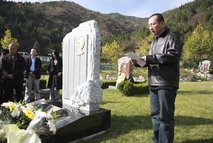
AP – This Oct. 28, 2008 photo shows Liu Xiaobo, right, reading a letter beside the grave of Bao Zunxin, a Chinese historian and political dissident who was arrested and jailed for his role in the 1989 Tiananmen Square democracy protests.

BEIJING – When the police came for Liu Xiaobo on a December night nearly two years ago, they didn't tell the dissident author why he was being taken away again. The line in the detention order for his "suspected crime" was left blank.

But Liu and the dozen officers who crowded into his dark Beijing apartment knew the reason. He was hours from releasing Charter 08, the China democracy movement's most comprehensive call yet for peaceful reform. The document would be viewed by the ruling Communist Party as a direct challenge to its 60-year monopoly on political power.

Liu, who over the past two decades had endured stints in prison and re-education camp, looked at the blank detention notice and lost his temper. "At that moment, I knew the day I was expecting had finally come," his wife, Liu Xia, said recently as she recounted the night of Dec. 8, 2008. Thinking of the Beijing winter, she said she brought him a down coat and cigarettes. The police took the cigarettes away.

Liu was sentenced last Christmas Day to 11 years in prison for subversion. The 54-year old literary critic is now a favorite to win the Nobel Peace Prize — in what would be a major embarrassment to the Chinese government. He is the best shot the country's dissident movement has had in winning the prestigious award since it began pushing for democratic change after China's authoritarian leaders launched economic, but not political, reforms three decades ago. Last year the prize was won by President Barack Obama. Other contenders for this year's prize include Zimbabwe Prime Minister Morgan Tsvangirai.

In an indication of Beijing's unease, China's deputy foreign minister has warned the Nobel Institute not to give the prize to a Chinese dissident, the director of the Norway-based institute said this week. In another sign of official disapproval, an editorial on Thursday in the state-run Global Times newspaper called Liu a radical and separatist.

Chinese police continue to threaten and question some of the more than 300 people who were the first to sign Charter 08, which was co-authored by Liu. Despite the risk, thousands more have signed it since its release.

Charter 08 is an echo of Charter 77, the famous call for human rights in then-Czechoslovakia that led to the 1989 Velvet Revolution that swept away the communist regime. The charter for China calls for more freedoms and an end to the Communist Party's political dominance. "The democratization of Chinese politics can be put off no longer," it says. Former peace prize winners Archbishop Desmond Tutu, the Tibetan spiritual leader the Dalai Lama and Charter 77 co-drafter Vaclav Havel have joined those calling for Liu to get the award. Scholars inside and outside China have mounted letter-writing campaigns on his behalf. "If I were the Chinese Communist Party, I would free him now. Release him. Now. So you don't have the humiliation and it's good for everyone," said Jean-Philippe Beja, a China scholar at the Paris-based Center for International Studies and Research and a longtime friend of Liu. The blunt, sometimes earthy Liu is not always liked, even by fellow activists. "He hasn't yet become the kind of inspiring person Mandela is," AIDS activist Wan Yanhai said in a Twitter post this week, referring to the former South African leader, also a Nobel laureate. But Liu is rare among government critics in China for being well-known not just among the dissident movement but among the wider public too. "Across the spectrum, Chinese intellectuals and students have high respect for Liu Xiaobo," said Andrew Nathan, a professor at Columbia University in New York who once sponsored Liu as a visiting scholar. "The award of the prize ... would be viewed by most as an act friendly to China." It was not the same when the Tibet-born Dalai Lama was awarded the peace prize in 1989. Not just the Chinese government but some of the public too were angry over the win by the exiled Buddhist leader — regarded as a traitor by officialdom for his calls for more autonomy for Tibet.

Liu first drew attention in 1986, when he criticized Chinese writers' "childish" obsession with the Nobel Prize. Two years later, he became a visiting scholar in Oslo, where the peace prize is awarded. There, in his first time outside China, his writings became more political. "Perhaps my personality means that I'll crash into brick walls wherever I go," Liu wrote from Oslo to Geremie Barme, a China scholar at Australian National University. "I can accept it all, even if in the end I crack my skull open." Liu cut short a visiting scholar stint at Columbia University months later to join the Tiananmen Square protests in Beijing in 1989. He and three other older activists famously persuaded students to peacefully leave the square hours before the deadly June 4 crackdown. "I remember clearly the difficulty and pain Liu Xiaobo and his comrades-in-arms — raised as they had been with the most radical type of an education — experienced in reaching this decision, one which only later was understood to have saved the lives of several hundred students," Xu Youyu, a professor with the Chinese Academy of Social Sciences, recently wrote in a public letter supporting Liu for the peace prize. Liu went to prison after the crackdown and was released in early 1991 because he had repented and "performed major meritorious services," state media said at the time, without elaborating. The bloody Tiananmen experience made Liu less radical, said Zhou Duo, a friend on the square. "He used to be impetuous, but he changed a lot after June 4," Zhou said. "He became more rational and mild. He criticized the Communist Party, but he preferred having good exchanges between government and the opposition about politics and democracy." Still, five years later Liu was sent to a re-education camp for three years for co-writing an open letter that demanded the impeachment of then-President Jiang Zemin.

Liu emerged from that sentence in 1999 to find the Internet age. He resisted the new medium of communication at first, but eventually called the Internet "God's present to China." Now Liu only writes a diary and letters to his wife, which she keeps private. His family can visit him in prison, but they can't talk about his case or world events, and officials stand by taking notes. His wife said the couple had never imagined Liu winning the peace prize.

"I can always predict when bad things are about to happen," she said, "but I can never totally believe that good things can become a reality."
___

Associated Press writer Isolda Morillo contributed to this report.

Source--http://news.yahoo.com/s/ap/as_china_nobel_prize_favorite

China sentences another Tibetan environmentalist

AFP– Jul 3, 2010

BEIJING — A leading Tibetan environmentalist has been jailed for subversion, the third such verdict amid an apparent crackdown on intellectuals in the Himalayan region, activists said Sunday. Rinchen Samdrup, 44, was sentenced to five years in prison on Saturday for attempting to incite subversion by a court in Tibet's Chamdo region, poet and rights activist Woeser said on her blog. The verdict comes after his brother Karma Samdrup, 42, a noted art and antique collector and philanthropist, was sentenced by a court in neighbouring Xinjiang late last month to 15 years for "grave-robbing"." These sentences are causing fear among a lot of Tibetan intellectuals," Woeser told AFP while declining to comment further on the verdict due to concerns over possible government reprisals.Karma Samdrup's wife confirmed the sentence on her Twitter account. Xia Jun, Rinchen's lawyer, was unreachable Sunday by telephone, while phones at the Chamdo intermediate court went unanswered. Chinese authorities have been accused of heavy handed measures against alleged "separatist" forces in the Himalayan regions since violent anti-Chinese riots erupted in Lhasa in April 2008 and spread to other parts of Tibetan inhabited regions.Late last year, Chime Namgyal, Rinchen Samdrup's younger brother, was sentenced to 21 months of "re-education through labour" for endangering state security, the London-based International Campaign For Tibet said in a statement on Saturday. The two brothers ran the "Snowlands Great Rivers Environmental Protection Association". "The case against Rinchen Samdrup is part of a larger case against his two brothers, two cousins, and other relatives and supporters and stands as a major case in which prominent Tibetans have been targeted and imprisoned despite no evidence of political activities," the statement said. The brothers had previously been praised by Chinese authorities and the state media for their environmental work, it added. According to Human Rights Watch, the brothers were arrested after attempting to highlight environmental abuses by local officials in Tibet. The New York-based group has expressed concern over the "increasing vulnerability of important cultural and entrepreneurial Tibetan figures to politically motivated arrests and prosecutions".
Source--http://www.google.com/hostednews/afp/article/ALeqM5jBfxzXXRmmv8ChV7Y5_RQ8QZV3JQ

September 24, 2010

His Holiness the Dalai Lama expresses hope of return to Tibet

His Holiness the Dalai Lama expresses hope of return to Tibet

[Tuesday, 21 September 2010, 5:24 p.m.]

Budapest: His Holiness the Dalai Lama has expressed hope that he would return to Tibet, and called on the Chinese leadership to start political liberalisation and find a solution in the interest of China and the Tibetan people.

"I'm an optimist, I think I will return to Tibet with a Chinese passport," His Holiness said Monday in his address to the Hungarian parliament in Budapest, which accorded him a red carpet reception. He was welcomed by president of the Hungarian Parliament's Tibet Group and the deputy leader of the LMP, the new political party in Hungary.

"The Chinese leaders sooner or later have to realise that they must start some sort of political liberalisation, or otherwise they will lose the world's trust," His Holiness the Dalai Lama told Hungarian MPs.

Reiterating that “suppression is not the solution to the Tibet problem”, His Holiness the Dalai Lama said “a solution must be found that is good for both China and Tibet”.

His Holiness reaffirmed that “the Tibetans are not seeking separation from China but a mutually beneficial solution to the Tibetan issue through genuine autonomy”.

His Holiness the Dalai Lama encouraged the Hungarian MPs to visit Tibet to see the situation for themselves.

Ms Szabo Timea, the deputy leader of the LMP said: “We are here to express our full support for the Tibetan causes. We'll support the regional national autonomy to preserve Tibetan culture and identity dating back to thousands of years.”

The LMP also expresses great concern about Tibet's environment and the impacts of climate change, said Ms Timea, who is also deputy chair of Parliamentary Committee of Human Rights.

The chairperson of the Parliament's Human Rights Committee also called on His Holiness the Dalai Lama.

In the afternoon, His Holiness the Dalai Lama addressed the students and members of the faculty of Central European University. The University has students from 100 countries and faculty from 40 countries.

http://longlivehhdl.ning.com/profiles/blogs/his-holiness-the-dalai-lama-340

September 06, 2010

Webcast of His Holiness the Dalai Lama Teachings in September

His Holiness the Dalai Lama Teachings in September--Teachings begin September 8, 2010

The official website of His Holiness the Dalai Lama will webcast the three-teaching at the main Buddhist temple in Dharamshala beginning Wednesday, September 8, 2010.

Dharamshala: His Holiness the Dalai Lama will give three-day teachings on The Heart Sutra (sherab nyingpo) and Gyalsey Thokme Sangpo's 37 Practices of A Bodhisattva (gyalsey laklen sodunma) at the request of a group from Southeast Asia. The teachings will be held at the Main Tibetan Temple in Dharamsala, from 8 - 10 September 2010.

There will be two sessions each day from approximately 9:30am-11:30am and 1:00pm-3:00pm Indian Standard Time (GMT+5.30). For timings in your region 9:30am Indian Standard time on 8 September is the same as 9:00pm 7 September Pacific Daylight Time in Los Angeles, USA.

Live Webcast in English: View Here
Live Webcast in Tibetan: View Here
Live Webcast in Chinese: View Here

-News story from Tibet.net

June 26, 2010

Tibet Online

This is a very excellent website, I recommend taking a peek.

Tibet Online

There's tons of accurate news, cultural information, activist information, links to other important Tibet sites, and information about the state of Tibet today. And much more!

June 15, 2010

Dharma Wheel Forum

Dharma Wheel is starting to pick up more. That's good. I woke up to find a slew of new posts and some new members there. But most importantly, Silent Bob is registered at DW.

May 10, 2010

The Sun Behind the Clouds

This looks like a must-see:  The Sun Behind the Clouds

It will be released in October, 2010.


“The documentary does a superlative job of examining the half-century dispute over Chinese rule of mountainous Tibet.”
VA Musetto, New York Post

“A potent update on Tibetans‘ 50-year struggle for justice and recognition…essential viewing for anyone who cares about the fate of the mountain region and the legacy of the Dalai Lama.”
Sheri Linden, The Hollywood Reporter

“…a welcome departure from many previous films about the decades-long friction between Tibet and China…an exception in what is not an angry film but a notably calm, well-considered and balanced one.”
Robert Koehler, Variety

April 14, 2010

Kyabje Lati Rinpoche passed away peacefully.

http://www.buddhistchannel.tv/index.php?id=9,9076,0,0,1,0

Biography: The Most Venerable Kyabje Lati Rinpoche
His Eminence Kyabje Lati Rinpoche was born in the Kham region of Eastern Tibet in 1922. After the famous Gongkar Rinpoche (previous incarnation) identified and recognized Him as a reincarnation of a great practitioner, Rinpoche consequently embarked on the fulfillment of His destiny by joining the local monastery in Tibet - at the age of ten.

By fifteen years old, Rinpoche was enrolled in Gaden Shartse Norling College, located in central Tibet. It is the most prestigious and renowned school in Tibet, and it was at Gaden Shartse Norling College where Rinpoche pursued his study of Buddhist scriptures, and eventually, earning Him the highest honours among the foremost scholars of His day.

At that time, Rinpoche?s field of study included Pramana Vidya (Logic), Prajnaparamita (Perfection of Wisdom), Madhyamika (Middle Philosophy), Abidharma (Treasure of Knowledge), Vinaya (Spiritual Rules and Moral Law).
In 1959, after nineteen years of intensive study and training, Rinpoche sat for the Geshe Lharmapa examination. This major examination was held in the summer palace of His Holiness the 14th Dalai Lama, located in the capital of Tibet, Lhasa.

Candidates were various scholars and top students from the 3 main monasteries, and yet Rinpoche still managed to emerge 2nd overall. In the next year, H.E. was officially conferred as "Geshe Lharampa", a qualification which is equivalent to the PH.D. degree in the Indian universities. And in that same year, Rinpoche joined the tantric college in Lhasa, and started intensive study in Tantra since.

In the following years, H.E. taught many young incarnate lamas, as well as gave dharma talks to the mass public. In 1964, Rinpoche arrived in Dharamsala, and was subsequently appointed as Spiritual Assistant to His Holiness the 14th Dalai Lama. Rinpoche serves His Holiness faithfully till today.
In 1976, under His Holiness?s suggestion, various universities in America invited Lati Rinpoche over, where H.E. gave illuminating dharma discourses to an appreciative public. In addition, Rinpoche taught at Namgyal Gomba (His Holiness?s personal monastery), at the debating college, and has guided and taught many laypeople as well.

In the same year, Rinpoche was appointed as the Abbot of the Shartse Norling College of Gaden Monastery, in South India. H.E. held this position for eight years ? where besides looking after the administration, law and order of the Sangha, Rinpoche also personally taught extensively on all aspects of Buddhism. Rinpoche?s contribution towards Gaden Shartse Norling College is widely recognized by all, and H.E. is deeply respected by many strong devotees all over the world.

Since His retirement, Rinpoche dedicated His life mainly on dharma practice, as well as propagating the dharma, guiding people along the sometimes complex path of the dharma. On repeated requests from many countries in Europe and America, Rinpoche has travelled extensively, benefiting dharma students in various parts of the world.

To His credit, Lati Rinpoche has authored many important books on Tibetan Buddhism, including:
- Death, Intermediate State and Rebirth
- Mind in Tibetan Buddhism
- Meditative States in Tibetan Buddhism.

_/\_ _/\_ _/\_

December 29, 2009

Tibetan film selected for Palm Springs International Film Festival Phayul Dharamsala, December 29 –

A documentary film by filmmaker couple Tenzing Sonam and Ritu Sarin has been selected for competition at the 21st Annual Palm Springs International Film Festival to be held at Palm Springs, California, USA from January 5-18, 2010.

“Sun Behind the Clouds: Tibet's Struggle for Freedom” is a film with “a uniquely Tibetan perspective on the trials and tribulations of the Dalai Lama and his people as they continue their struggle for freedom in the face of determined suppression by one of the world’s biggest and most powerful nations.”

The website of the filmmaker duo says they had an intimate access to the Tibetan leader His Holiness the Dalai Lama over the course of an eventful year, which included the 2008 protests in Tibet, the international response to it, the Beijing Olympics, and the breakdown in talks between the Tibetan envoys and the Chinese government.

“Set against this backdrop, the film explores the interplay between the personal and the historic, spirituality and politics, and the tension between the Dalai Lama's efforts to find a peaceful resolution to the Tibet situation based on compromise and dialogue, and the impatience of a younger generation of Tibetans who are ready to take a more confrontational course,” says the films synopsis on the website.

The film was premiered at the DMZ Korean International Documentary Festival in October 2009 and will have its London premiere at THE HUMAN RIGHTS Watch International Film Festival in March 2010. The 79 minute long film was produced by Tenzing and Ritu in association with Arch Communications, GmbH, Austria and Roland Films, USA.

Tenzing Sonam and Ritu have made several films on Tibet including the widely acclaimed “Shadow Circus: CIA in Tibet”. Their first stint at feature film was “Dreaming Lhasa”, a low budget film with entirely unknown and non professional cast but that won accolades at festivals.http://www.phayul.com/news/article.aspx ... al&t=1&c=1

December 21, 2009

Gulbarga - Dalai Lama lauds India's religious tolerance

Image and video hosting by TinyPic
His Holiness the Dalai Lama prostrates in front of a statue of Buddha at the Buddha Vihara in Gulbarga, Karnataka. Deccan Herald photo.

Deccan Herald [Sunday, December 20, 2009 01:54]

Gulbarga - Delivering a discourse on ‘The Four Noble Truths of Buddhism’ on the occasion of the first anniversary of Buddha Vihara here on Saturday the Tibetan leader in exile said that religious tolerance of ‘Aryabhoomi,’ a reference to India found in Mahabharata, has been in existence in this country from thousands of years.

“Not only Hinduism, Jainism, Buddhism, Sikhism which are the native religions but also Christianity and Islam have flourished here. Religious tolerance is inherent in Indian tradition,’’ Dalai Lama said.

“There may be a few differences. Constructive criticism of any religion is acceptable. But the basic tenets such as love, compassion, truth, brotherhood etc remain the same in all religions," he added.

Dalai Lama said that there was not much difference between Hinduism and Buddhism except in a few aspects.Large number of people including those from the neighbouring states of Andhra Pradesh and Maharashtra and different parts of Karnataka had arrived to listen Dalai Lama.

Dalai Lama is on a two-day visit to Gulbarga exclusively for delivering religious discourses at the newly built Buddha Vihara. He had visited the Vihara in January this year.

Source
Showing posts with label News. Show all posts

His Holiness to come to Long Beach Convention Center

>> February 16, 2011

GSTDL to Host His Holiness the Dalai Lama on May 1, 2011

It gives us great joy to announce that Gaden Shartse Thubten Dhargye Ling will be hosting His Holiness the Dalai Lama on May 1, 2011. Although His Holiness will be our guest for only one day, it will be an extraordinary day.

We are honored that His Holiness has decided to confer a Solitary Yamantaka Initiation on the morning of May 1, 2011. In the afternoon His Holiness will be delivering a public talk on ‘Secular Ethics and Meditation.’ These events will take place in the Terrace Theater at the Long Beach Convention Center.

His Holiness is requiring several commitments from those who attend the initiation. Please see the Highest Yoga Tantra page for more information on the initiation. Because it is so rare that His Holiness would confer an initiation from the Highest Yoga Tantra class of initiations in the United States, we feel something very special and significant will be taking place. The tickets for the Initiation will be free of cost for all; however, only serious students who are willing to abide by the commitments laid out by His Holiness may attend the initiation. Please read the Highest Yoga Tantra page for more details, including information on how to register for the Initiation. Monastics may register for the events on May 1, 2011 by completing the online registration form at the bottom of the Highest Yoga Tantra page.

We invite you to become a sponsor of His Holiness’ 2011 visit. See the Invitation to Become a Sponsor page for more information.

In addition to the event on May 1, 2011, Gaden Shartse Thubten Dhargye Ling will be sponsoring several events in the days leading up to May 1, 2011. See the Gaden Shartse Thubten Dhargye Ling Weekend page.

Tickets for His Holiness’ public talk and for the GSTDL Weekend events will be available for purchase by the general public starting 10 am on February 22, 2011 via Ticketmaster. Type ‘GSTDL’ into the search box on the www.ticketmaster.com website to bring up all four events for which tickets will be sold via Ticketmaster. Tickets may also be purchased through the box office of the Long Beach Convention Center starting at 10 am on February 22, 2011.

We have posted a page with travel and lodging information and also a page with answers to frequently asked questions.

More Information

Read more...

China Denies Karmapa Links, Tibetans Express Anger

>> February 03, 2011

by Ananth Krishnan, The Hindu, Feb 1, 2011

Accusation shows “India is keeping its mistrustful attitude toward China,” says official

BEIJING, China -- The Chinese government has denied suggestions that it had links with the 17th Karmapa, whose monastery was recently raided in Dharamsala, saying the accusation reflected the Indian government's mistrust towards China.

An official of the Communist Party's United Front Work Department, which is in charge of minority and religious affairs, said media reports in India were inaccurate.

“The speculation by India's media, regarding the matter of the Karmapa as a Chinese agent or spy, shows that India is keeping its mistrustful attitude toward China,” Xu Zhitao, an official at the department, told the State-run Global Times newspaper on Sunday.

Voices in the Tibetan community here, including one prominent writer, also expressed anger on Monday at the allegations that the revered Karmapa was a Chinese spy, hitting out at Indian authorities' handling of the recent investigation into his monastery's finances.

Nearly $ 1.6 million in foreign currencies was found following a raid in a monastery in Dharamsala.

“Money from donations”
Representatives of the Karmapa, who is the head of the Kagyu sect and one of Tibetan Buddhism's most important leaders, said the money was from donations from his followers. They have denied Indian media reports which claimed that the money, which included notes in Chinese Yuan as well as other currencies, was an indication of the Karmapa's ties to the Chinese government.
The Karmapa is a widely revered figure among Tibetans in China – perhaps second only to the Dalai Lama, who is the head of the Gelugpa sect and Tibetan Buddhism's most important figure.

The Dalai Lama has indicated his support to the Karmapa, calling for a thorough investigation. He said “some negligence”, rather than a political conspiracy, was likely behind the issue.

Tsering Woeser, a prominent Tibetan writer and poet, told The Hindu on Monday that the allegations, whether made by the Indian government or State police, were “totally irresponsible.”

“How can currency being found be proof that he is a spy?” she asked. “Karmapa is the spiritual leader for all people of Chinese origin, home and abroad,” said Ms. Woeser, who has been a vocal critic of China's religious policies. “It is legitimate that he will get donations in Chinese currency. The government in India, a country which has so many religious leaders, should know that this amount is not even really that large.”

She said she was “deeply hurt” by the allegations. “I am sure many Tibetans are too,” she added.

Key figure

Ogyen Trinley Dorje (25), the 17th Karmapa, was born in Qamdo county in Tibet Autonomous Region. Recognised in 1992, he was the first “Living Buddha” whose appointment was confirmed and approved by the Communist Party of China, which took control of Tibet in 1951. Dorje left Tibet for India in 1999, arriving in Dharamsala.

The Karmapa has been seen as a key figure in the future of Tibetan Buddhism, and as a possible successor to the 75 year-old Dalai Lama as a leader of the Tibetan movement. The 11th Panchen Lama is the second highest-ranked leader after the Dalai Lama in the Gelugpa sect. His appointment by the Chinese government has, however, not been accepted by many Tibetans.

While the Chinese government often criticises the Dalai Lama as a “splittist”, it has generally refrained from commenting on the Karmapa. The Chinese media rarely discusses either the Karmapa or his departure to India.

On Sunday, Mr. Xu said: “Karmapa left China in 1999 for the purpose of religious behaviors [sic], just as he claimed.”

Ms. Woeser countered claims that China's silence suggested its tacit support for the Tibetan leader. “Karmapa is completely different from the Dalai Lama,” she said.

“He is a spiritual leader without political power, so the Chinese government has no reason to point its finger at him.”

Source

Read more...

Dalai Lama Says Succession Not A Serious Problem For Him

>> December 27, 2010

As the spiritual leader of the Tibetan people as the Dalai Lama ages Buddhists here in Syracuse have been joining Buddhists across the world with shared anxieties about what will happen when the Dalai Lama retires or dies. As the very much admired spiritual leader of Buddhism in every corner of the world the Dalai Lama fully understands the impact which his presence has for his followers. However, he says he is not concerned about the issue of succession to his position.            
The Tibet Sunhttp://tibetsun.com, has reported "Succession not a serious issue for me: Dalai Lama". In fact His Holiness the Dalai Lama has recently said  “Succession is not a serious issue for me. Looks like the Chinese government is more seriously looking for it. ” The Dalai Lama made these comments  while answering questions on the sidelines of the Hindustan Times Leadership Summit in the national capital of India, New Delhi. The Dalai Lama went on to comment that the continuation of the Dalai Lama as an institution depended on what the Tibetan people wanted. He said “I made it very clear as early as 1969, if majority of Tibetan people feel that now the Dalai Lama institution is no more needed, we can finish it."
The Dalai Lama fled Tibet with many of his supporters and took refuge in India when Chinese troops moved in and took control of Lhasa, the capital of Tibet, in 1959. Since than he has headed the Tibetan government-in-exile in Dharamshala in Himachal Pradesh. About 140,000 Tibetans now live in exile, over 100,000 of them in different parts of India.  And over six million Tibetans live in Chinese occupied in Tibet.

Buddhists here in Syracuse will join in prayers with Buddhists from aro
und the world that there will be a continuation of respect for Buddhist values when the Dalai Lama is no longer around.


Mandel News Service: http://www.mandelnews.com

Read more...

Dalai Lama 'to retire' from government-in-exile role

>> November 24, 2010

by Adam Plowright – Tue Nov 23, 2010
NEW DELHI (AFP) – The Dalai Lama intends to retire as head of the Tibetan government in exile next year as he looks to reduce his ceremonial role and scale back his workload, his spokesman told AFP Tuesday.
The Tibetan movement in exile, based in the northern Indian hill station of Dharamshala since 1960, directly elected a political leader in 2001 for the first time.
"Since then, His Holiness has always said he has been in a semi-retired state," spokesman Tenzin Taklha said.
"In recent months, His Holiness has been considering approaching the Tibetan parliament in exile to discuss his eventual retirement."
Taklha stressed that his "retirement" would be from his ceremonial responsibilities as head of the government, such as signing resolutions, not his role as spiritual leader and figurehead for Tibetans.
"This does not mean that he will withdraw from leading the political struggle. He is the Dalai Lama, so he will always lead the Tibetan people," he said.
The 75-year-old Nobel Peace Prize winner is the global face for the Tibetan struggle against Chinese rule in Tibet, as well as a leading promoter of human rights, dialogue between religions and Buddhist values.
In the past few months he has kept up his frenetic travel schedule, visiting Canada, the United States, Poland and Japan, among other countries.
Taklha said the Dalai Lama would raise the subject of his retirement at the next session of parliament in March and would then look to step back from his responsibilities in the following six months.
"It would depend on talking to the parliament and hearing their views on this. Nothing is for sure, but these are things that are being considered by him," he said.
The speaker of the parliament, Penpa Tsering, told AFP that "every Tibetan would like him to continue as long as his physical condition allows him to." "It is definitely going to be a political change. It is a big, big issue for us. I think we have to wait to look at how and the nature of his presentation (to parliament)," he added.
He stressed that it was important that, whatever the outcome of the discussions, the Dalai Lama should remain as the leading voice in talks between the government in exile and China.
"He has repeatedly mentioned that he will continue to take responsibility for dealing with the Chinese government and he should continue because that is the biggest issue that concerns us all," he said.
There are concerns inside and outside Tibet that his eventual death will deal a blow to the coherence of the Tibetan movement, which seeks independence or autonomy for the Buddhist region from Chinese rule.
The community in exile is braced for a huge struggle with Beijing about the future holder of the Dalai Lama role. China has already stated it intends to have the final say on any reincarnation.
As the highest ranking lama in Tibetan Buddhism, he is seen as the spiritual leader of the region after being chosen aged two as the reincarnation of the original Dalai Lama, who was born in 1391.
The current Dalai Lama, born Tenzin Gyatso, has suggested there are several ways of resolving the succession problem in addition to the traditional way in which a search party is sent out to find the reincarnation.
The successor could simply be named by senior religious figures in the way Catholics chose the Pope, or the office could be abolished all together, with another figure assuming responsibilities as spiritual leader.
The 26-year-old Karmapa, a young monk who like the Dalai Lama fled across the Himalayas from Tibet to seek sanctuary in India, has the highest profile among a cast of young lamas who could fill the void.
The Karmapa is formally recognised not only by the Dalai Lama but also by China which, prior to his escape, had been politically grooming him as the highest reincarnate lama under its control.

Read more...

Junta Putting Pressure on Buddhist Clergy: Clinton

>> November 21, 2010

By LALIT K JHA, The Irrawaddy, November 18, 2010

WASHINGTON, USA -- The Burmese military junta continues its tight control over the activities of Buddhist monks and discriminates against religious minorities, US Secretary of State Hillary Clinton said on Wednesday.
“In Burma, the government continues its tight control of the activities of Buddhist clergy and discriminates against minority religious communities,” Clinton said in remarks on the release of the annual State Department report on religious freedom.
“The release last Sunday of Aung San Suu Kyi is a positive step. However, there are more than 2,100 political prisoners in Burma, including many monks and other religious figures,”  Clinton said.       
The report  identifies Burma as one of the eight countries that have been designated as countries of particular concern.

“Those eight countries are Burma, China, Eritrea, Iran, North Korea, Saudi Arabia, Sudan, and Uzbekistan,” said Michael Posner, the assistant secretary of state for Democracy, Human Rights and Labor.
“We are now reviewing that process separate from this report. This report states the facts.  Now, we’re going to have an internal process where we evaluate these, and in the next couple of months, we will designate countries going forward that are on this list,” she said.
The International Religious Freedom Report 2010 by the State Department said the Burmese government imposed restrictions on certain religious activities and limited freedom of religion, although generally permitted adherents of government-registered religious groups to worship as they chose.
Noting that there was no change in the government's limited degree of respect for religious freedom during the reporting period, the report said religious activities and organizations were subject to restrictions on freedom of expression, association and assembly.
“The government continued to monitor meetings and activities of virtually all organizations, including religious organizations and required religious groups to seek permission from authorities before holding any large public event,” the report said.
The Burmese military rulers continued to systematically restrict Buddhist clergy efforts to promote human rights and political freedom, it said, adding that many of the Buddhist monks arrested in the violent crackdown that followed pro-democracy demonstrations in September 2007, including prominent activist monk U Gambira, remained in prison serving long sentences.
According to the report, the Burmese government also actively promotes Theravada Buddhism over other religions, particularly among ethnic minorities.
“Christian and Islamic groups continued to struggle to obtain permission to repair places of worship or build new ones. The regime continued to closely monitor Muslim activities. Restrictions on worship for other non-Buddhist minority groups also continued,” it said.
 Although there were no new reports of forced conversions of non-Buddhists, authorities in some cases influenced placement of orphans and homeless youth, preferring Buddhist monasteries to Christian orphanages in an apparent effort to prevent Christian groups’ or missionaries’ influence, it said.
Adherence or conversion to Buddhism was an unwritten prerequisite for promotion to senior government and military ranks. All senior level officers of the ruling State Peace and Development Council (SPDC) and the armed forces are Buddhists, it said.
The report said during the reporting period, social tensions continued between the Buddhist majority and the Christian and Muslim minorities.
“Widespread prejudice existed against citizens of South Asian origin, many of whom are Muslims. The government continued to refuse to recognize the Muslim Rohingya ethnic minority as citizens and imposed restrictions on their movement and marriage,” it said.
Meanwhile, senior US Sen. Mitch McConnell, on Wednesday urged the Burmese rulers to ensure that the release of Aung San Suu Kyi is permanent.
“Make no mistake, the release of Suu Kyi is a positive step forward in Burma. Yet it is only the first—and by no means the final—step that must take place in that beleaguered country,” he said in a statement.
“While fellow advocates of democracy in Burma rightly rejoice in her being freed, our feelings of joy and relief are tempered by several sobering concerns,” he said.
“First, there is the matter of her safety. We all remember the brutal attack against her in 2003.  That must not be permitted to happen again. Second, we know Suu Kyi has been released in the past only to be later detained on trumped-up charges. We want her release to be permanent, not temporary. Third, although she was granted unconditional release, it remains to be seen whether the regime will tolerate her active participation in public affairs,” McConnell said.

Read more...

"The Buddha from Dolpo"

>> November 15, 2010

Revised Version of "The Buddha from Dolpo" Now Available

The Buddha from Dolpo: A Study of the Life and Thought of the Tibetan Master Dolpopa Sherab Gyaltsen by Cyrus Stearns is now in a revised and expanded edition.
Book CoverBook Cover
"The Buddha from Dölpo is the most significant contribution to the study of the life and revelations of one of the most enigmatic personalities in Tibetan intellectual history, the Jonang master Dolpopa Sherab Gyaltsen (1292–1361). Narrating Dolpopa's life story and evolution of thought, Cyrus Stearns lucidly describes how this foremost exponent of shentong philosophical thinking and Kalachakra tantric practice served as the catalyst figure for the Jonang Buddhist tradition during its formative period in fourteenth-century Tibet. A decade after its first publication, this revised and enlarged edition includes several significant refinements and additions, including a translation of Dolpopa's own commentary on his masterful work concerning the calculations of cosmic time according to shentong literature known as the Fourth Council. With this revision, Stearns secures The Buddha from Dölpo its place within the Western-language canon of scholarship on Tibetan Buddhism, making it an essential read for understanding Dolpopa's presentation of shentong, the Kalachakra Tantra in Tibet, and the early Jonang Buddhist tradition."
― Michael R. Sheehy, Ph.D., Executive Director of Jonang Foundation ―

http://networkedblogs.com/avVpQ?ref=nf

Read more...

Released Tibetan Monk in Serious Health Condition

-Wednesday, 03 November 2010 11:49 James Dunn, The Tibet Post International


Dharamshala: A Tibetan monk is seriously ill after being released from Chinese prison last month, The Tibet Post has learnt. The monk is suffering from serious kidney and stomach ailments and is requiring constant health care.

The monk, who has been identified as Jamyang Tenzin, was arrested in October 2007 for resisting a political re-educational campaign in his monastery following protests that occurred during the horse-racing festival in Lithang, Kardze. At the 2007 festival, a Tibetan nomad, Ronggyal Adrak, grabbed a microphone from a Chinese official and made a speech in support of exiled Tibetan spiritual leader His Holiness the Dalai Lama.
He was scheduled for an early release in August but was released only on October 8th, after refusing to to accept Chinese conditions for his release, said Lobsang Dawa Rinpoche, a Tibetan monk living in India and citing contacts in Tibet.
"The Tibetan public planned to host a grand reception for him, but the Chinese authorities forbade any kind of gathering and threatened to send Jamyang Tenzin back to prison if any reception were held," Lobsang Dawa said.
Lobsang Dawa added. "They took him to a hospital in [the provincial capital] Chengdu, but his health is not good," he said.
Due to his severe beatings and torture at the hand of the Chinese prison guards, Jamyang health has deteriorated rapidly, both physically and mentally. Before his prison sentence Jamyang was a very outspoken member of the Tibetan community, however, it is reported that since his release he avoids talking or meeting with anyone, spending a lot of time in his room.

Read more...

New Author has Joined Us

>> October 07, 2010

I'm so pleased to announce that Yue-han Su has accepted my invitation and joined us as an author here! He is going to be such a fabulous contributor to this group blog with his insights, knowledge, and amazing writing skills.

A very warm welcome to you Yue-han Su!

If you are interested in being a contributor here please contact any one of us and let us know so we can kindly consider it.

Read more...

New Author

>> October 04, 2010

I'm really pleased to announce that Ogyen is now an author at this blog. She's a prolific writer and I'm looking forward to her contributions! Aside from being a prolific writer she's a fascinating person. Welcome Ogyen!

Read more...

Contender for Nobel prize is in Chinese prison

>> October 03, 2010

By CARA ANNA, Associated Press Writer

AP – This Oct. 28, 2008 photo shows Liu Xiaobo, right, reading a letter beside the grave of Bao Zunxin, a Chinese historian and political dissident who was arrested and jailed for his role in the 1989 Tiananmen Square democracy protests.

BEIJING – When the police came for Liu Xiaobo on a December night nearly two years ago, they didn't tell the dissident author why he was being taken away again. The line in the detention order for his "suspected crime" was left blank.

But Liu and the dozen officers who crowded into his dark Beijing apartment knew the reason. He was hours from releasing Charter 08, the China democracy movement's most comprehensive call yet for peaceful reform. The document would be viewed by the ruling Communist Party as a direct challenge to its 60-year monopoly on political power.

Liu, who over the past two decades had endured stints in prison and re-education camp, looked at the blank detention notice and lost his temper. "At that moment, I knew the day I was expecting had finally come," his wife, Liu Xia, said recently as she recounted the night of Dec. 8, 2008. Thinking of the Beijing winter, she said she brought him a down coat and cigarettes. The police took the cigarettes away.

Liu was sentenced last Christmas Day to 11 years in prison for subversion. The 54-year old literary critic is now a favorite to win the Nobel Peace Prize — in what would be a major embarrassment to the Chinese government. He is the best shot the country's dissident movement has had in winning the prestigious award since it began pushing for democratic change after China's authoritarian leaders launched economic, but not political, reforms three decades ago. Last year the prize was won by President Barack Obama. Other contenders for this year's prize include Zimbabwe Prime Minister Morgan Tsvangirai.

In an indication of Beijing's unease, China's deputy foreign minister has warned the Nobel Institute not to give the prize to a Chinese dissident, the director of the Norway-based institute said this week. In another sign of official disapproval, an editorial on Thursday in the state-run Global Times newspaper called Liu a radical and separatist.

Chinese police continue to threaten and question some of the more than 300 people who were the first to sign Charter 08, which was co-authored by Liu. Despite the risk, thousands more have signed it since its release.

Charter 08 is an echo of Charter 77, the famous call for human rights in then-Czechoslovakia that led to the 1989 Velvet Revolution that swept away the communist regime. The charter for China calls for more freedoms and an end to the Communist Party's political dominance. "The democratization of Chinese politics can be put off no longer," it says. Former peace prize winners Archbishop Desmond Tutu, the Tibetan spiritual leader the Dalai Lama and Charter 77 co-drafter Vaclav Havel have joined those calling for Liu to get the award. Scholars inside and outside China have mounted letter-writing campaigns on his behalf. "If I were the Chinese Communist Party, I would free him now. Release him. Now. So you don't have the humiliation and it's good for everyone," said Jean-Philippe Beja, a China scholar at the Paris-based Center for International Studies and Research and a longtime friend of Liu. The blunt, sometimes earthy Liu is not always liked, even by fellow activists. "He hasn't yet become the kind of inspiring person Mandela is," AIDS activist Wan Yanhai said in a Twitter post this week, referring to the former South African leader, also a Nobel laureate. But Liu is rare among government critics in China for being well-known not just among the dissident movement but among the wider public too. "Across the spectrum, Chinese intellectuals and students have high respect for Liu Xiaobo," said Andrew Nathan, a professor at Columbia University in New York who once sponsored Liu as a visiting scholar. "The award of the prize ... would be viewed by most as an act friendly to China." It was not the same when the Tibet-born Dalai Lama was awarded the peace prize in 1989. Not just the Chinese government but some of the public too were angry over the win by the exiled Buddhist leader — regarded as a traitor by officialdom for his calls for more autonomy for Tibet.

Liu first drew attention in 1986, when he criticized Chinese writers' "childish" obsession with the Nobel Prize. Two years later, he became a visiting scholar in Oslo, where the peace prize is awarded. There, in his first time outside China, his writings became more political. "Perhaps my personality means that I'll crash into brick walls wherever I go," Liu wrote from Oslo to Geremie Barme, a China scholar at Australian National University. "I can accept it all, even if in the end I crack my skull open." Liu cut short a visiting scholar stint at Columbia University months later to join the Tiananmen Square protests in Beijing in 1989. He and three other older activists famously persuaded students to peacefully leave the square hours before the deadly June 4 crackdown. "I remember clearly the difficulty and pain Liu Xiaobo and his comrades-in-arms — raised as they had been with the most radical type of an education — experienced in reaching this decision, one which only later was understood to have saved the lives of several hundred students," Xu Youyu, a professor with the Chinese Academy of Social Sciences, recently wrote in a public letter supporting Liu for the peace prize. Liu went to prison after the crackdown and was released in early 1991 because he had repented and "performed major meritorious services," state media said at the time, without elaborating. The bloody Tiananmen experience made Liu less radical, said Zhou Duo, a friend on the square. "He used to be impetuous, but he changed a lot after June 4," Zhou said. "He became more rational and mild. He criticized the Communist Party, but he preferred having good exchanges between government and the opposition about politics and democracy." Still, five years later Liu was sent to a re-education camp for three years for co-writing an open letter that demanded the impeachment of then-President Jiang Zemin.

Liu emerged from that sentence in 1999 to find the Internet age. He resisted the new medium of communication at first, but eventually called the Internet "God's present to China." Now Liu only writes a diary and letters to his wife, which she keeps private. His family can visit him in prison, but they can't talk about his case or world events, and officials stand by taking notes. His wife said the couple had never imagined Liu winning the peace prize.

"I can always predict when bad things are about to happen," she said, "but I can never totally believe that good things can become a reality."
___

Associated Press writer Isolda Morillo contributed to this report.

Source--http://news.yahoo.com/s/ap/as_china_nobel_prize_favorite

Read more...

China sentences another Tibetan environmentalist

AFP– Jul 3, 2010

BEIJING — A leading Tibetan environmentalist has been jailed for subversion, the third such verdict amid an apparent crackdown on intellectuals in the Himalayan region, activists said Sunday. Rinchen Samdrup, 44, was sentenced to five years in prison on Saturday for attempting to incite subversion by a court in Tibet's Chamdo region, poet and rights activist Woeser said on her blog. The verdict comes after his brother Karma Samdrup, 42, a noted art and antique collector and philanthropist, was sentenced by a court in neighbouring Xinjiang late last month to 15 years for "grave-robbing"." These sentences are causing fear among a lot of Tibetan intellectuals," Woeser told AFP while declining to comment further on the verdict due to concerns over possible government reprisals.Karma Samdrup's wife confirmed the sentence on her Twitter account. Xia Jun, Rinchen's lawyer, was unreachable Sunday by telephone, while phones at the Chamdo intermediate court went unanswered. Chinese authorities have been accused of heavy handed measures against alleged "separatist" forces in the Himalayan regions since violent anti-Chinese riots erupted in Lhasa in April 2008 and spread to other parts of Tibetan inhabited regions.Late last year, Chime Namgyal, Rinchen Samdrup's younger brother, was sentenced to 21 months of "re-education through labour" for endangering state security, the London-based International Campaign For Tibet said in a statement on Saturday. The two brothers ran the "Snowlands Great Rivers Environmental Protection Association". "The case against Rinchen Samdrup is part of a larger case against his two brothers, two cousins, and other relatives and supporters and stands as a major case in which prominent Tibetans have been targeted and imprisoned despite no evidence of political activities," the statement said. The brothers had previously been praised by Chinese authorities and the state media for their environmental work, it added. According to Human Rights Watch, the brothers were arrested after attempting to highlight environmental abuses by local officials in Tibet. The New York-based group has expressed concern over the "increasing vulnerability of important cultural and entrepreneurial Tibetan figures to politically motivated arrests and prosecutions".

Source--http://www.google.com/hostednews/afp/article/ALeqM5jBfxzXXRmmv8ChV7Y5_RQ8QZV3JQ

Read more...

His Holiness the Dalai Lama expresses hope of return to Tibet

>> September 24, 2010

His Holiness the Dalai Lama expresses hope of return to Tibet

[Tuesday, 21 September 2010, 5:24 p.m.]

Budapest: His Holiness the Dalai Lama has expressed hope that he would return to Tibet, and called on the Chinese leadership to start political liberalisation and find a solution in the interest of China and the Tibetan people.

"I'm an optimist, I think I will return to Tibet with a Chinese passport," His Holiness said Monday in his address to the Hungarian parliament in Budapest, which accorded him a red carpet reception. He was welcomed by president of the Hungarian Parliament's Tibet Group and the deputy leader of the LMP, the new political party in Hungary.

"The Chinese leaders sooner or later have to realise that they must start some sort of political liberalisation, or otherwise they will lose the world's trust," His Holiness the Dalai Lama told Hungarian MPs.

Reiterating that “suppression is not the solution to the Tibet problem”, His Holiness the Dalai Lama said “a solution must be found that is good for both China and Tibet”.

His Holiness reaffirmed that “the Tibetans are not seeking separation from China but a mutually beneficial solution to the Tibetan issue through genuine autonomy”.

His Holiness the Dalai Lama encouraged the Hungarian MPs to visit Tibet to see the situation for themselves.

Ms Szabo Timea, the deputy leader of the LMP said: “We are here to express our full support for the Tibetan causes. We'll support the regional national autonomy to preserve Tibetan culture and identity dating back to thousands of years.”

The LMP also expresses great concern about Tibet's environment and the impacts of climate change, said Ms Timea, who is also deputy chair of Parliamentary Committee of Human Rights.

The chairperson of the Parliament's Human Rights Committee also called on His Holiness the Dalai Lama.

In the afternoon, His Holiness the Dalai Lama addressed the students and members of the faculty of Central European University. The University has students from 100 countries and faculty from 40 countries.

http://longlivehhdl.ning.com/profiles/blogs/his-holiness-the-dalai-lama-340

Read more...

Webcast of His Holiness the Dalai Lama Teachings in September

>> September 06, 2010

His Holiness the Dalai Lama Teachings in September--Teachings begin September 8, 2010

The official website of His Holiness the Dalai Lama will webcast the three-teaching at the main Buddhist temple in Dharamshala beginning Wednesday, September 8, 2010.

Dharamshala: His Holiness the Dalai Lama will give three-day teachings on The Heart Sutra (sherab nyingpo) and Gyalsey Thokme Sangpo's 37 Practices of A Bodhisattva (gyalsey laklen sodunma) at the request of a group from Southeast Asia. The teachings will be held at the Main Tibetan Temple in Dharamsala, from 8 - 10 September 2010.

There will be two sessions each day from approximately 9:30am-11:30am and 1:00pm-3:00pm Indian Standard Time (GMT+5.30). For timings in your region 9:30am Indian Standard time on 8 September is the same as 9:00pm 7 September Pacific Daylight Time in Los Angeles, USA.

Live Webcast in English: View Here
Live Webcast in Tibetan: View Here
Live Webcast in Chinese: View Here

-News story from Tibet.net

Read more...

Tibet Online

>> June 26, 2010

This is a very excellent website, I recommend taking a peek.

Tibet Online

There's tons of accurate news, cultural information, activist information, links to other important Tibet sites, and information about the state of Tibet today. And much more!

Read more...

Dharma Wheel Forum

>> June 15, 2010

Dharma Wheel is starting to pick up more. That's good. I woke up to find a slew of new posts and some new members there. But most importantly, Silent Bob is registered at DW.

Read more...

The Sun Behind the Clouds

>> May 10, 2010

This looks like a must-see:  The Sun Behind the Clouds

It will be released in October, 2010.


“The documentary does a superlative job of examining the half-century dispute over Chinese rule of mountainous Tibet.”
VA Musetto, New York Post

“A potent update on Tibetans‘ 50-year struggle for justice and recognition…essential viewing for anyone who cares about the fate of the mountain region and the legacy of the Dalai Lama.”
Sheri Linden, The Hollywood Reporter

“…a welcome departure from many previous films about the decades-long friction between Tibet and China…an exception in what is not an angry film but a notably calm, well-considered and balanced one.”
Robert Koehler, Variety

Read more...

Prayers for Tibet.

>> April 15, 2010

Earthquake. http://www.phayul.com/

Read more...

Kyabje Lati Rinpoche passed away peacefully.

>> April 14, 2010

http://www.buddhistchannel.tv/index.php?id=9,9076,0,0,1,0

Biography: The Most Venerable Kyabje Lati Rinpoche
His Eminence Kyabje Lati Rinpoche was born in the Kham region of Eastern Tibet in 1922. After the famous Gongkar Rinpoche (previous incarnation) identified and recognized Him as a reincarnation of a great practitioner, Rinpoche consequently embarked on the fulfillment of His destiny by joining the local monastery in Tibet - at the age of ten.

By fifteen years old, Rinpoche was enrolled in Gaden Shartse Norling College, located in central Tibet. It is the most prestigious and renowned school in Tibet, and it was at Gaden Shartse Norling College where Rinpoche pursued his study of Buddhist scriptures, and eventually, earning Him the highest honours among the foremost scholars of His day.

At that time, Rinpoche?s field of study included Pramana Vidya (Logic), Prajnaparamita (Perfection of Wisdom), Madhyamika (Middle Philosophy), Abidharma (Treasure of Knowledge), Vinaya (Spiritual Rules and Moral Law).
In 1959, after nineteen years of intensive study and training, Rinpoche sat for the Geshe Lharmapa examination. This major examination was held in the summer palace of His Holiness the 14th Dalai Lama, located in the capital of Tibet, Lhasa.

Candidates were various scholars and top students from the 3 main monasteries, and yet Rinpoche still managed to emerge 2nd overall. In the next year, H.E. was officially conferred as "Geshe Lharampa", a qualification which is equivalent to the PH.D. degree in the Indian universities. And in that same year, Rinpoche joined the tantric college in Lhasa, and started intensive study in Tantra since.

In the following years, H.E. taught many young incarnate lamas, as well as gave dharma talks to the mass public. In 1964, Rinpoche arrived in Dharamsala, and was subsequently appointed as Spiritual Assistant to His Holiness the 14th Dalai Lama. Rinpoche serves His Holiness faithfully till today.
In 1976, under His Holiness?s suggestion, various universities in America invited Lati Rinpoche over, where H.E. gave illuminating dharma discourses to an appreciative public. In addition, Rinpoche taught at Namgyal Gomba (His Holiness?s personal monastery), at the debating college, and has guided and taught many laypeople as well.

In the same year, Rinpoche was appointed as the Abbot of the Shartse Norling College of Gaden Monastery, in South India. H.E. held this position for eight years ? where besides looking after the administration, law and order of the Sangha, Rinpoche also personally taught extensively on all aspects of Buddhism. Rinpoche?s contribution towards Gaden Shartse Norling College is widely recognized by all, and H.E. is deeply respected by many strong devotees all over the world.

Since His retirement, Rinpoche dedicated His life mainly on dharma practice, as well as propagating the dharma, guiding people along the sometimes complex path of the dharma. On repeated requests from many countries in Europe and America, Rinpoche has travelled extensively, benefiting dharma students in various parts of the world.

To His credit, Lati Rinpoche has authored many important books on Tibetan Buddhism, including:
- Death, Intermediate State and Rebirth
- Mind in Tibetan Buddhism
- Meditative States in Tibetan Buddhism.

_/\_ _/\_ _/\_

Read more...

>> December 29, 2009

Tibetan film selected for Palm Springs International Film Festival Phayul Dharamsala, December 29 –

A documentary film by filmmaker couple Tenzing Sonam and Ritu Sarin has been selected for competition at the 21st Annual Palm Springs International Film Festival to be held at Palm Springs, California, USA from January 5-18, 2010.

“Sun Behind the Clouds: Tibet's Struggle for Freedom” is a film with “a uniquely Tibetan perspective on the trials and tribulations of the Dalai Lama and his people as they continue their struggle for freedom in the face of determined suppression by one of the world’s biggest and most powerful nations.”

The website of the filmmaker duo says they had an intimate access to the Tibetan leader His Holiness the Dalai Lama over the course of an eventful year, which included the 2008 protests in Tibet, the international response to it, the Beijing Olympics, and the breakdown in talks between the Tibetan envoys and the Chinese government.

“Set against this backdrop, the film explores the interplay between the personal and the historic, spirituality and politics, and the tension between the Dalai Lama's efforts to find a peaceful resolution to the Tibet situation based on compromise and dialogue, and the impatience of a younger generation of Tibetans who are ready to take a more confrontational course,” says the films synopsis on the website.

The film was premiered at the DMZ Korean International Documentary Festival in October 2009 and will have its London premiere at THE HUMAN RIGHTS Watch International Film Festival in March 2010. The 79 minute long film was produced by Tenzing and Ritu in association with Arch Communications, GmbH, Austria and Roland Films, USA.

Tenzing Sonam and Ritu have made several films on Tibet including the widely acclaimed “Shadow Circus: CIA in Tibet”. Their first stint at feature film was “Dreaming Lhasa”, a low budget film with entirely unknown and non professional cast but that won accolades at festivals.http://www.phayul.com/news/article.aspx ... al&t=1&c=1

Read more...

Gulbarga - Dalai Lama lauds India's religious tolerance

>> December 21, 2009

Image and video hosting by TinyPic
His Holiness the Dalai Lama prostrates in front of a statue of Buddha at the Buddha Vihara in Gulbarga, Karnataka. Deccan Herald photo.

Deccan Herald [Sunday, December 20, 2009 01:54]

Gulbarga - Delivering a discourse on ‘The Four Noble Truths of Buddhism’ on the occasion of the first anniversary of Buddha Vihara here on Saturday the Tibetan leader in exile said that religious tolerance of ‘Aryabhoomi,’ a reference to India found in Mahabharata, has been in existence in this country from thousands of years.

“Not only Hinduism, Jainism, Buddhism, Sikhism which are the native religions but also Christianity and Islam have flourished here. Religious tolerance is inherent in Indian tradition,’’ Dalai Lama said.

“There may be a few differences. Constructive criticism of any religion is acceptable. But the basic tenets such as love, compassion, truth, brotherhood etc remain the same in all religions," he added.

Dalai Lama said that there was not much difference between Hinduism and Buddhism except in a few aspects.Large number of people including those from the neighbouring states of Andhra Pradesh and Maharashtra and different parts of Karnataka had arrived to listen Dalai Lama.

Dalai Lama is on a two-day visit to Gulbarga exclusively for delivering religious discourses at the newly built Buddha Vihara. He had visited the Vihara in January this year.

Source

Read more...

  © Blogger template Webnolia by Ourblogtemplates.com 2011 | eDesign Blog | Make Money Online

Back to TOP